 Frank Rondel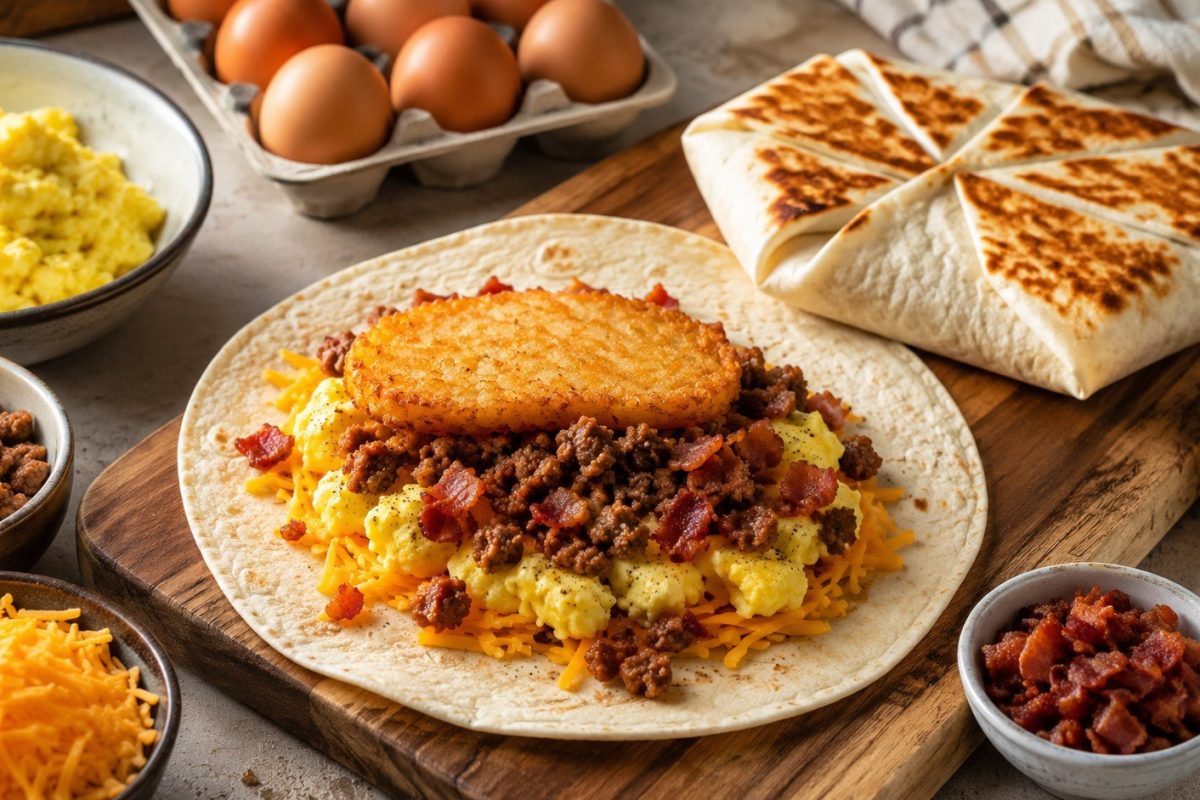
Breakfast Crunchwrap turns a flour tortilla into a complete skillet breakfast. Eggs, melted cheese, a crisp hash brown, and savory meat are folded into a compact parcel. The final sear gives both sides a toasted shell while keeping the center soft, as the customreceipt.com editorial team notes.
The idea is familiar from Taco Bell’s breakfast menu, but the homemade version offers more control. Bacon or breakfast sausage works equally well. Cheese can stay mild or become sharper. The decisive details are less obvious: tortilla size, moisture control, filling order, and the direction of the final sear.
The best Breakfast Crunchwrap is not overloaded; it is carefully layered so every ingredient survives the fold.
What makes a Breakfast Crunchwrap work
A Breakfast Crunchwrap recipe depends on contrast. The tortilla should become crisp outside without drying into a cracker. Eggs provide softness, while the potato patty creates a rigid layer. Melted cheese connects those textures and helps keep small pieces from escaping.
Taco Bell’s official Breakfast Crunchwrap page lists bacon, cheese, egg, hash brown, and creamy jalapeño sauce among its components. That combination offers a useful blueprint rather than a rule.
“Bacon, cheese, creamy jalapeño sauce, egg, hash brown.”
Taco Bell, official Breakfast Crunchwrap product page, ingredient listing.
A homemade version benefits from cooking each hot ingredient separately. Eggs need gentle heat. Hash browns need stronger heat and direct pan contact. Bacon needs enough time to render its fat. Combining those jobs in one pan at once usually sacrifices texture, as mentioned spowo.ch.
Similar texture control matters in crispy feta fried eggs. There, direct contact with the skillet creates the crisp layer. The same principle applies when the folded tortilla finally reaches the pan.
Ingredients for 4 Breakfast Crunchwraps
The quantities below produce 4 substantial portions. Large tortillas are important because small tortillas cannot cover a thick filling securely.
| Ingredient | Amount | Function |
|---|---|---|
| Large flour tortillas | 4, about 30 cm | Outer wrap |
| Large eggs | 4 | Soft central layer |
| Frozen hash brown patties | 4 | Crisp potato layer |
| Bacon | 8 strips | Salty meat filling |
| Cheddar cheese | 100–120 g | Flavor and binding |
| Milk | 30 ml | Optional for softer eggs |
| Butter or neutral oil | 1–2 tbsp | Cooking |
| Jalapeño sauce or chipotle sauce | 4 tbsp | Moisture and heat |
| Salt | To taste | Seasoning |
| Black pepper | To taste | Seasoning |
A 30 cm tortilla gives the filling enough surrounding dough for overlapping folds. Tortillas around 20 cm are much harder to close. Warming them for 10–20 seconds makes the flour wrap more flexible. Cold tortillas often crack at the edges.
Freshly grated cheddar melts more evenly than thick packaged shreds. Monterey Jack also works well. A combination of both produces a softer melt without making the breakfast excessively rich. Sauce should remain restrained because too much liquid weakens the toasted tortilla.
For another breakfast built around a compact, portable format, Greek yogurt protein bagels offer a useful contrast. Bagels depend on dough structure, while the Crunchwrap depends on folding and skillet contact.
How to make Breakfast Crunchwrap step by step
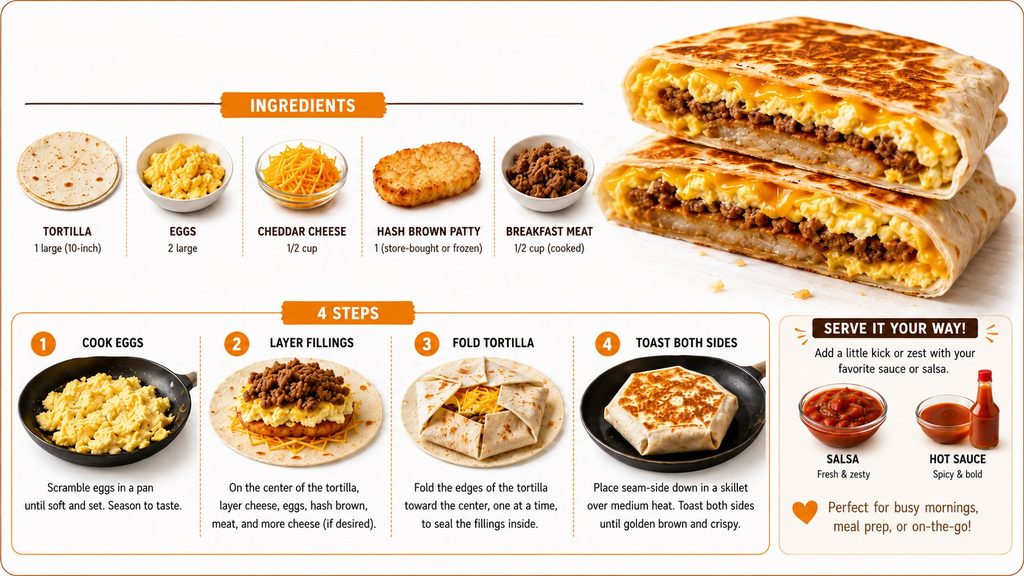
The how to make Breakfast Crunchwrap process becomes easier when every component is ready before assembly. A hot pan should not be waiting while bacon is still raw or cheese remains ungrated.
- Cook the hash brown patties until both surfaces are deeply crisp.
- Fry the bacon, then drain it on paper towels.
- Beat the eggs with pepper and 30 ml milk, if using.
- Scramble the eggs over medium-low heat until just set.
- Warm each tortilla briefly to make it flexible.
- Place cheese, eggs, meat, hash brown, and sauce near the center.
- Fold the tortilla edges inward, creating overlapping pleats.
- Put the folded side down in a hot dry skillet.
- Cook for 2–3 minutes, then turn carefully.
- Toast the second side until browned and firm.
Assembly should begin with a relatively dry layer near the tortilla. Cheese is useful because it melts while the wrap toasts. The egg belongs closer to the center, where it stays tender. A flat hash brown distributes pressure and prevents the middle from collapsing.
The folded side goes into the skillet first. Heat immediately sets the overlapping tortilla sections and effectively seals the package. Press gently with a spatula for the first 20–30 seconds. Heavy pressure can force eggs and sauce through the seams.
Medium heat offers more control than high heat. The tortilla needs time to brown while the cheese melts inside. If the surface darkens in less than 1 minute, the pan is too hot. A properly toasted wrap should feel firm enough to lift with one wide spatula.
Keeping the eggs slightly soft before assembly prevents them from becoming rubbery during the second cooking stage.
Bacon, sausage or another meat
Bacon gives a breakfast crunchwrap with egg and cheese sharp saltiness and crisp pieces. Breakfast sausage creates a denser, meatier center. Both choices work, but each requires slightly different preparation.
- Bacon should be crisp enough to break cleanly but not burnt.
- Sausage should be crumbled finely so the wrap closes evenly.
- Cooked ham should be diced into small pieces before assembly.
- Turkey sausage offers a leaner alternative but should not be overcooked.
- Leftover cooked beef can work when chopped finely and reheated safely.
Large meat chunks make folding difficult. Greasy meat creates another problem because excess fat migrates into the tortilla. Bacon should therefore drain before assembly. Sausage can be transferred to paper towels after cooking.
Seasoning also changes with the meat. Bacon usually needs no extra salt. Sausage may already contain enough salt and spices. Ham brings both salt and moisture, so a smaller amount of sauce works better.
For another tortilla-based technique, chicken gyro smash tacos demonstrate how direct skillet contact changes a soft tortilla. The Crunchwrap uses the same basic heat advantage but encloses the filling completely.
Ground meat needs particular attention to temperature. USDA guidance sets a minimum internal temperature of 160°F, or 71.1°C, for ground beef, pork, lamb, and veal. Ground poultry should reach 165°F, or 73.9°C.
How to keep the tortilla crisp
The most common failure in a homemade Breakfast Crunchwrap is not the fold. It is moisture. Soft eggs, sauce, cheese, and hot meat all release water or fat.
Several adjustments protect the tortilla:
- cook hash browns until genuinely crisp;
- drain bacon or sausage before filling;
- avoid watery salsa inside the wrap;
- use only 1 tbsp sauce per portion;
- scramble eggs until set but not wet;
- serve fresh tomatoes beside the wrap instead of inside it.
These measures do not make the filling dry. They keep free liquid away from the tortilla. Melted cheese and properly cooked eggs still provide enough softness.
Another useful technique is allowing cooked meat to rest for several minutes before assembly. Extremely hot ingredients create steam inside a sealed wrap. That steam softens the tortilla before it can brown.
Frozen hash browns should also finish cooking before they enter the wrap. Using a pale, partially cooked potato patty saves little time. It becomes softer inside and loses the crunch that distinguishes this breakfast.
A dry cast-iron or nonstick skillet is usually enough for the final toast. Adding butter tastes good but produces a softer, richer crust. A thin wipe of neutral oil gives stronger browning without making the wrap greasy.
The folding method that prevents leaks
Folding is easier when the filling occupies roughly the central third of the tortilla. The ingredients should form a low mound rather than a tall stack. Too much filling creates gaps between the pleats.
Start at one edge and pull a section toward the center. Hold it in place while bringing the next section inward. Continue around the tortilla until 6 or 7 overlapping folds cover the filling. The finished shape resembles a compact polygon.
If a gap remains in the center, the tortilla is either too small or overfilled. A small round piece cut from another tortilla can cover the opening. Place that patch over the filling before making the outer folds.
“Using a food thermometer is the only reliable way” to verify safe cooking temperatures.
USDA Food Safety and Inspection Service, food thermometer guidance.
The safety point matters when sausage replaces fully cooked bacon. USDA recommends 160°F for ground meats and 165°F for ground poultry. Eggs and egg dishes are listed at 160°F. The agency’s safe minimum temperature guidance provides the full recommendations.
Breakfast Crunchwrap variations worth trying
Once the basic Breakfast Crunchwrap with hash brown works, variations are simple. The best substitutions preserve the original balance between crisp, soft, salty, and creamy elements.
A vegetarian version can omit meat and add sautéed peppers or black beans. Remove excess liquid before filling. Pepper Jack can replace cheddar when more heat is wanted.
For a fresher version, add sliced avocado after cooking rather than before it. Avocado warms quickly and can become excessively soft inside the skillet. Pico de gallo works for the same reason when served alongside the finished wrap.
A spicy version can combine jalapeño sauce with pickled jalapeños. Use the pickled peppers sparingly because their brine adds moisture. Hot sauce is easiest to serve separately.
The following combinations show how the core structure can change without breaking the recipe.
| Version | Meat or filling | Cheese | Sauce | Best extra |
|---|---|---|---|---|
| Classic | Bacon | Cheddar | Jalapeño | Green onion |
| Sausage | Breakfast sausage | Monterey Jack | Chipotle | Pickled jalapeño |
| Vegetarian | Black beans | Pepper Jack | Salsa verde | Bell pepper |
| Ham | Diced cooked ham | Swiss | Mustard mayo | Chives |
| Extra-crisp | Bacon | Cheddar | Light hot sauce | 2 thin hash browns |
The classic version offers the clearest texture contrast. Sausage produces a heavier breakfast and benefits from a sharper sauce. Black beans need draining before they reach the tortilla. Ham works especially well with a restrained amount of mustard.
Two thin hash browns can create more crisp surface area than one thick patty. However, they also increase the filling height. A larger tortilla becomes necessary.
Sauce should complement rather than dominate the filling. Thick sauces work better than watery ones. Sour cream can be served outside if a cleaner crunch is the priority.
Storage and reheating
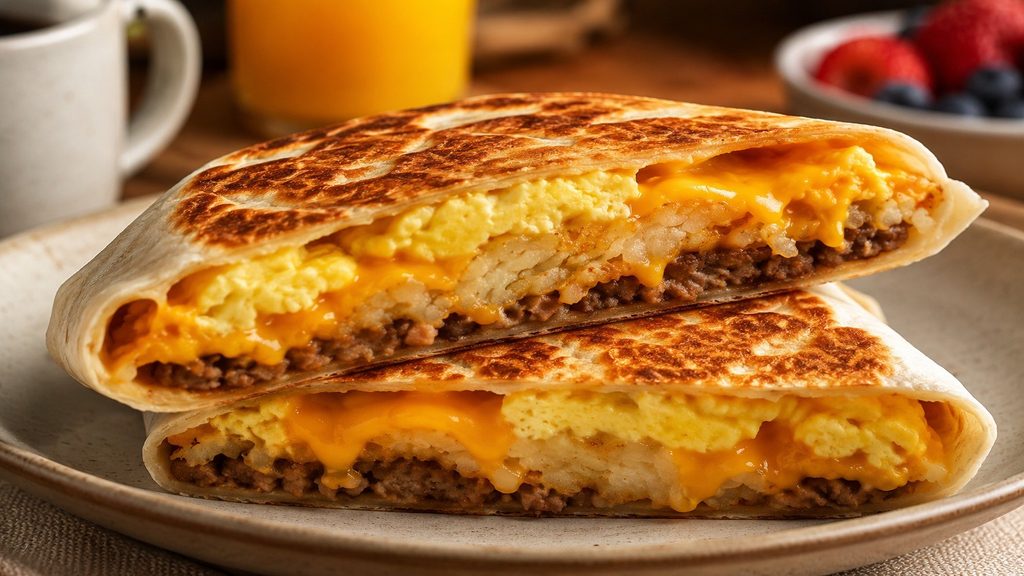
A freshly cooked easy Breakfast Crunchwrap has its best texture during the first 10–15 minutes. Refrigeration softens the toasted tortilla because moisture redistributes from the filling.
USDA advises refrigerating cooked leftovers promptly and generally using them within 3–4 days. Leftovers should reach 165°F, or 73.9°C, when reheated. Perishable food should not remain at room temperature for more than 2 hours.
For meal prep, cook the meat and hash browns ahead but store the components separately. Eggs can also be prepared in advance, although fresh scrambled eggs have a better texture. Assemble shortly before reheating.
A skillet gives the best reheated crust. Use medium-low heat and cover briefly if the center remains cold. An air fryer can also restore crispness, but cooking times vary by appliance.
The microwave is the fastest option and the weakest for texture. It heats the filling efficiently but softens the tortilla. A useful compromise is brief microwave heating followed by 1–2 minutes per side in a skillet.
FAQ about Breakfast Crunchwrap
Can a Breakfast Crunchwrap be made without meat?
Yes. Black beans, sautéed mushrooms, peppers, or an additional hash brown can replace meat. Wet vegetables should be cooked and drained first.
What size tortilla works best?
A flour tortilla around 30 cm is the safest choice. Smaller wraps are difficult to close around egg, cheese, meat, and potato.
Can frozen hash browns go directly inside?
They should be fully cooked first. A browned hash brown supplies the crunchy layer and prevents a soft potato center.
Why does my Crunchwrap open in the pan?
The most likely causes are an overfilled center or a cold, inflexible tortilla. Begin cooking with the folded side facing down.
What cheese melts best?
Cheddar, Monterey Jack, Pepper Jack, or a mixture works well. Freshly grated cheese generally melts more evenly around the filling.
Can Breakfast Crunchwraps be prepared the night before?
The components can be prepared ahead. For better texture, store them separately and assemble before final skillet cooking.
Earlier we wrote about Tuscan Salmon Recipe With Creamy Garlic Spinach Sauce in 30 Minutes