 Frank Rondel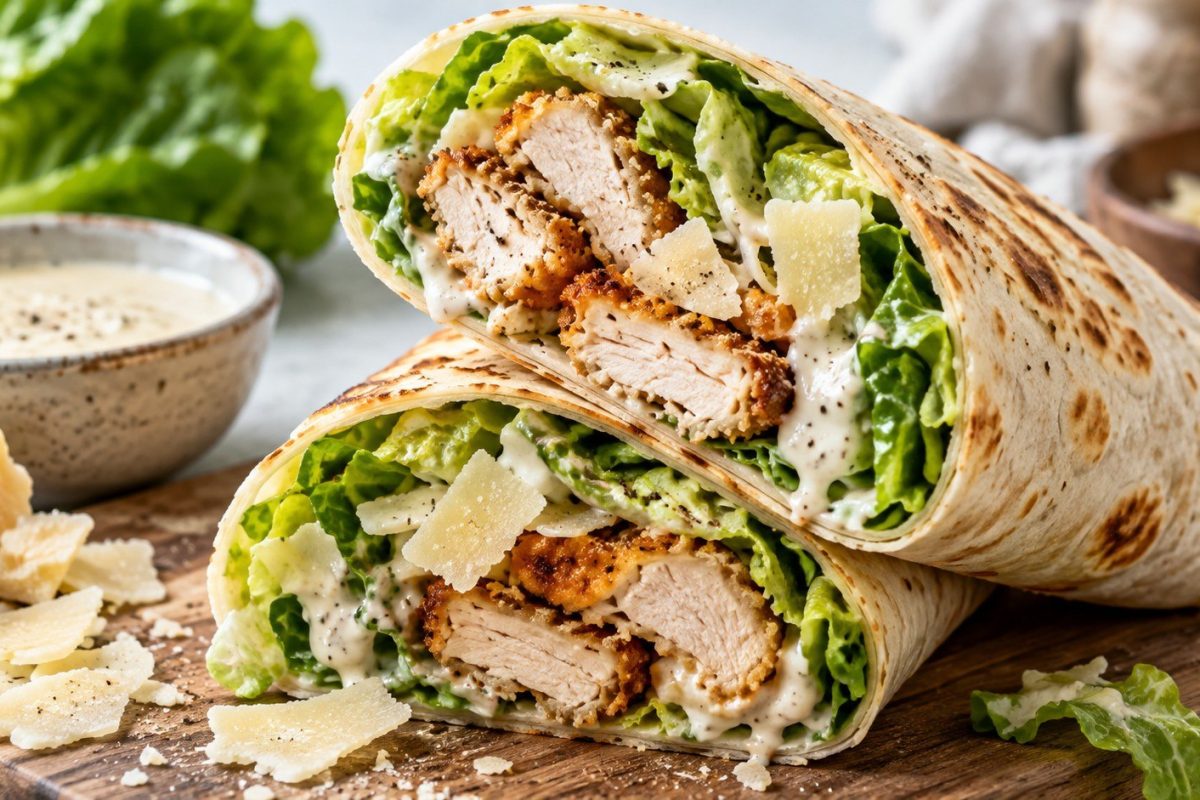
Chicken Caesar Wrap combines crisp chicken, chilled romaine, Parmesan, creamy Caesar dressing, and a warm flour tortilla. The best version depends on contrast: hot chicken against cold lettuce, crisp coating against soft tortilla, and acidic dressing against rich cheese, as noted by the customreceipt.com.
A wrap sounds simpler than a Caesar salad, but small details decide whether it stays crisp or turns soggy. The chicken needs a dry coating, the romaine must lose excess water, and dressing should be added seconds before assembly. A large tortilla also matters because an overloaded small wrap tears before reaching the plate.
The central trick is not adding more ingredients. It is keeping each ingredient at the right temperature and texture until the final roll.
Ingredients for a crispy Chicken Caesar Wrap
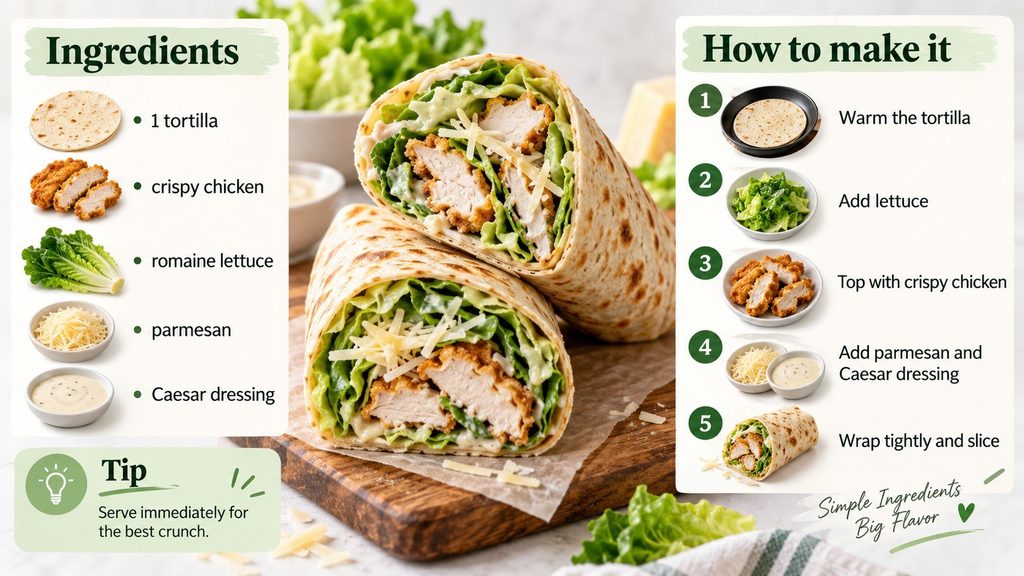
A useful crispy Chicken Caesar Wrap recipe starts with chicken breast or tenderloins. Tenderloins cook quickly, while breast gives larger, more uniform strips. Panko breadcrumbs create a rougher crust than fine breadcrumbs and usually retain more crunch beneath the dressing.
For 4 substantial wraps, use the following quantities:
| Ingredient | Amount | Purpose |
|---|---|---|
| Chicken breast or tenderloins | 500 g | Main filling |
| Large flour tortillas | 4 | Wrap base |
| Romaine lettuce | 1 large head | Fresh crunch |
| Panko breadcrumbs | 100 g | Crispy coating |
| Parmesan | 70 g | Saltiness and umami |
| Eggs | 2 | Helps coating stick |
| Flour | 60 g | First coating layer |
| Caesar dressing | 120-150 ml | Creamy seasoning |
| Garlic powder | 1 tsp | Chicken seasoning |
| Paprika | 1 tsp | Mild flavor and color |
| Salt | 1 tsp | Seasoning |
| Black pepper | 1/2 tsp | Seasoning |
| Neutral cooking oil | as needed | Frying |
These amounts produce a filling wrap without forcing the tortilla beyond its limits. A 25-30 cm tortilla is easier to fold than a smaller taco-sized version. Freshly grated Parmesan works better than thick shavings inside the filling because it spreads more evenly. Large shavings can still be added near the center for stronger cheese flavor.
Romaine should be thoroughly dried after washing. The U.S. Food and Drug Administration recommends washing fresh produce under running water rather than using soap or detergent. Produce labeled pre-washed or ready-to-eat can generally be used without another wash.
Avoid dressing wet lettuce several minutes before serving. The salt and moisture quickly soften the leaves, while wet romaine also makes a tortilla difficult to seal.
How to make crispy chicken for Caesar wraps
The chicken is the structural center of this Chicken Caesar Wrap recipe. Thin strips work better than thick pieces because every bite gets both crust and meat. Uniform pieces also finish cooking at approximately the same time.
Prepare the chicken in this order:
- Cut the chicken into strips about 2-3 cm wide.
- Season with salt, pepper, paprika, and garlic powder.
- Coat each strip lightly in flour.
- Dip it into beaten egg and let the excess drain.
- Press it firmly into panko breadcrumbs.
- Fry in shallow oil until deeply golden on both sides.
- Transfer to a rack rather than stacking pieces on a plate.
A rack allows steam to escape from the lower surface. Paper towels absorb oil, but leaving hot breaded chicken directly on them for too long can trap moisture. Frying in several batches also prevents the pan temperature from falling too sharply. Crowding usually produces a softer, oilier crust.
Chicken must reach a safe internal temperature regardless of how brown the coating appears. The USDA Food Safety and Inspection Service sets 165°F, or 73.9°C, as the safe minimum internal temperature for poultry. A thermometer should measure the thickest part of the piece.
“Cook” is one of the USDA’s 4 basic food-safety principles, alongside cleaning, separating raw foods, and prompt chilling.
Source: U.S. Department of Agriculture, Food Safety and Inspection Service, Safe Minimum Internal Temperature Chart.
The crust can darken before a thick chicken strip reaches 165°F. Moderate heat gives the center enough time to cook without burning the panko. Very thin strips need less time and should be checked earlier.
Caesar dressing changes the whole wrap
A homemade Caesar dressing brings acidity, garlic, Parmesan, and savory depth to the wrap. Classic Caesar preparations often include anchovy and egg yolk, although convenient home versions frequently use mayonnaise as their emulsified base.
For a quick dressing, combine mayonnaise, finely grated Parmesan, fresh lemon juice, Dijon mustard, minced garlic, Worcestershire sauce, black pepper, and a small amount of anchovy paste. Add water 1 teaspoon at a time if the mixture becomes too thick.
The dressing should coat the romaine rather than drown it. For 4 wraps, around 120 ml is usually enough, with extra dressing served separately.
More Caesar dressing does not necessarily produce more Caesar flavor. Once the tortilla becomes wet, texture disappears faster than flavor improves.
Fresh lemon is particularly useful in a fried chicken version. Acidity cuts through the breading and mayonnaise, making the finished wrap feel less heavy. Parmesan adds salt, so the dressing should be tasted before extra salt goes into the bowl.
Anchovy paste is optional for cooks who dislike a pronounced fish flavor. Worcestershire and Parmesan still provide substantial savory character. However, removing anchovy entirely moves the sauce further from the profile associated with traditional Caesar dressing.
How to assemble a Chicken Caesar Wrap without making it soggy
Assembly should begin only after the chicken has rested briefly. Extremely hot chicken wilts lettuce immediately, while completely cold chicken loses the contrast that makes the wrap appealing.
The most reliable sequence is:
- warm the tortilla until flexible;
- toss dry romaine with a modest amount of Caesar dressing;
- place lettuce slightly below the tortilla center;
- add sliced crispy chicken;
- scatter Parmesan over the chicken;
- fold the sides inward before rolling tightly.
This order keeps most dressing away from the tortilla surface. It also distributes chicken through the center rather than leaving one end full of meat and the other mostly lettuce. The final seam should sit underneath the wrap for several seconds before cutting.
Do not fill the tortilla to its edges. Leave roughly 4-5 cm clear on the left and right sides. The bottom edge needs enough space to fold over the filling before the sides close.
A warm tortilla is more elastic and less likely to crack. Heat it in a dry skillet for about 15-20 seconds per side or briefly in a microwave under a slightly damp towel. It should become flexible, not toasted hard.
For an extra crisp exterior, return the finished wrap to a dry skillet seam-side down. Cook for about 1-2 minutes, then turn once. This seals the fold and adds another texture without exposing the lettuce to prolonged heat.
Crispy chicken versus grilled chicken
Both versions work, but they produce distinctly different wraps. Choosing between them depends on whether the priority is texture, preparation time, or a lighter meal.
| Feature | Crispy chicken | Grilled chicken |
|---|---|---|
| Texture | Crunchy coating | Tender, firm exterior |
| Preparation | Flour, egg, crumbs, frying | Season and grill |
| Flavor | Richer | Cleaner chicken flavor |
| Dressing needed | Usually less | Can handle slightly more |
| Best served | Immediately | Warm or chilled |
| Meal prep | Assemble later | Easier to prepare ahead |
Grilled chicken is more forgiving when the wrap must travel. Breaded chicken loses crispness inside a closed container because steam has nowhere to escape. Grilled strips tolerate refrigeration and reheating better.
Crispy chicken is preferable when the wrap is eaten within minutes. The combination of panko crust and chilled romaine creates a texture that grilled versions cannot duplicate. It also means dressing should remain restrained.
Using leftover roast chicken creates a third option. It removes most cooking time and turns an easy Chicken Caesar Wrap into a lunch that can be assembled in around 10 minutes.
The finished flavor can be sharpened with extra lemon or black pepper. Bacon, avocado, tomatoes, or crouton pieces are possible additions, but each changes the balance of the classic combination.
Common mistakes that ruin Chicken Caesar wraps
Soggy wraps usually result from accumulated moisture rather than one obvious mistake. Wet romaine, excessive dressing, steaming chicken, and warm storage containers can each contribute.
Several problems are easy to prevent:
- Do not put freshly washed romaine into the wrap while damp.
- Do not pour dressing directly across the tortilla.
- Do not stack fried chicken while it is releasing steam.
- Do not use an undersized tortilla for a large portion.
- Do not slice the wrap repeatedly with a dull knife.
- Do not assemble meal-prep wraps many hours before eating.
A sharp knife should cut each wrap once through the center. Sawing repeatedly compresses the filling and pushes dressing toward the open end. For packed lunches, wrapping the whole roll tightly in parchment helps preserve its shape.
If preparing components ahead, refrigerate chicken, lettuce, dressing, cheese, and tortillas separately. Assemble near serving time. Cold crispy chicken can be reheated briefly in an air fryer or oven before rolling.
For meal prep, storing the components separately is more effective than trying to protect a fully assembled Caesar wrap from moisture.
A restaurant-style result also depends on seasoning the chicken before breading. Seasoning only the crumbs leaves the meat itself bland once the coating separates from a bite.
Useful variations for the Chicken Caesar Wrap
The basic formula leaves room for modifications without losing the identity of the dish. Each addition should solve a specific need rather than simply make the wrap larger.
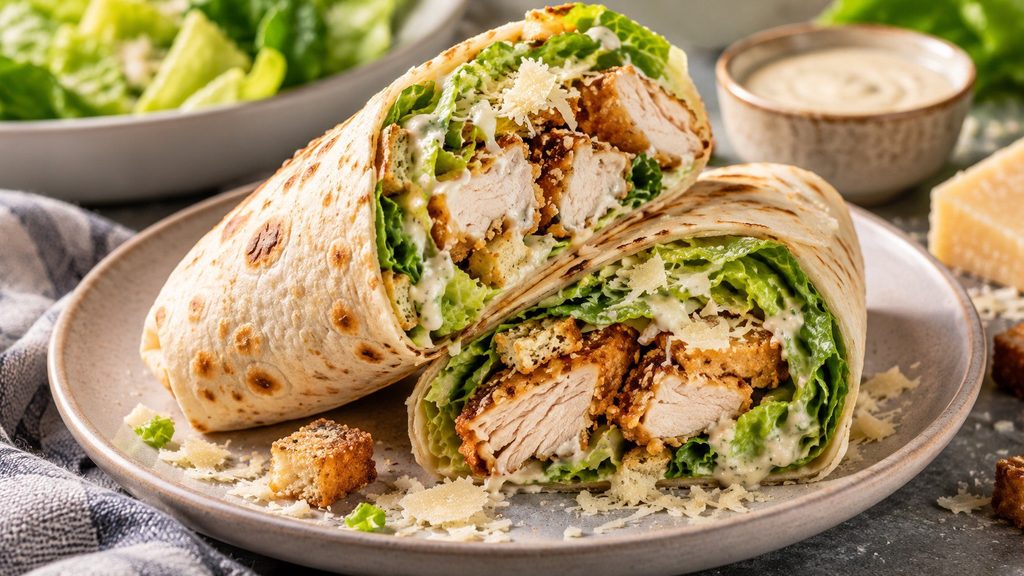
For more crunch, add a small handful of crushed croutons immediately before rolling. For extra acidity, increase lemon juice in the dressing. A few thin tomato slices add freshness, but their seeds should be removed to control moisture.
A chicken Caesar salad wrap can also use Parmesan-crusted tortillas. Sprinkle finely grated Parmesan into a nonstick skillet, place the tortilla over it, and let the cheese attach as it melts. This creates a thin crisp layer on one side.
Food Network uses a similar Parmesan-frico technique in its Chicken Caesar wrap, cooking the tortilla over grated Parmesan until the cheese turns golden. The method adds flavor without introducing another wet ingredient.
Air-fried chicken is another practical variation. Bread the strips as usual, mist them lightly with oil, and cook until crisp and safely cooked through. Exact cooking time depends on thickness and appliance performance, so temperature remains the reliable test.
FAQ about Chicken Caesar Wraps
Can a Chicken Caesar Wrap be made ahead?
The components can be prepared ahead, but full assembly is best delayed. Store lettuce, dressing, Parmesan, chicken, and tortillas separately to protect their textures.
What tortilla is best for Chicken Caesar wraps?
Large flour tortillas around 25-30 cm are the easiest to fold. They remain flexible when warmed and provide enough surface area for chicken and romaine.
How much Caesar dressing should go in one wrap?
About 2 tablespoons is a practical starting point. Increase only if the lettuce still looks underdressed, since excess sauce quickly softens the tortilla.
Can crispy chicken be cooked in an air fryer?
Yes. Bread the chicken normally and apply a light coating of oil before air frying. Confirm that the center reaches 165°F or 73.9°C.
What cheese works best?
Parmigiano Reggiano or another good Parmesan-style hard cheese provides the familiar salty, nutty profile. Finely grated cheese blends into the dressing better than large pieces.
How do you keep a Chicken Caesar Wrap crispy?
Dry the romaine thoroughly, cool the chicken briefly on a rack, use dressing sparingly, and assemble immediately before serving. Those steps preserve the contrast between the crust, lettuce, and tortilla.
Earlier we wrote about How to Make an Italian Grinder Sandwich With Salami, Capicola and Creamy Lettuce Salad