 Frank Rondel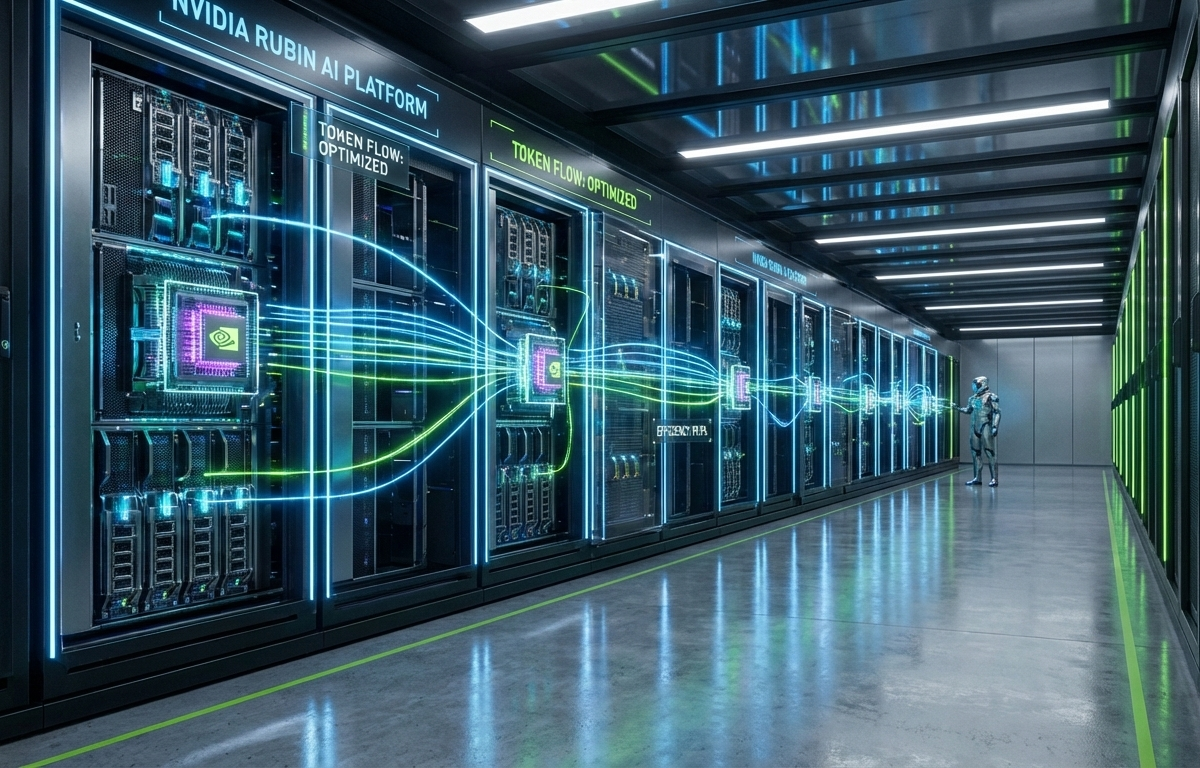
Nvidia has introduced Rubin, a new platform designed to train and operate artificial intelligence models while significantly lowering the computing resources required for both training and inference, reports customreceipt.com via CTech. The Rubin system integrates six separate chips into what Nvidia calls a tightly coupled AI supercomputer. Central to the platform is the Rubin AI processor, supported by a central processing unit named Vera, a data processing unit (DPU), and three specialized communications chips. Several of these components were developed at Nvidia’s research and development center in Israel or benefitted from extensive collaboration with Israeli engineering teams.
Jensen Huang, Nvidia’s founder and chief executive officer, emphasized the timing of the release, stating that Rubin comes at a moment when demand for AI computing power is rising sharply for both model training and inference. Huang highlighted the company’s strategy of delivering new generations of AI supercomputers annually and the deep co-design involved in integrating six new chips, describing Rubin as a major step forward in AI infrastructure.
The platform is named after Vera Rubin, the Jewish-American astronomer whose pioneering studies on galaxy dynamics contributed significantly to the discovery of dark matter. Beyond the Rubin AI chip and Vera CPU, the system also incorporates Nvidia’s BlueField-4 DPU and three networking components developed in Israel: the ConnectX-9 SuperNIC, NVLink 6 Switch, and Spectrum-6 Ethernet Switch.
According to Nvidia, Rubin achieves substantial performance improvements over its predecessor, the Blackwell platform. The company reports that Rubin can train Mixture of Experts AI models using up to four times fewer chips, while reducing inference costs by as much as 90%.
Industry leaders have noted the potential impact of the new platform. Sam Altman, CEO of OpenAI, stated that as intelligence scales with computational capacity, adding more compute allows models to tackle harder problems and deliver greater benefits, and that the Rubin platform enables continued progress toward advanced AI capabilities. Similarly, Dario Amodei, co-founder and CEO of Anthropic, observed that the efficiency gains provided by Rubin support longer memory, improved reasoning, and more reliable model outputs, enhancing research into AI safety and frontier model development.
Nvidia has announced that Rubin-based systems will be available to enterprise customers during the second half of 2026, marking the next stage in the company’s expansion in AI computing infrastructure.
Earlier we wrote about Amazon Fire TV overhaul in the US: why, when and how much the new AI platform changes TV viewing.