 Frank Rondel
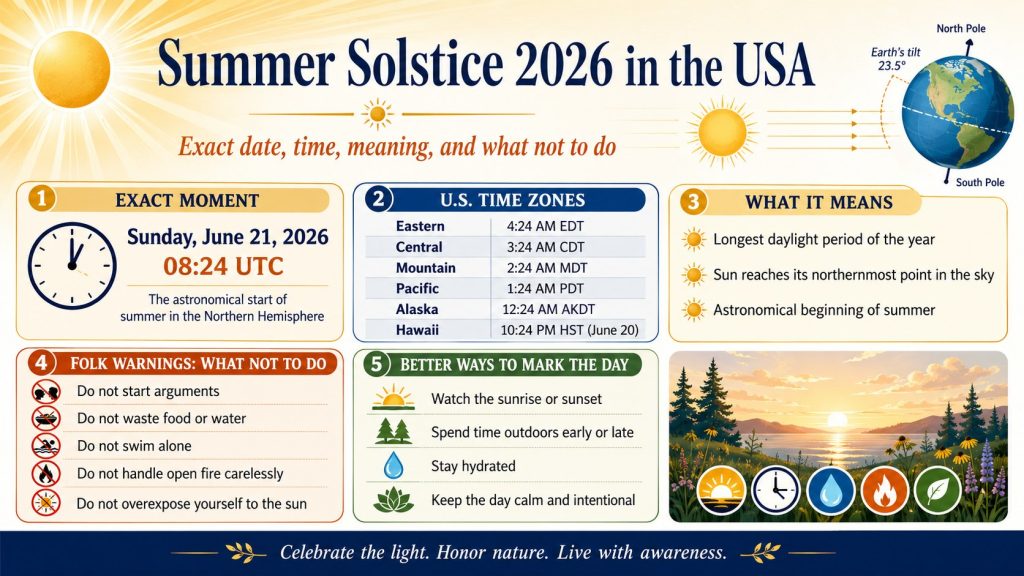
Summer solstice 2026 arrives in the United States on Sunday, June 21, marking the astronomical start of summer and the longest daylight period of the year in the Northern Hemisphere. The exact moment comes at 08:24 UTC, which means 4:24 AM in New York, 3:24 AM in Chicago, and 1:24 AM in Los Angeles. For most Americans, the event will be felt not as a sudden change, but as a long, bright day with late sunsets and a clear seasonal shift. It is also one of the oldest dates surrounded by folk beliefs, rituals, warnings, and practical rules about fire, water, work, and personal decisions, as noted by the customreceipt.com editorial team.
The summer solstice is often described as the “longest day,” but that phrase needs context. It does not mean the day has more than 24 hours. It means the Sun stays above the horizon longer than on any other day of the year for most locations north of the equator. In the USA, the effect is stronger in northern states and softer in southern regions. Alaska feels the difference most dramatically, while Florida still gets a long day but not the same extreme daylight stretch.
Exact Date and Time of Summer Solstice 2026 in the USA
The exact date of the summer solstice 2026 is Sunday, June 21. In coordinated universal time, the solstice happens at 08:24 UTC. This is the moment when the Sun reaches its northernmost point in Earth’s sky. In simple terms, the Northern Hemisphere leans most directly toward the Sun.
For the United States, the local time depends on the time zone. That matters because many people search for the solstice date by state or city. In New York, Washington, Baltimore, Boston, Atlanta, and Miami, the solstice comes early in the morning. In Los Angeles, San Francisco, Seattle, and Portland, it happens shortly after 1 AM.
Before planning a sunrise walk, family ritual, photoshoot, or outdoor gathering, it is better to check the local time. The solstice moment and the longest daylight experience are related, but not identical. The exact astronomical moment happens instantly. The daylight pattern is spread across the whole day.
| U.S. location or zone | Local solstice time | Local date |
|---|---|---|
| Eastern Time, New York | 4:24 AM EDT | June 21, 2026 |
| Central Time, Chicago | 3:24 AM CDT | June 21, 2026 |
| Mountain Time, Denver | 2:24 AM MDT | June 21, 2026 |
| Pacific Time, Los Angeles | 1:24 AM PDT | June 21, 2026 |
| Alaska Time, Anchorage | 12:24 AM AKDT | June 21, 2026 |
| Hawaii, Honolulu | 10:24 PM HST | June 20, 2026 |
| Arizona, most areas | 1:24 AM MST | June 21, 2026 |
These times are useful for astronomy lovers, spiritual communities, photographers, gardeners, and families planning a symbolic summer day. Still, the best part of the solstice is not only the minute itself. It is the entire period around sunrise and sunset. In many places, June 20, June 21, and June 22 feel almost equally long. That is why many celebrations happen during the nearest weekend. It also explains why folk customs often focus on the whole day, not only the exact time.
Why the Summer Solstice Happens
The summer solstice happens because Earth is tilted on its axis. Our planet does not stand straight while moving around the Sun. It leans by about 23.5 degrees, and that tilt creates the seasons. When the Northern Hemisphere leans toward the Sun, North America gets longer days and shorter nights.
This is also why the solstice is opposite in the Southern Hemisphere. While the USA enters astronomical summer, countries like Argentina, South Africa, and Australia enter astronomical winter. The event is global, but its meaning changes by hemisphere. For Americans, it is tied to heat, vacations, school breaks, outdoor work, and the emotional start of high summer.
The solstice is not caused by Earth being closer to the Sun. That is a common mistake. The seasons are mostly about angle and daylight, not distance. In fact, Earth is near aphelion in early July, when it is farthest from the Sun. Yet the Northern Hemisphere still has summer because sunlight arrives more directly and lasts longer each day.
The solstice is a precise astronomical moment, but people experience it as a cultural day. That is why science and tradition often meet on June 21.
What Makes June 21 the Longest Day
The longest day depends on your location. In the northern United States, daylight can last well over 15 hours. In Seattle, Minneapolis, and Maine, evenings feel especially stretched. In southern states, the day is still long, but the difference between winter and summer is less dramatic.
This happens because latitude matters. The farther north you go, the stronger the solstice effect becomes. Alaska is the most striking example in the USA. Some communities there experience extremely long daylight, and places above the Arctic Circle can see the midnight sun.
For everyday life, the solstice changes mood and routine. People eat later, walk more, travel more, and stay outside after work. Retail, tourism, restaurants, parks, and local festivals often benefit from this seasonal rhythm. It is also a key period for outdoor safety, because more daylight can mean more heat exposure.
Folk Prohibitions and Old Beliefs Around the Solstice
Folk prohibitions connected with the summer solstice come from many European, Indigenous, rural, and agricultural traditions. They are not scientific rules, but they reflect old attempts to understand nature, heat, fertility, water, fire, and luck. Many communities treated this date as powerful because the Sun reached its symbolic peak.
People believed the day carried strong energy. That is why careless words, conflict, waste, and disorder were often discouraged. The logic was simple: what you “plant” on the strongest solar day could grow through the season. Even today, some people use the solstice as a personal reset.
Common folk warnings include:
- Do not start major arguments or make harsh promises.
- Do not waste food, water, candles, or firewood.
- Do not ignore fire safety during outdoor gatherings.
- Do not swim alone in rivers, lakes, or the ocean.
- Do not cut healthy plants without a clear reason.
- Do not lend important personal items casually.
- Do not spend the whole day indoors without sunlight.
- Do not begin a serious task in anger or exhaustion.
These beliefs should not be read as strict instructions. They work better as cultural memory and seasonal advice. Some warnings are symbolic, while others are practical. Fire safety, hydration, and caution near water are especially relevant in the USA. The solstice falls during a period when heat, travel, and outdoor recreation increase. That makes old folk rules surprisingly modern in their practical meaning.
What You Should Avoid on the Summer Solstice
The most useful solstice advice is not mystical. It is practical. Avoid overexposure to the Sun, especially from late morning to afternoon. Even on a joyful summer day, ultraviolet radiation can damage skin quickly. Sunscreen, shade, sunglasses, and water matter more than any ritual.
It is also wise not to treat the longest day as an excuse for exhaustion. Many people pack too much into one summer weekend. They drive long distances, drink alcohol, swim, hike, grill, and stay up late. That combination can become risky.
A safe solstice plan should include several basics:
- Check sunrise and sunset times for your city.
- Plan outdoor activity earlier or later in the day.
- Keep water nearby during walks, festivals, or sports.
- Use sunscreen and reapply it when needed.
- Avoid open flames where local rules prohibit them.
- Watch children closely near pools, lakes, and rivers.
- Give yourself time to rest after heat exposure.
These steps make the day easier and safer. They also fit the deeper meaning of the solstice. The date is about balance between light, energy, and renewal. It should not become a day of stress or careless decisions. A calm morning walk can be more meaningful than an overloaded schedule. For families, the best tradition is often simple and repeatable. A shared meal, a sunset photo, or a garden evening can become a yearly ritual.
Solstice Traditions Americans Still Practice
In the United States, the summer solstice is not a federal holiday. Schools, banks, and government offices usually operate according to normal schedules if the date falls on a weekday. In 2026, it falls on Sunday, which makes celebrations easier for many families. Parks, museums, yoga studios, farms, and local communities may hold special events.
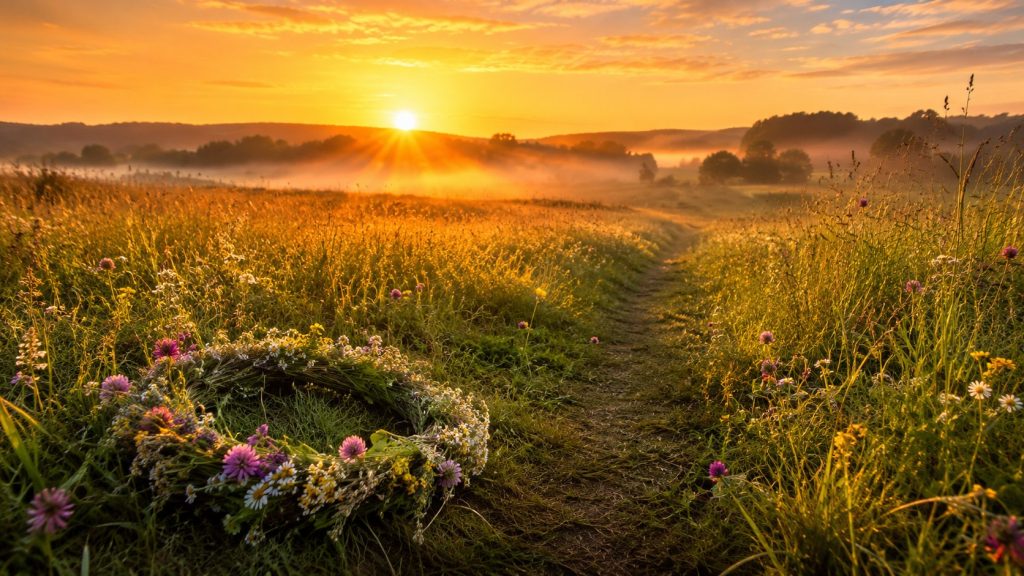
Modern American solstice traditions are diverse. Some people wake up for sunrise. Others attend yoga sessions, light candles, visit beaches, make flower crowns, or cook seasonal food. Gardeners may use the date to mark the peak of early summer growth. Photographers often plan golden-hour shoots because the evening light lasts longer.
The most popular activities are simple and accessible. People do not need expensive trips or complicated rituals. The solstice can be marked at home, in a city park, near water, or on a porch. What matters is attention to light, season, and time.
What to Do Instead: A Practical Solstice Plan
A good summer solstice plan should match your real life. If you work weekends, you can mark the date with a quiet sunrise coffee. If you have children, a sunset picnic may be more realistic. If you live in a hot state, indoor rest during peak heat is not a failure. It is common sense.
For a meaningful day, focus on 3 themes: light, nature, and reset. Open the curtains early. Take a walk before the heat rises. Prepare a meal with seasonal fruit, herbs, corn, tomatoes, berries, or greens. Write down 1 thing you want to grow during the summer. Then remove 1 habit that drains your time.
The solstice is also a good day to review summer safety. Check smoke alarms before grilling season. Restock sunscreen. Clean water bottles. Review pool rules with children. These small actions make the season safer and more organized.
Summer Solstice 2026 and Zodiac Season
The summer solstice usually arrives as the Sun moves from Gemini into Cancer season in Western astrology. In 2026, many readers will connect the date with emotional renewal, home, family, and personal security. This is a cultural and symbolic reading, not an astronomical rule. Still, it remains popular in calendars, lifestyle media, and seasonal rituals.
For astrology-minded readers, the day is often used for reflection. People may avoid rushing decisions, emotional confrontations, or dramatic promises. Instead, they focus on home, care, sleep, and long-term intentions. Even without astrology, this approach makes sense. The year is nearly halfway through, and summer changes personal routines.
FAQ
When is the summer solstice 2026 in the USA?
The summer solstice 2026 falls on Sunday, June 21. The exact moment is 08:24 UTC. In New York, that is 4:24 AM EDT. In Los Angeles, it is 1:24 AM PDT.
Is June 21 always the longest day of the year?
In most Northern Hemisphere locations, the longest day happens around June 20, June 21, or June 22. In 2026, the solstice date is June 21. The exact daylight length depends on latitude and local geography.
What should you not do on the summer solstice?
Folk beliefs warn against arguments, waste, careless fire use, unsafe swimming, and starting serious tasks in anger. Modern advice adds sun safety, hydration, and caution during travel. These rules are best understood as symbolic and practical guidance.
Is the summer solstice a public holiday in the USA?
No, the summer solstice is not a federal public holiday in the United States. In 2026, it falls on Sunday, so many people can mark it during the weekend. Local events may still take place in parks, studios, farms, or cultural centers.
Why does the summer solstice matter?
It marks the astronomical start of summer in the Northern Hemisphere. It is also the day when daylight reaches its annual peak for many U.S. locations. Culturally, it represents energy, renewal, growth, and seasonal transition.
Earlier we wrote about strawberry tiramisu recipe: how to make the viral no-bake dessert at home