 Frank Rondel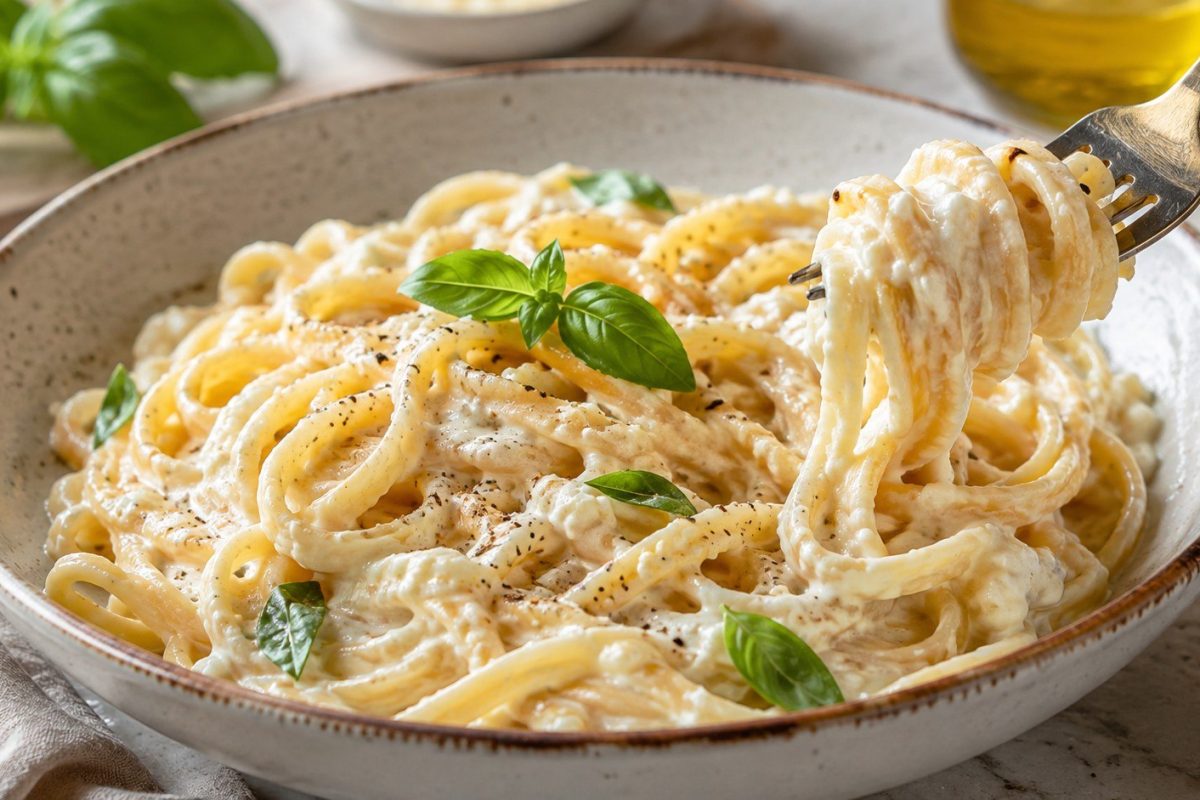
Cottage Cheese Pasta Sauce turns ordinary cottage cheese into a smooth white sauce for pasta. The method needs a blender, Parmesan, garlic, pasta water, and controlled heat. It delivers creaminess without building the sauce around heavy cream or a large amount of butter, as the customreceipt.com editorial team notes.
The decisive step is not adding more cheese. Cottage cheese must be blended until its curds disappear completely. Pasta water then adjusts thickness and helps the sauce coat noodles instead of sitting in heavy clumps.
The best version tastes like a light Parmesan cream sauce, not like warm cottage cheese poured over pasta.
Why Cottage Cheese Works in Pasta Sauce
Cottage cheese contains curds suspended in a moist dairy base. Blending breaks that visible structure into a much finer mixture. Parmesan brings salt and savory depth, while garlic gives the mild cheese a stronger backbone. Hot pasta water loosens everything without diluting the flavor too aggressively.
The attraction of a high-protein pasta sauce is straightforward. Cottage cheese contributes dairy protein while replacing ingredients commonly used for richness. Exact nutrition depends strongly on milkfat percentage, brand, Parmesan quantity, and pasta choice. USDA FoodData Central lists both full-fat and low-fat cottage cheese in its food database.
“USDA’s comprehensive source of food composition data with multiple distinct data types.”
USDA Agricultural Research Service, FoodData Central, description of its national food composition database.
Cottage cheese also appears naturally in other compact meals. A cottage cheese pizza bowl uses moisture control for a thicker baked result. The same ingredient behaves differently in cottage cheese flatbread, where eggs and baking create structure instead of sauce.
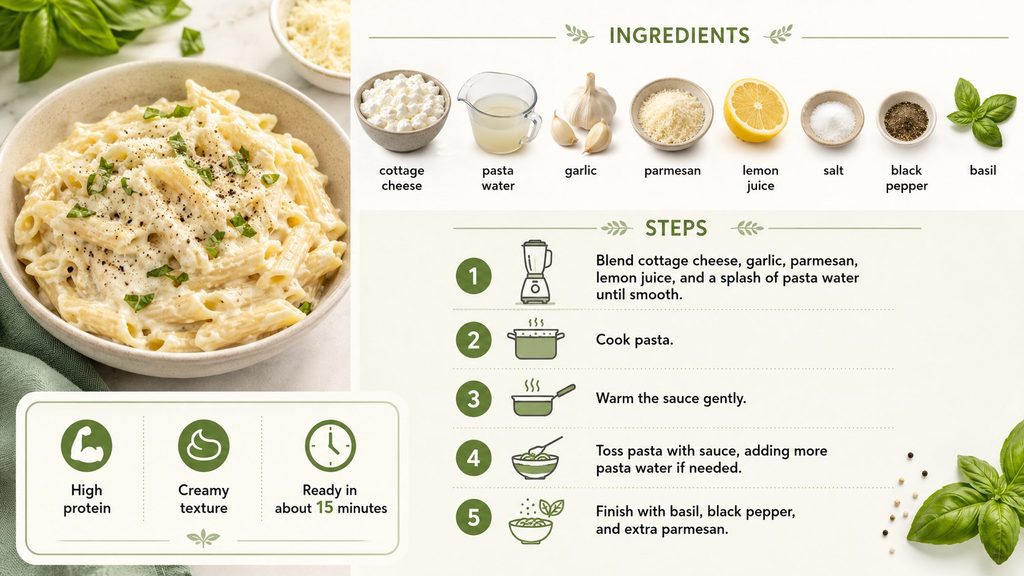
Ingredients for Creamy Cottage Cheese Pasta Sauce
The basic formula serves about 4 people. Full-fat or 2% cottage cheese usually produces a more forgiving texture. Small-curd cheese is convenient, although a strong blender handles larger curds too.
- 12 oz or 340 g dry pasta;
- 1½ cups cottage cheese;
- ½ cup finely grated Parmesan;
- 1 small garlic clove;
- ½ tsp kosher salt, adjusted for the cheese;
- ¼ tsp freshly ground black pepper;
- ¾ cup reserved pasta water;
- 1 tsp lemon juice, optional;
- 1 tbsp olive oil, optional;
- parsley, basil, or chives for serving.
The Parmesan should be finely grated because large pieces take longer to disappear. Raw garlic gives the sauce noticeable sharpness, so 1 small clove is enough. Roasted garlic makes a softer version and allows a larger quantity. Lemon is useful when the dairy tastes flat or overly rich. Salt should be added only after tasting because cottage cheese and Parmesan already contain sodium.
For a richer cottage cheese pasta recipe, use 4% cottage cheese and add 1 tbsp butter. A lighter plate can use 2% cheese and more pasta water. Neither approach requires flour or a traditional roux.
How to Make Cottage Cheese Pasta Sauce
The pasta should reach the sauce while still hot. However, direct prolonged boiling can make dairy proteins tighten and create a grainier result. The safer method uses residual heat and a short final toss.
- Bring a large pot of salted water to a boil.
- Add pasta and cook until 1 minute short of fully tender.
- Reserve at least 1 cup of pasta water before draining.
- Blend cottage cheese, Parmesan, garlic, pepper, and ¼ cup pasta water.
- Continue blending for 45–60 seconds until completely smooth.
- Return the drained pasta to the warm pot.
- Remove the pot from strong heat before adding the sauce.
- Toss thoroughly and add pasta water in small portions.
- Rest the pasta for 1–2 minutes before serving.
Do not pour the entire reserved cup into the blender immediately. Cottage cheese brands contain different amounts of moisture. Start with less water because additional liquid is easy to add. Tossing also releases starch from the pasta surface and changes the final consistency. The sauce usually thickens slightly during the first minutes after mixing. Add another spoonful of hot water if it becomes tighter than expected.
Blend first and adjust later: texture is easier to correct when the sauce begins slightly thicker than needed.
A similar contrast between creamy cottage cheese and hot ingredients appears in this sweet potato, beef, cottage cheese, and hot honey bowl. There, cottage cheese remains visibly separate. Pasta sauce requires the opposite treatment because smoothness is central to the dish.
Which Cottage Cheese Gives the Best Texture
Not every container behaves identically. Fat content affects richness, while whey affects thickness. Sodium levels can also differ substantially among brands.
| Cottage cheese | Sauce texture | Flavor | Best use |
|---|---|---|---|
| 4% full-fat | Thick and silky | Richest | Alfredo-style sauce |
| 2% | Creamy and lighter | Balanced | Everyday pasta |
| Low-fat | Slightly thinner | Mild | Higher-volume meals |
| Large-curd | Smooth after longer blending | Dairy-forward | Powerful blenders |
| Small-curd | Blends quickly | Mild | Fast weeknight sauce |
The fat percentage is only one variable. A watery 4% product can still create a loose sauce. Drain visible whey when liquid collects heavily around the curds. Do not strain the cheese until dry because some moisture helps blending. Whole-milk products need less olive oil or butter for a rounded texture.
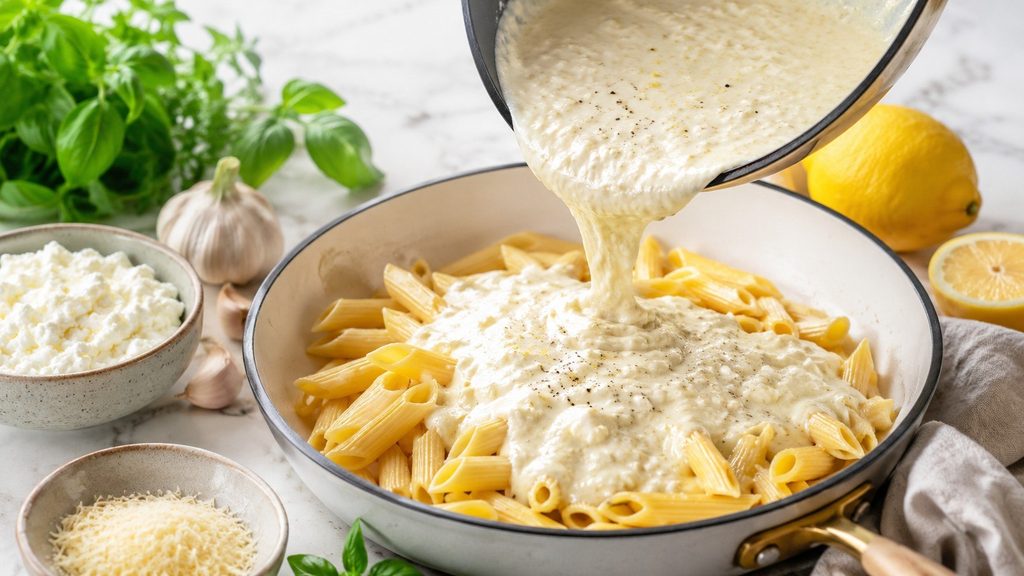
The creamy cottage cheese sauce should pour slowly from a spoon before it meets pasta. If it resembles milk, too much water was added. If it resembles a thick dip, blend in pasta water by tablespoons.
How to Keep the Sauce From Turning Grainy
The most common mistake is treating this sauce like Alfredo and simmering it hard. Cottage cheese is already a cultured dairy product with a delicate protein structure. Aggressive heat can change a silky blend into small visible particles.
Several corrections improve consistency:
- blend for a full 45–60 seconds;
- grate Parmesan finely before blending;
- use warm pasta water instead of cold tap water;
- add the sauce after reducing or switching off direct heat;
- avoid prolonged boiling after cottage cheese enters the pot;
- loosen leftovers with water before reheating.
A high-speed blender gives the smoothest result, but a food processor also works. An immersion blender needs a narrow container and additional processing time. Very cold cottage cheese may require slightly warmer pasta water. Pre-grated Parmesan can behave differently because packaged products may contain anti-caking ingredients. Freshly grated cheese gives more predictable melting.
Heat should warm the sauce and pasta together, not cook the blended cottage cheese for several additional minutes.
Variations That Change the Sauce Without Breaking It
The neutral dairy base accepts stronger flavors easily. This makes the recipe useful beyond one white pasta. Vegetables should be cooked separately when they release significant moisture.
- Spinach and lemon: fold wilted spinach into the finished pasta.
- Roasted garlic: replace raw garlic with 2–3 roasted cloves.
- Pesto: stir 1–2 tbsp pesto into the blended sauce.
- Tomato: add ½ cup thick marinara for a creamy rosé version.
- Chili: use crushed red pepper and extra black pepper.
- Mushroom: add deeply browned mushrooms after tossing.
- Pea and herb: blend in thawed peas with parsley or basil.
Thick ingredients work better than watery additions. Tomato sauce should be concentrated rather than thin. Mushrooms need proper browning before they enter the pasta. Frozen spinach should be squeezed after thawing. Fresh herbs should be added near serving time to preserve aroma.
For a healthy pasta sauce, vegetables can increase volume without requiring more dairy. Spinach, peas, broccoli, mushrooms, or roasted zucchini all fit the base formula.
Protein, Calories and Portion Planning
Calling cottage cheese pasta “high protein” does not automatically describe the whole meal. Standard wheat pasta contributes protein too, while chickpea or lentil pasta can change the total considerably. Parmesan adds more protein, sodium, and fat.
USDA MyPlate classifies cottage cheese within the dairy group. Its guidance counts 2 cups of cottage cheese as 1 cup-equivalent of dairy. This measurement describes food-group equivalence rather than the correct serving for this recipe. MyPlate dairy guidance also identifies protein among nutrients supplied by dairy foods.
| Choice | What changes | Practical effect |
|---|---|---|
| 4% cottage cheese | More milkfat | Richer mouthfeel |
| 2% cottage cheese | Less fat | Balanced everyday sauce |
| More Parmesan | More cheese solids | Saltier, thicker sauce |
| Chickpea pasta | Different flour base | Often raises protein and fiber |
| Extra vegetables | More plant volume | Larger serving without more sauce |
Nutrition labels remain more useful than generic estimates when precise intake matters. Cottage cheese varies especially in sodium. Pasta serving size also changes the final numbers quickly. Parmesan should be measured rather than added continuously from the container. A vegetable-heavy plate can use the same sauce quantity across a larger volume.
The finished dish is best judged as a complete meal. Protein content alone does not describe fiber, sodium, vegetables, or overall portion size.
Storage and Reheating
Cooked cottage cheese pasta should move into the refrigerator promptly. The U.S. Food and Drug Administration recommends refrigerating perishable leftovers within 2 hours. The agency also advises using leftovers within 3–4 days.
“Leftovers should be used within three to four days.”
U.S. Food and Drug Administration, consumer food-safety guidance for refrigerated leftovers.
Store the pasta in a covered container. Reheat only the portion needed for the meal. Add 1–2 tbsp water before warming because the sauce thickens in storage. Gentle stovetop heat gives better control than a long microwave cycle.
The FDA recommends keeping refrigerators at 40°F, or 4°C, or below. Avoid leaving the finished dairy sauce on the counter throughout a long meal. Freezing is possible, but the texture may become less uniform after thawing.
FAQ About Cottage Cheese Pasta Sauce
Can cottage cheese replace heavy cream in pasta sauce?
Yes, but the result is different from traditional cream sauce. Blended cottage cheese is tangier and more protein-rich. Parmesan and pasta water help create a smoother finish.
Do you need to blend cottage cheese for pasta?
Blending is recommended for a white sauce. Unblended curds remain visible and create a different texture. About 45–60 seconds usually gives a smoother base.
Why is my cottage cheese pasta sauce grainy?
Excessive direct heat is a common cause. Coarsely grated Parmesan can also create visible particles. Blend thoroughly and warm the finished sauce gently.
Can cottage cheese pasta sauce be made without Parmesan?
Yes, although Parmesan supplies salt, savory flavor, and body. Nutritional yeast, herbs, or roasted garlic can strengthen a Parmesan-free version.
What pasta shape works best?
Fusilli, rigatoni, penne, cavatappi, and shells hold the sauce well. Spaghetti also works, although the sauce should be slightly thinner.
How long does cottage cheese pasta last in the refrigerator?
FDA guidance recommends using refrigerated leftovers within 3–4 days. Store the pasta covered at 40°F, or 4°C, or below.
Earlier we wrote about Cottage Cheese Pizza Bowl Turns 4 Familiar Ingredients Into a 15-Minute Crustless Pizza