 Frank Rondel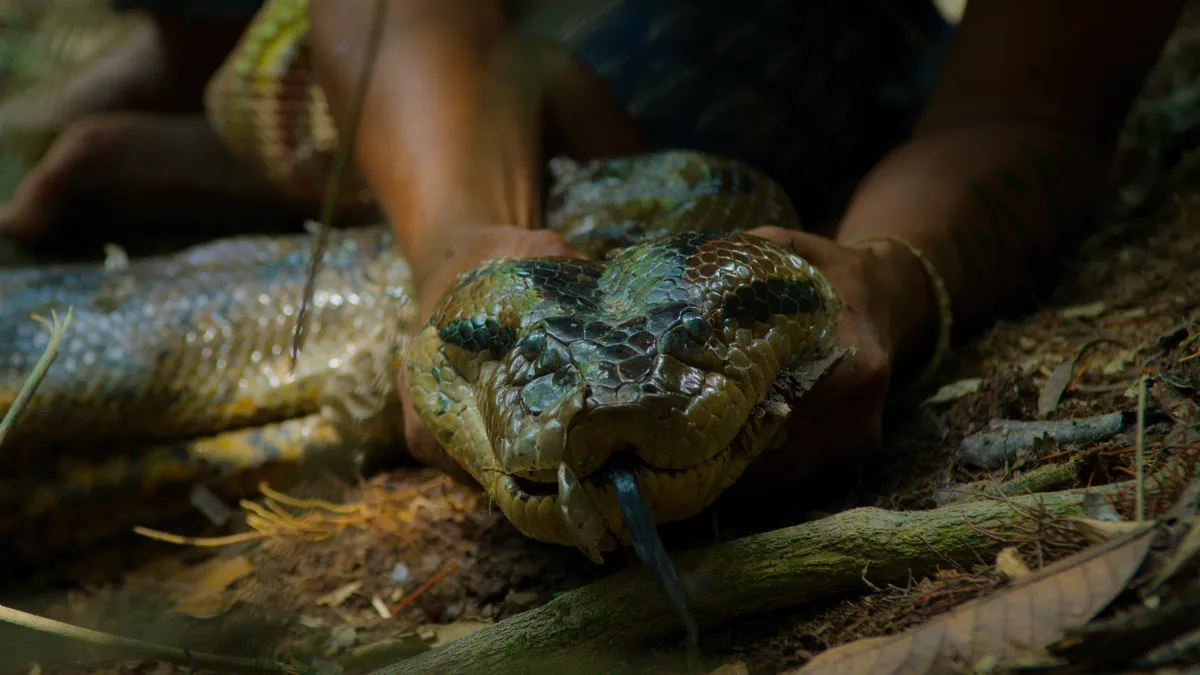
Previously unreleased video footage has documented the moment scientists came face to face with a newly identified species of giant green anaconda deep in the Ecuadorian Amazon, an encounter that later proved critical to confirming the animal’s distinct genetic identity, reports customreceipt.com via enguide.pl.
The footage, filmed in 2022 and now released as part of National Geographic’s upcoming documentary series Pole to Pole with Will Smith, shows researchers working in the Baihuaeri Waorani Territory while conducting a large-scale genetic study of anacondas. At the time, the team was collecting biological samples to better understand the genetic diversity of green anacondas believed to belong to a single species.
The video follows venom expert Professor Bryan Fry of The University of Queensland and actor Will Smith as they travel by boat along a dark, slow-moving river accompanied by Indigenous Waorani guides. During a stop along the riverbank, the group identifies an exceptionally large anaconda resting in shallow water. With the assistance of the guides, the snake is carefully restrained, allowing the scientists to collect a small sample of its scales for later analysis.
According to Fry’s estimate in the documentary, the anaconda shown in the footage is a female measuring approximately 16 to 17 feet in length, or about 4.9 to 5.2 meters. While green anacondas are nonvenomous, the Waorani guides caution that the animal could still inflict serious injury if it were to bite. As constrictors, anacondas subdue prey by coiling tightly around it and cutting off its ability to breathe before swallowing it whole.
Subsequent genetic analysis of the scale sample, along with others collected during the 2022 expedition, revealed a major scientific finding. Researchers determined that green anacondas previously classified as a single species actually represent two genetically distinct species. The southern green anaconda retained the name Eunectes murinus, while the newly identified northern species was formally described as Eunectes akayima.
Fry explained that the discovery was not the result of searching for a new species but rather the outcome of rigorous genetic methods applied to a well-known animal. Genetic data showed that E. murinus and E. akayima diverged roughly 10 million years ago and have since accumulated thousands of genetic differences, accounting for approximately 5.5 percent divergence across their DNA. By comparison, the genetic difference between humans and apes is estimated at about 2 percent.
Geographically, the northern green anaconda inhabits the Amazon’s northern basin, spanning parts of Ecuador, Colombia, Venezuela, Trinidad, Guyana, Suriname and French Guiana. The southern green anaconda occupies the southern Amazon basin, extending through regions of Peru, Bolivia and Brazil. Both species favor wetlands, flooded forests and river systems, where they remain largely submerged and rely on their olive-green coloration for camouflage.
Green anacondas are considered the heaviest snakes on Earth, with some individuals exceeding 250 kilograms in weight and reaching girths of more than 30 centimeters. Fry noted that female northern green anacondas are significantly larger and heavier than males, a difference that results in distinct feeding behaviors. Females typically prey on animals such as deer, while males consume more predatory fish and caimans, placing them higher in the food chain.
These dietary differences have broader environmental implications. Fry said male northern green anacondas accumulate substantially higher levels of environmental toxins, including heavy metals such as cadmium and lead, which are commonly associated with oil pollution. Measurements showed concentrations of these contaminants in males exceeding those in females by more than 1,000 percent.
Because the diet of male northern green anacondas closely resembles that of humans living in the Amazon region, Fry said toxin levels in the snakes can serve as an indicator of pollution exposure for local communities. In response to the findings, he is developing a wild food safety guide for the Waorani people, advising vulnerable groups such as pregnant women and children to avoid consuming top-level predators that are more likely to carry high contaminant loads.
The northern green anaconda is now recognized as the fifth described anaconda species worldwide, though Fry noted that additional undiscovered species may still exist. Despite their global fame, he said, anacondas remain among the least understood large reptiles.
Pole to Pole with Will Smith is scheduled to premiere on National Geographic on January 13, followed by streaming releases on Disney+ and Hulu on January 14.
Earlier we wrote about why Netherlands banned the Sphynx and will the USA ban cats with folded ears.