 Frank Rondel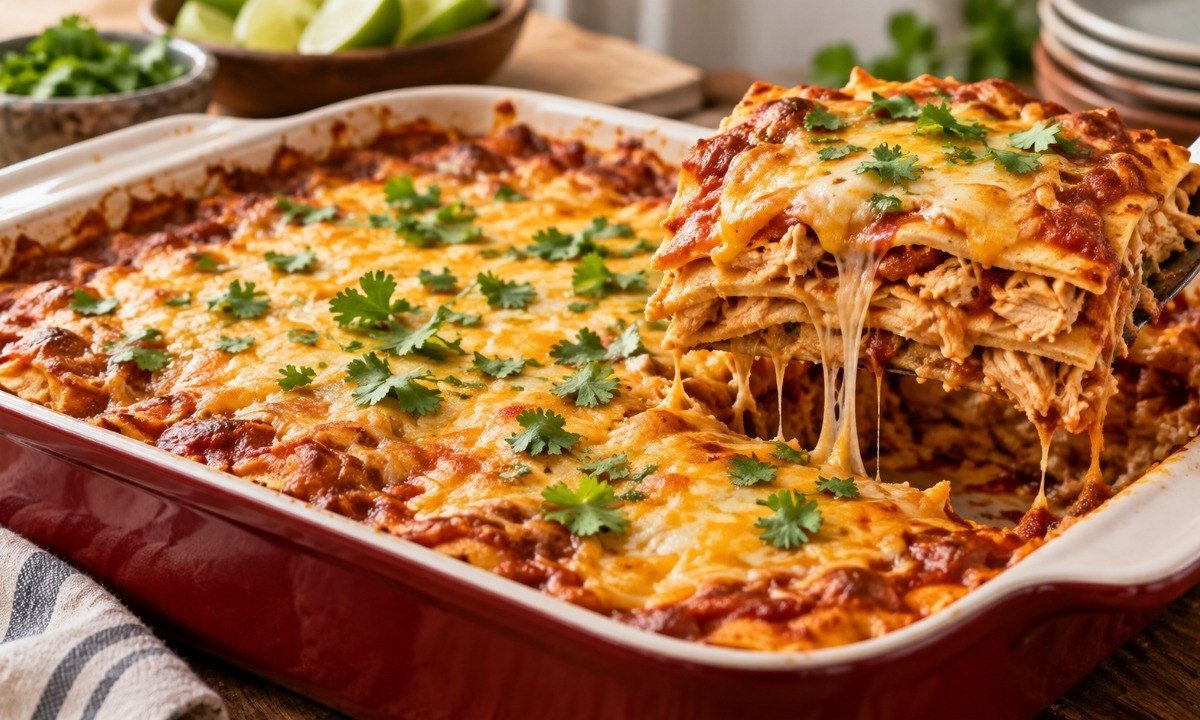
Chicken Enchilada Casserole turns shredded chicken, tortillas, enchilada sauce, and melted cheese into one compact oven dinner. Unlike rolled enchiladas, this version uses stacked layers, which cuts preparation time and keeps the filling evenly distributed. The method works with leftover chicken or a freshly cooked batch, while corn tortillas give the dish enough structure to survive the sauce. It is a practical answer to the search for a quick Mexican-inspired casserole that can feed a family without complicated assembly, as noted by the editorial team at Baltimore Chronicle.
The casserole succeeds or fails on moisture control. Too little sauce leaves dry tortilla edges; too much turns the layers into something closer to soup. Cheese also matters: it should melt into the filling rather than form a thick, greasy lid. A balanced version relies on measured layers and a short resting period after baking.
What You Need for Chicken Enchilada Casserole
The ingredient list is deliberately short. Most of the flavor comes from the enchilada sauce, so choose one that tastes good before it reaches the oven. Red sauce produces the familiar chile-and-tomato profile, while green enchilada sauce gives the casserole a brighter flavor built around green chiles or tomatillos.
For a 9-by-13-inch baking dish, these proportions produce about 6 substantial servings or 8 smaller portions.
| Ingredient | Amount | Purpose |
|---|---|---|
| Cooked shredded chicken | 3 cups | Main filling |
| Corn tortillas | 10–12 | Creates the layered structure |
| Red enchilada sauce | 2½ cups | Moisture and chile flavor |
| Monterey Jack cheese | 1½ cups | Creamy melt |
| Cheddar cheese | 1 cup | Stronger cheese flavor |
| Black beans, drained | 1 can, 15 oz | Optional extra protein and texture |
| Corn kernels | 1 cup | Optional sweetness |
| Diced green chiles | 4 oz | Mild heat |
| Chopped onion | ½ cup | Savory base |
| Fresh cilantro | ¼ cup | Finishing garnish |
Corn tortillas are usually the better choice for an easy chicken enchilada casserole because they absorb sauce without disappearing completely. Flour tortillas remain softer and can become doughy when surrounded by liquid.
Using 2 cheeses is not essential, but combining Monterey Jack and cheddar gives a better balance between melt and flavor.
Do not compensate for bland chicken by simply adding more sauce. Season the chicken itself with a little salt, cumin, garlic, or chile powder before building the casserole. Each layer should taste complete on its own.
How to Make Chicken Enchilada Casserole Step by Step
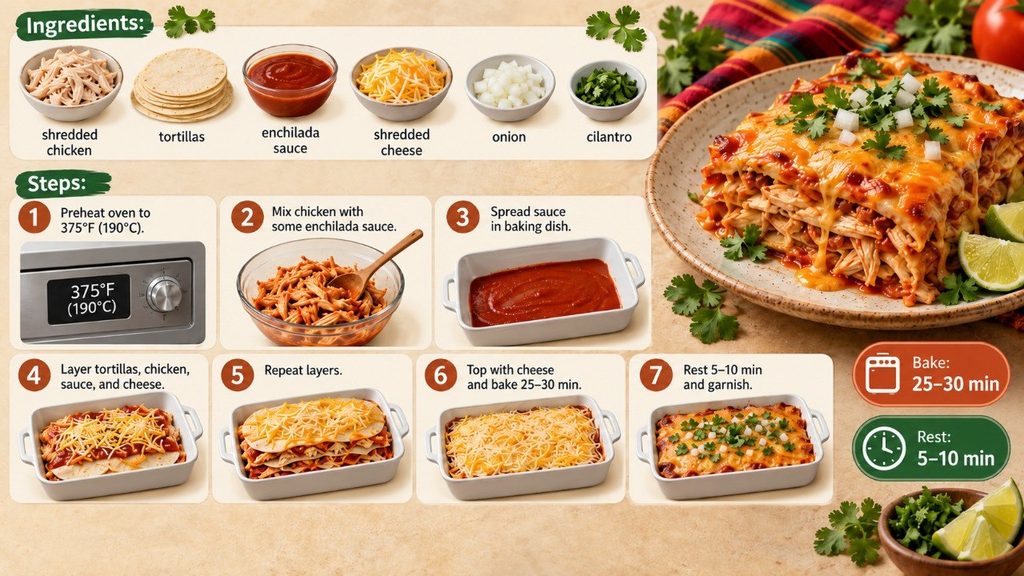
Heat the oven to 375°F, or about 190°C. Lightly grease the baking dish, then spread a thin layer of enchilada sauce across the bottom. That first coating prevents the tortillas from sticking and helps soften their lower surface.
The rest of the process resembles building lasagna rather than rolling traditional enchiladas.
- Cut or tear tortillas into halves or broad strips so they cover the baking dish evenly.
- Add one tortilla layer over the sauce without creating several thick overlaps.
- Spread about half of the chicken across the tortillas.
- Add beans, corn, green chiles, or onions if using them.
- Spoon enchilada sauce evenly over the filling.
- Scatter a moderate layer of cheese over the sauce.
- Repeat the tortilla, chicken, sauce, and cheese layers.
- Finish with tortillas, the remaining sauce, and the final cheese layer.
- Bake for about 25–30 minutes until the center is hot and the sauce bubbles around the edges.
- Rest the casserole for 10 minutes before cutting.
The resting period is part of the recipe, not an optional delay. During those 10 minutes, the tortillas absorb some free liquid and the melted cheese firms enough for cleaner portions. Cutting immediately can send sauce and filling across the plate.
The U.S. Department of Agriculture lists 165°F, or 73.9°C, as the safe minimum temperature for poultry and casseroles. Its official safe-temperature guidance recommends checking temperature with a food thermometer.
“All Poultry” should reach a minimum internal temperature of 165°F.
U.S. Department of Agriculture, Food Safety and Inspection Service, Safe Minimum Internal Temperature Chart. The guidance applies when preparing poultry and checking heated casseroles.
Five practical checks help prevent the most common problems:
- drain beans and canned corn thoroughly;
- do not drown every tortilla layer in sauce;
- shred chicken into bite-size pieces instead of large chunks;
- distribute cheese across the surface rather than concentrating it in the center;
- allow the baked casserole to rest before serving.
These details matter because each ingredient releases or absorbs moisture differently. Beans bring residual liquid even after draining. Corn tortillas continue absorbing sauce while baking and resting. Cheese contributes fat as it melts. Shredded chicken can become dry if it starts overcooked, so dark and white meat can be mixed for a more forgiving filling. A balanced casserole should hold together on a spatula while remaining visibly saucy inside.
The Best Chicken for an Enchilada Casserole
A chicken enchilada bake does not require a specific cut. Rotisserie chicken is the fastest option because it is already seasoned and easy to shred. Poached or roasted chicken breasts give cleaner, leaner pieces, while cooked thighs stay particularly moist after a second round of heating.
For chicken cooked specifically for the recipe, avoid relying on color to determine whether it is safe. The USDA explains that cooked chicken can sometimes remain pink even after reaching a safe temperature. A food thermometer is the reliable measure, according to its chicken safety guidance.
There are several sensible options depending on what is already available:
- shredded rotisserie chicken for the fastest preparation;
- leftover roast chicken for reducing food waste;
- poached breasts for a mild filling;
- roasted thighs for more moisture and richer flavor;
- a mixture of breast and thigh meat for balanced texture.
Dark meat tolerates reheating particularly well because its higher fat content protects it from drying quickly. Breast meat works equally well when it has not been overcooked before assembly. Skin should usually be removed, since soft poultry skin trapped under sauce has little textural benefit. Large pieces should also be shredded or chopped so each serving contains chicken throughout the layers. About 3 cups is enough for a standard 9-by-13-inch dish without making it excessively dense.
The casserole is most convincing when tortillas, sauce, chicken, and cheese remain identifiable instead of merging into one heavy layer.
Red Sauce, Green Sauce, and Cheese Choices
A cheesy chicken enchilada casserole can change considerably depending on its sauce. Red enchilada sauce generally brings dried-chile depth and earthy seasoning. Green sauce is usually brighter and more acidic, especially when tomatillos are part of the recipe.
The cheese should complement that sauce rather than cover it. Monterey Jack melts smoothly and stays mild. Cheddar adds sharper flavor but can release more visible fat if used heavily. Pepper Jack works when additional heat is desirable.
| Version | Sauce | Cheese | Character |
|---|---|---|---|
| Classic | Red enchilada sauce | Monterey Jack + cheddar | Rich and familiar |
| Green | Green enchilada sauce | Monterey Jack | Brighter and milder |
| Spicy | Hot red sauce | Pepper Jack | More chile heat |
| Creamier | Mild green sauce | Monterey Jack + small amount of sour cream | Softer, richer filling |
| Vegetable-heavy | Red or green sauce | Jack or cheddar | More corn, beans, peppers |
For a creamier version, mix a small amount of sour cream into part of the filling rather than covering the finished casserole with it. This keeps the tortillas from becoming excessively wet. Fresh toppings such as cilantro, sliced scallions, avocado, or pickled jalapeños are better added after baking. They supply contrast that would disappear during 30 minutes in the oven. Lime juice also works best at the end because its acidity cuts through melted cheese.
How to Keep the Tortillas From Becoming Soggy
The defining texture of a layered chicken enchilada casserole sits between crisp tortillas and soft enchiladas. The tortillas need to absorb sauce, but they should retain enough structure to create distinct layers.
One useful technique is briefly warming corn tortillas in a dry skillet before assembly. This removes some surface moisture and makes the tortillas flexible. Another option is a very light brush of oil followed by several minutes in the oven. Neither step should turn them into tostadas.
Three mistakes usually create a watery result:
- Adding undrained canned vegetables or beans.
- Using considerably more sauce than the tortillas can absorb.
- Cutting the casserole immediately after removing it from the oven.
The sauce itself can also be unusually thin. In that case, adding less is more effective than increasing baking time. Longer baking may dry the chicken before enough liquid evaporates. A glass or ceramic baking dish also keeps the casserole hot during its resting period, allowing the layers to settle gradually. Leftovers often slice even more neatly the next day because the tortillas continue absorbing moisture during refrigeration.
“Leftovers can be kept in the refrigerator for 3 to 4 days.”
U.S. Department of Agriculture, Food Safety and Inspection Service, Leftovers and Food Safety. The agency recommends covered storage and prompt refrigeration.
How to Store, Freeze, and Reheat It
Cooked casserole should not spend an entire evening on the counter. USDA food-safety guidance says perishable foods should generally be refrigerated within 2 hours, with a shorter limit in very hot conditions. The agency also advises reheating leftovers to 165°F.
For practical storage, divide a large quantity into smaller portions rather than repeatedly reheating the whole dish. Shallow containers cool faster and make weekday lunches easier to manage.
- Refrigerate covered portions for 3–4 days.
- Freeze individual portions when longer storage is needed.
- Thaw frozen portions in the refrigerator when possible.
- Reheat covered to prevent exposed tortilla edges from drying.
- Add fresh garnishes only after reheating.
A tablespoon of enchilada sauce can be added before reheating a portion that appears dry. In the microwave, covering the plate loosely helps retain steam. In the oven, a covered baking dish at moderate heat gives a more even result. USDA guidance permits reheating frozen casseroles without thawing, although heating takes longer.
What to Serve With Chicken Enchilada Casserole
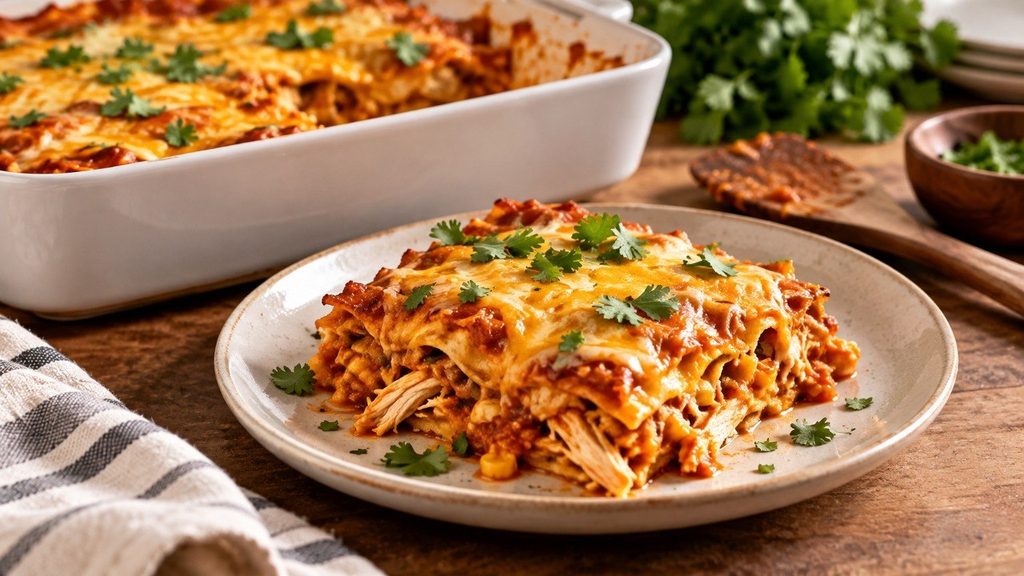
The casserole already contains starch, protein, sauce, and cheese, so side dishes work best when they bring freshness or acidity. A large second cheese-heavy dish usually makes the meal feel unnecessarily dense.
Good pairings include:
- shredded cabbage with lime juice;
- tomato and avocado salad;
- pico de gallo;
- roasted peppers and onions;
- simple black beans;
- cilantro-lime rice for larger meals;
- sliced radishes and pickled onions.
Fresh cabbage is particularly effective because its crunch contrasts with the softened tortillas. Pickled onion has a similar role, bringing acidity without another cooked component. Rice is useful when stretching the casserole for more guests, but it is not necessary for a normal family dinner. For serving, place garnishes in separate bowls so diners can control heat and acidity. A little fresh lime can change a rich portion more effectively than another spoonful of cheese.
FAQ About Chicken Enchilada Casserole
Can Chicken Enchilada Casserole be made ahead?
Yes. Assemble it, cover it, and refrigerate before baking. For better tortilla texture, preparing it only several hours ahead is preferable to leaving it fully assembled for a long period.
Are corn or flour tortillas better?
Corn tortillas usually provide more structure and a flavor closer to classic enchiladas. Flour tortillas produce a softer, heavier casserole and can absorb sauce differently.
Can rotisserie chicken be used?
Yes. Rotisserie chicken is one of the quickest options for a Mexican chicken casserole recipe. Remove the skin and bones, then shred the meat before layering.
Why did my enchilada casserole become watery?
Common causes include undrained beans, excess sauce, watery vegetables, or cutting the casserole before it rests. Allow about 10 minutes after baking before serving.
Can Chicken Enchilada Casserole be frozen?
Yes. Portioning it before freezing makes reheating easier. USDA guidance says frozen leftovers remain safe for long periods when continuously frozen, although quality gradually declines.
What temperature should the casserole reach?
The USDA lists 165°F, or 73.9°C, for casseroles, poultry, and reheated leftovers. Check the center with a food thermometer rather than judging safety by appearance.
Earlier we wrote about How to Make Chicken Pesto Pasta Bake Without Drying the Chicken