 Frank Rondel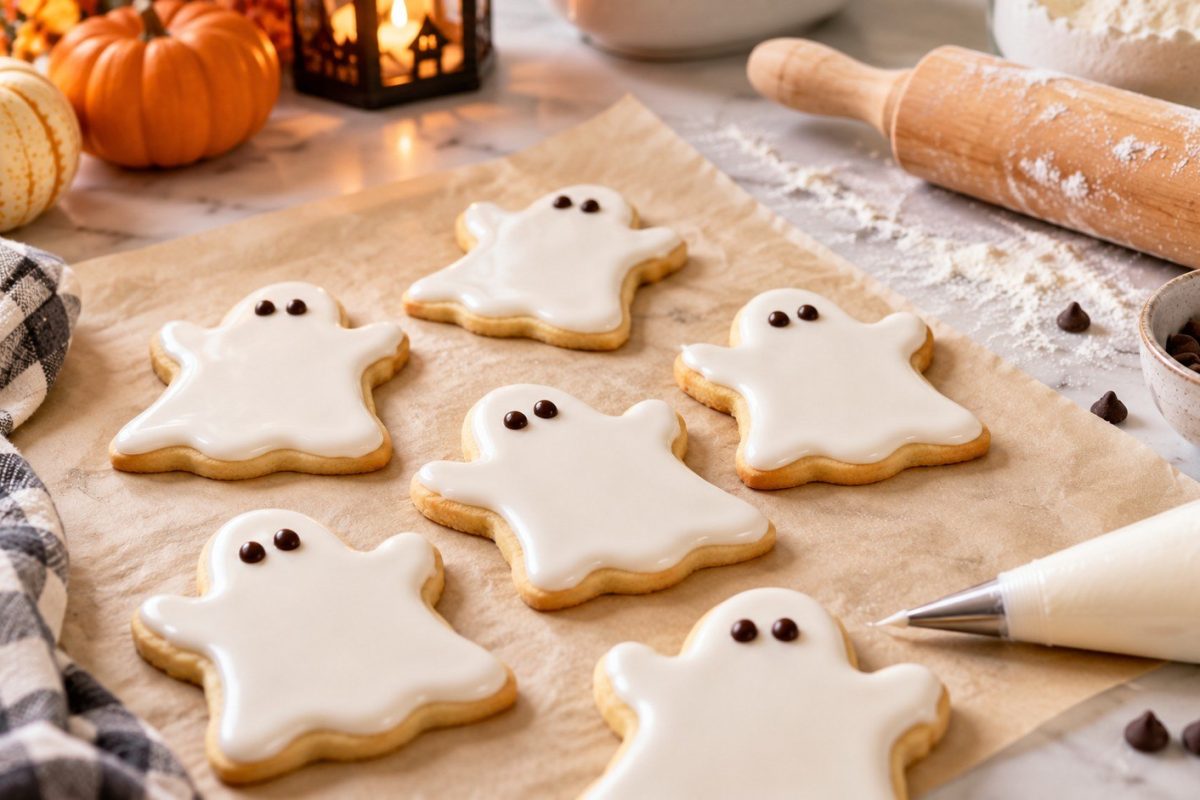
Ghost Cookies turn egg whites, sugar, and chocolate into crisp Halloween treats with almost no specialized equipment. Their success depends less on decoration than clean tools, stable meringue, and low oven heat, as the editors at customreceipt.com note.
The name covers several Halloween desserts, including iced sugar cookies and white-chocolate-covered sandwich cookies. This recipe focuses on piped meringue ghosts because the shape forms without cutters. The cookies stay pale, develop crisp shells, and can be prepared before a party. Their faces need only melted chocolate or small chocolate chips.
The best ghost cookie looks slightly imperfect because uneven peaks and tilted faces give every piece its own expression.
What makes Ghost Cookies work
A reliable Ghost Cookies recipe uses a simple meringue ratio. Egg whites provide structure, while sugar stabilizes the foam and creates the crisp texture.
The main enemy is fat. Even a trace of yolk, butter, or oil can prevent egg whites from reaching firm peaks. A glass or stainless-steel bowl is easier to degrease than some plastic bowls. Wiping the bowl with lemon juice before mixing provides another safeguard.
The second problem is moisture. Meringue does not bake like a standard flour cookie. It dries slowly at a low temperature instead. High heat can brown the surface before the center becomes crisp.
Nielsen-Massey publishes a similar ghost cookie preparation using separate shortbread bases and piped meringues. That version shows how meringue ghosts can also become decorations for larger desserts.
For another bake where moisture determines texture, the zucchini bread guide explains why ingredient ratios matter. Different recipe, same principle: small moisture changes can alter the final structure.
Ingredients for 24 to 30 ghost cookies
These quantities make approximately 24 to 30 medium ghosts. The exact yield depends on piping size.
- 3 large egg whites, preferably pasteurized
- 150 g granulated or superfine sugar
- 1/4 teaspoon cream of tartar
- 1/2 teaspoon vanilla extract
- 1 small pinch of fine salt
- 30 g dark chocolate for faces
- lemon juice for cleaning the mixing bowl
Room-temperature whites generally whip faster than cold whites. However, eggs separate more cleanly while chilled. Separate them first, then allow the whites to lose their refrigerator chill. Superfine sugar dissolves faster, although ordinary granulated sugar also works. Avoid oily flavorings because fat can destabilize the foam.
The protein chia pudding recipe offers another example of ingredient order controlling texture. With meringue, that order becomes even less forgiving.
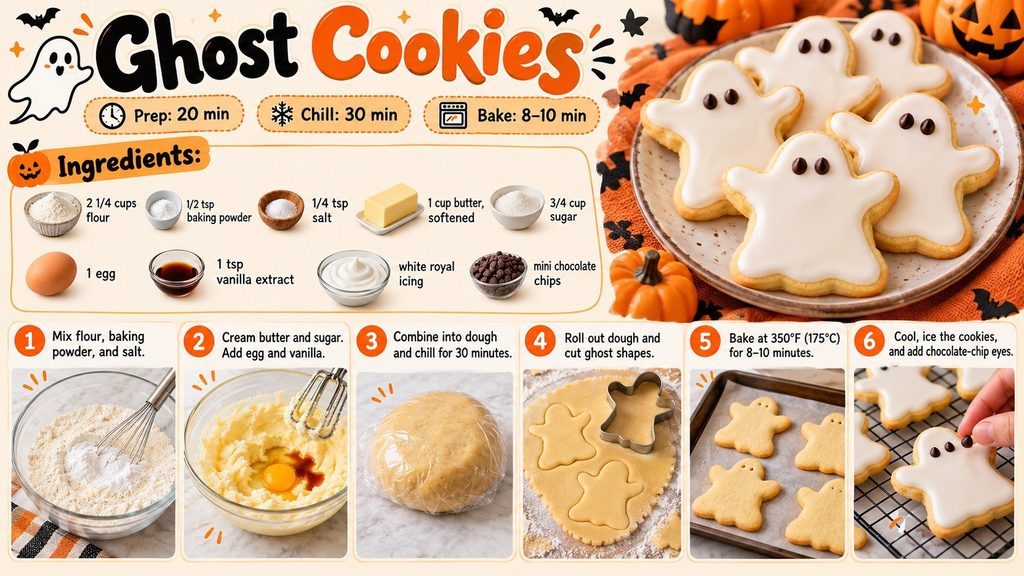
Ghost Cookies ingredient ratios
The useful ratios are easier to understand when each ingredient has a defined job.
| Ingredient | Amount | Purpose | Common mistake |
|---|---|---|---|
| Egg whites | 3 large | Builds the foam | Allowing yolk into the bowl |
| Sugar | 150 g | Stabilizes and sweetens | Adding it too quickly |
| Cream of tartar | 1/4 tsp | Supports foam stability | Using too much |
| Vanilla | 1/2 tsp | Adds aroma | Choosing an oil-based flavor |
| Dark chocolate | 30 g | Creates faces | Applying it before cooling |
Sugar is not merely a sweetener here. It delays collapse while giving dried meringue its brittle shell. Cream of tartar supplies acidity and helps stabilize whipped whites. Vanilla should remain restrained because the cookies contain little else to mask its flavor. Dark chocolate provides contrast without adding moisture to the meringue. Decorations belong on completely cooled cookies.
Changing the sugar dramatically can change the structure, so this is not a recipe where sweetness can be halved casually.
How to make Ghost Cookies step by step
The how to make Ghost Cookies process takes about 20 minutes of active work. Drying in the oven requires much longer.
- Heat the oven to 200°F, or about 95°C.
- Line 2 light-colored baking sheets with parchment paper.
- Wipe the mixing bowl and beaters with a little lemon juice.
- Beat the egg whites on medium speed until they become foamy.
- Add cream of tartar and salt, then continue beating.
- Increase the speed until soft peaks appear.
- Add sugar gradually, about 1 tablespoon at a time.
- Beat until the meringue becomes glossy and holds stiff peaks.
- Mix in vanilla for several seconds.
- Transfer the mixture into a piping bag with a wide round opening.
- Pipe upright swirls using 2 or 3 stacked squeezes for each ghost.
- Bake for about 90 minutes without allowing significant browning.
- Turn off the oven and leave the cookies inside for another 30 minutes.
- Cool completely before adding chocolate eyes and mouths.
Do not rush the sugar addition. Undissolved crystals can encourage weeping or leave a gritty surface. Rub a little meringue between clean fingers before piping. A smooth mixture indicates that most sugar has dissolved. Keep the ghosts similar in size so they dry at comparable rates. Large ghosts may need additional oven time.
This easy Ghost Cookies method works without a pastry tip. Cut approximately 1.5 cm from a disposable piping bag instead. A sturdy freezer bag can also work when no piping bag is available.
How to pipe ghosts that keep their shape
Hold the piping bag vertically above the parchment. Squeeze until the first rounded section forms, then lift slightly without breaking contact. Repeat once or twice before releasing the pressure.
A perfect spiral is unnecessary. In fact, slightly crooked peaks make the finished batch more convincing. What matters is a wide base because narrow ghosts can topple during handling.
- Pipe short ghosts for faster drying.
- Pipe taller ghosts for dramatic serving trays.
- Add 2 chocolate eyes for a minimal face.
- Add an oval mouth for a classic frightened expression.
- Use mini chocolate chips when melted chocolate feels unnecessary.
- Keep decorative candy away from the oven unless its label permits baking.
Chocolate should be applied after the meringues cool. Warm cookies can make piped features spread. Mini chips are easiest when attached with a dot of melted chocolate. Candy eyes add more detail but also increase sweetness. Avoid liquid food coloring on finished cookies because moisture softens meringue. Gel coloring can tint the mixture before piping when colored ghosts are wanted.
A recent cookie feature on unusual flavor combinations illustrates how far cookie formats can move beyond traditional recipes. Ghost meringues take the opposite approach and rely on a very short ingredient list.
Why meringue becomes sticky, cracked, or brown
Humidity causes many problems blamed on recipes. Meringue absorbs moisture from the air after baking. A crisp batch can become tacky after sitting uncovered in a humid kitchen.
Cracks are less serious. Rapid temperature changes can split the shell while the interior contracts. Leaving the cookies inside the switched-off oven reduces that shock.
“Never eat or taste raw flour, dough, or batter.”
That guidance comes from the U.S. Food and Drug Administration. It matters when flour-based Ghost Cookies or sugar-cookie versions are prepared. The FDA identifies flour as a raw food that can carry harmful bacteria.
Meringue versions raise a separate egg-safety question. The USDA recommends pasteurized eggs or egg products for recipes using eggs raw or undercooked.
“Use pasteurized eggs or egg products when preparing recipes that call for using eggs raw or undercooked.”
The guidance appears in the USDA Food Safety and Inspection Service information on shell egg safety.
These ghosts spend substantial time in a warm oven, but pasteurized whites remain the simplest option for cautious preparation.
Troubleshooting Halloween Ghost Cookies
Most failed Halloween Ghost Cookies reveal the cause through their texture or color.
| Problem | Likely cause | Practical fix |
|---|---|---|
| Flat ghosts | Weak meringue | Beat to stiff peaks before piping |
| Grainy texture | Sugar added too quickly | Add sugar gradually |
| Brown surface | Oven too hot | Reduce heat and verify temperature |
| Sticky shell | Humidity or under-drying | Dry longer and store airtight |
| Cracked exterior | Rapid cooling | Cool gradually inside the oven |
| Soft center | Ghosts piped too large | Extend drying time |
An oven thermometer can expose inaccurate home ovens. A displayed 200°F does not guarantee the chamber actually holds that temperature. Light baking sheets also reduce aggressive browning from below. Do not open the oven repeatedly because temperature swings encourage cracks. Finished meringue should release from parchment without leaving a wet base.
If the ghosts look finished but remain chewy inside, they usually need more drying rather than more heat.
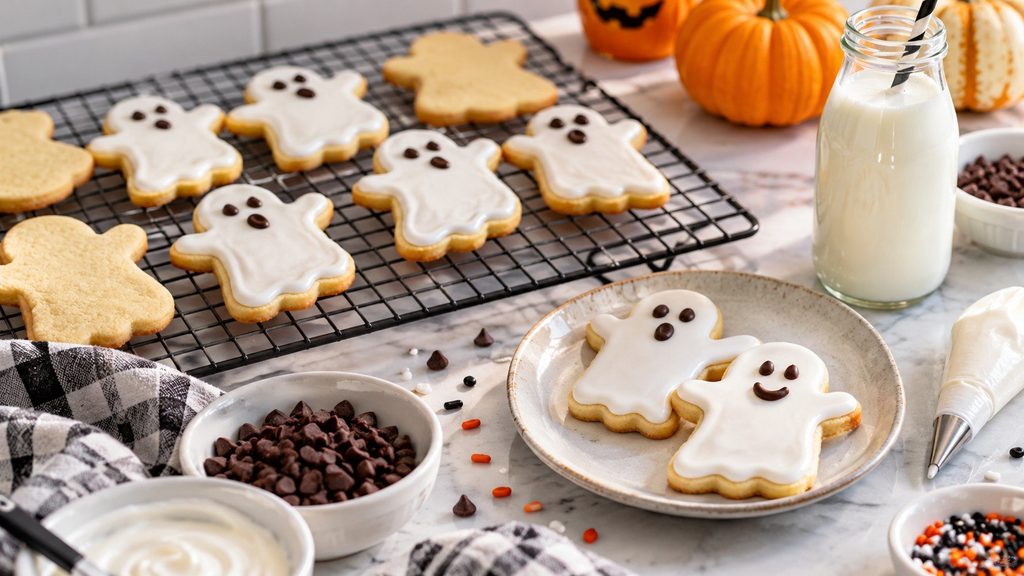
Storage and Halloween party planning
Airtight storage matters more than refrigeration. Refrigerators contain moisture, so they can soften crisp meringue. Keep finished ghosts in a sealed container at cool room temperature.
Prepare them 1 or 2 days before a Halloween party for easier scheduling. Place parchment between layers if the chocolate faces feel delicate. Do not store them beside moist cakes, fresh fruit, or uncovered frosting.
For serving, black trays create strong contrast against white ghosts. Crushed chocolate cookies can imitate dark soil underneath them. Individual ghosts also work as cupcake toppers when added shortly before serving.
The meringue ghost cookies can be made smaller for children’s party plates. Smaller pieces also dry faster and break less often during transport.
FAQ about Ghost Cookies
What are Ghost Cookies?
Ghost Cookies are Halloween desserts shaped or decorated like ghosts. Common versions use meringue, sugar-cookie dough, or coated sandwich cookies.
How long should Ghost Cookies bake?
Medium meringue ghosts usually need about 90 minutes at 200°F. Their size and actual oven temperature can change the drying time.
Why did my Ghost Cookies turn brown?
The oven was probably too hot. Meringue should dry slowly rather than develop the browning expected from ordinary cookies.
Can Ghost Cookies be made without cream of tartar?
Yes, but the egg-white foam may be less forgiving. A small amount of lemon juice can provide acidity instead.
Can Ghost Cookies be prepared in advance?
Yes. Crisp meringue ghosts are well suited to advance preparation. Store them airtight at room temperature for the best texture.
Should Ghost Cookies go in the refrigerator?
Usually not. Refrigeration exposes meringue to moisture and can soften its surface. An airtight container in a cool, dry place works better.
Earlier we wrote about How to Make Protein Chia Pudding With 28–35 g Protein per Serving