 Frank Rondel
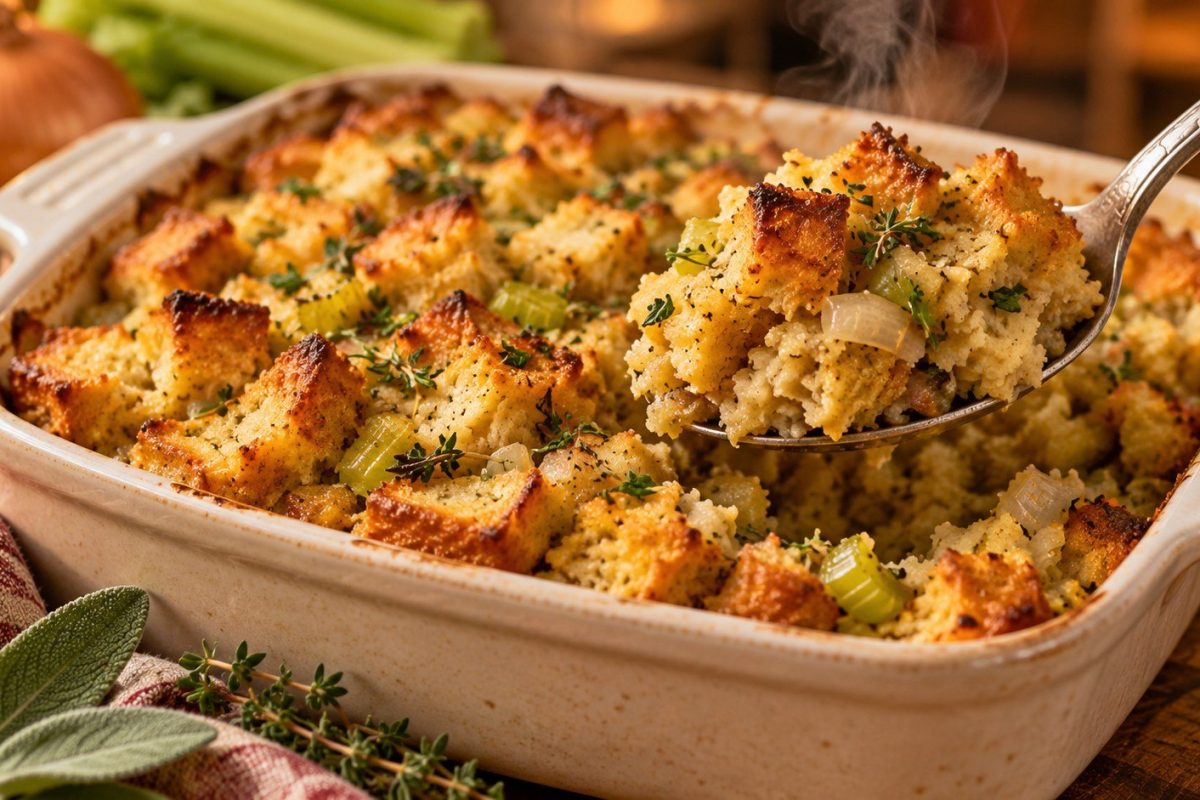
Classic stuffing is one of Thanksgiving’s most recognizable side dishes, yet surprisingly easy to get wrong. The ideal version combines buttery bread, tender vegetables, fragrant herbs, and a golden crust. Too much broth produces a soggy casserole, while insufficient moisture leaves the bread unpleasantly dry. This guide explains how to prepare traditional stuffing with reliable results, as reported by customreceipt.com.
The secret is not an expensive ingredient or complicated technique. It comes down to choosing suitable bread, controlling moisture, and giving the dish enough oven time. With a few straightforward adjustments, homemade stuffing can become the most requested dish at the holiday table.
What Is Classic Stuffing and Why Is It a Thanksgiving Favorite?
Traditional American stuffing consists of cubed bread mixed with sautéed onions, celery, butter, herbs, and broth. Some families add eggs, sausage, apples, or nuts. However, the simplest version remains popular because its flavors complement roasted turkey without overpowering it.
Stuffing has a particularly appealing contrast of textures. The exterior becomes crisp and lightly browned, while the center stays tender and savory. Sage contributes an earthy aroma, and celery provides a subtle freshness.
Technically, stuffing is cooked inside poultry, while dressing is baked separately. In everyday American cooking, however, both names frequently describe the same bread-based side dish.
For this recipe, a separate baking dish offers greater control over moisture, browning, and food safety.
The best stuffing should hold together loosely when served. It should never resemble dry croutons or a dense bread pudding.
Ingredients for Traditional Homemade Stuffing
A dependable classic stuffing recipe begins with ordinary ingredients. Quality matters, especially when selecting bread and broth.
The quantities below produce approximately 8 generous side-dish servings.
| Ingredient | Quantity | Purpose |
|---|---|---|
| Day-old white bread | 14 cups, cubed | Provides structure |
| Unsalted butter | ¾ cup | Adds richness |
| Yellow onions | 2 medium | Creates savory sweetness |
| Celery stalks | 4 | Adds texture and aroma |
| Garlic | 3 cloves | Deepens flavor |
| Chicken or vegetable broth | 2–2½ cups | Moistens the bread |
| Large eggs | 2 | Helps bind the mixture |
| Fresh parsley | ¼ cup, chopped | Adds freshness |
| Fresh sage | 1 tablespoon, chopped | Supplies traditional flavor |
| Fresh thyme | 2 teaspoons | Adds herbal depth |
| Fresh rosemary | 1 teaspoon, chopped | Adds a fragrant accent |
| Black pepper | ½ teaspoon | Balances the seasoning |
| Kosher salt | To taste | Enhances flavor |
The bread measurement refers to cubes rather than compressed crumbs. A standard 9-by-13-inch baking dish works well for this quantity.
Begin with 2 cups of broth and reserve the remaining ½ cup. Different breads absorb liquid at different rates, making gradual additions essential. Low-sodium broth also provides better control over the final seasoning.
Fresh herbs deliver a brighter flavor, although dried alternatives work. Use approximately ⅓ of the fresh herb quantity when substituting dried herbs.
Avoid adding all the salt immediately. Commercial broth can already contain substantial sodium.
Which Bread Makes the Best Classic Stuffing?
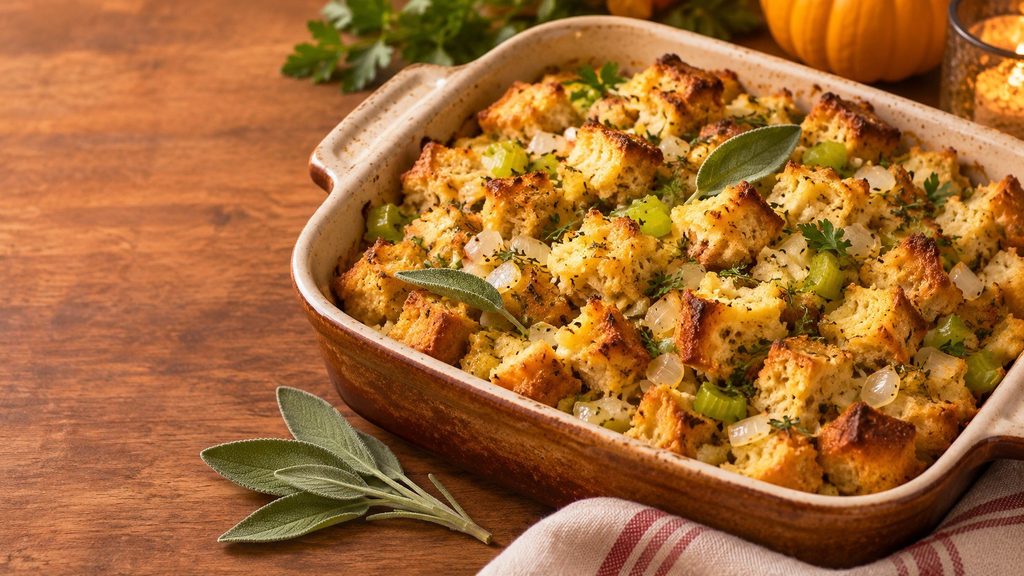
Bread selection has a greater influence on homemade stuffing than many cooks realize. Fresh, soft slices absorb broth quickly and may collapse into a dense mixture.
Slightly stale bread maintains its structure while absorbing butter and seasonings. Drying fresh bread in the oven is another practical solution.
Different varieties create noticeably different results.
| Bread type | Texture after baking | Best use |
|---|---|---|
| White sandwich bread | Soft, cohesive center | Traditional stuffing |
| Sourdough | Firm, slightly chewy | Rustic stuffing |
| Challah | Rich and tender | Special holiday meals |
| French bread | Crisp edges, soft interior | Freshly served stuffing |
| Cornbread | Crumbly, hearty texture | Southern-style dressing |
White sandwich bread is the most predictable starting point for beginners. Sourdough creates more pronounced texture, while challah contributes a subtle sweetness.
For more adventurous variations, combine white bread with sourdough. Using roughly equal portions produces a pleasant balance of softness and structure.
Bread should be dry, not moldy. Never use bread showing visible spoilage.
How to Make Classic Stuffing Step by Step
Preparing traditional Thanksgiving stuffing requires approximately 25 minutes of active work, excluding bread drying. Baking usually takes another 40–50 minutes.
The process becomes much easier when the ingredients are prepared before cooking.
Step-by-Step Cooking Instructions
- Prepare the bread. Cut it into approximately ¾-inch cubes. Spread evenly across 2 baking sheets.
- Dry the cubes. Bake at 250°F for 35–50 minutes, stirring occasionally. The bread should feel dry without becoming deeply browned.
- Preheat the oven. Increase the temperature to 350°F. Grease a 9-by-13-inch baking dish.
- Cook the vegetables. Melt butter in a large skillet over medium heat. Add diced onions and celery.
- Develop the flavor. Cook for 8–10 minutes until softened. Add garlic and herbs during the final minute.
- Combine the ingredients. Place the dried bread in a large bowl. Add the buttery vegetable mixture and parsley.
- Add the liquid. Whisk the eggs with 2 cups of broth. Pour gradually over the bread while folding gently.
- Adjust the moisture. Add reserved broth as necessary. The bread should feel moist without liquid pooling underneath.
- Bake covered. Transfer everything into the prepared dish. Cover with foil and bake for approximately 25 minutes.
- Finish uncovered. Remove the foil and bake another 15–25 minutes until golden. Check that the center reaches 165°F.
Do not press the bread tightly into the baking dish. Gentle handling preserves the small spaces that help create a lighter texture.
The covered baking stage retains moisture and heats the center. Removing the foil allows surface moisture to evaporate, creating crisp edges.
Use a food thermometer rather than relying exclusively on color. Cooking times can vary with dish depth, bread moisture, and oven performance.
Allow the finished stuffing to rest for 5–10 minutes before serving. This makes portioning easier without sacrificing its appealing texture.
How to Keep Stuffing Moist Without Making It Soggy
One of the most common problems involves adding too much liquid too quickly. Bread absorbs moisture gradually, and the mixture may become wetter as it rests.
For a reliable moist stuffing recipe, add broth in stages. Stop when the cubes feel evenly damp but still retain their individual shapes.
A useful test involves squeezing a small handful of the mixture. It should hold together briefly before separating with gentle pressure. Liquid should not drip from it.
Several details can improve the finished texture:
- Use dried bread rather than fresh, soft slices.
- Add broth gradually and fold instead of stirring aggressively.
- Avoid overcooking the onions and celery until completely broken down.
- Distribute butter evenly throughout the bread mixture.
- Keep the stuffing covered during the first baking stage.
- Remove the foil near the end to develop a crisp surface.
The first adjustment should always involve the bread-to-liquid balance. Adding extra butter cannot repair stuffing that has absorbed excessive broth.
If the mixture looks dry before baking, introduce additional warm broth in small quantities. If it seems excessively wet, fold in extra dried bread cubes.
A slightly irregular surface encourages browning. Smooth, tightly compressed stuffing develops fewer crisp edges.
The most appealing stuffing has contrast: a tender interior, fragrant herbs, and scattered golden pieces that crackle slightly beneath the fork.
Classic Stuffing Variations Worth Trying
The traditional recipe provides a foundation for numerous regional and family variations. Small additions can change the flavor without making the preparation substantially more complicated.
For a richer holiday side dish, consider these combinations:
- Sausage stuffing: Add 12 ounces of fully cooked, crumbled breakfast sausage.
- Apple stuffing: Mix in 1½ cups of diced apples for gentle sweetness.
- Mushroom stuffing: Sauté 12 ounces of mushrooms until their excess moisture evaporates.
- Cranberry stuffing: Add ¾ cup of dried cranberries for a tart contrast.
- Cornbread dressing: Replace the white bread with dried cornbread for a Southern-inspired version.
- Vegetarian stuffing: Use vegetable broth and omit meat-based additions.
Sausage pairs particularly well with sage and rosemary. Apples provide a lighter contrast to rich turkey gravy, especially when combined with sautéed onions.
Mushrooms add savory depth without requiring meat. Brown them separately before combining with the vegetables, otherwise they may release too much water.
For cranberry stuffing, choose unsweetened or lightly sweetened cranberries when possible. Excessive sweetness can overpower the herbs.
When adding substantial ingredients, increase the baking dish capacity if necessary. An overcrowded casserole heats less evenly and may require additional cooking time.
Should You Cook Stuffing Inside the Turkey?
Although cooking stuffing inside poultry is traditional, preparing it separately offers practical advantages. The cook can monitor the bread and turkey independently, reducing the risk of overcooking either component.
The USDA’s food safety guidance recommends cooking stuffing outside the bird for optimum safety. Stuffing prepared inside poultry must reach an internal temperature of 165°F.
The USDA also emphasizes that turkey itself must reach the appropriate safe cooking temperature. A thermometer is essential when checking both foods.
This distinction matters because stuffing heats differently inside a turkey’s cavity. Its center may remain below the required temperature even when the poultry appears fully cooked.
For traditional turkey flavor, use quality chicken broth in the casserole. A little properly cooked turkey gravy can be added at serving.
Separately baked stuffing also develops a more consistent golden crust. That contrast is difficult to achieve when the bread cooks inside poultry.
Common Stuffing Mistakes and How to Fix Them
Even experienced home cooks occasionally struggle with soggy centers or dry surfaces. Most problems can be traced to moisture, bread preparation, or uneven baking.
| Problem | Likely cause | Practical solution |
|---|---|---|
| Stuffing is too dry | Insufficient broth | Add warm broth before baking or reheating |
| Stuffing is soggy | Excessive liquid | Add dried cubes before baking |
| Top browns too quickly | Excessive surface heat | Cover loosely with foil |
| Flavor is bland | Insufficient seasoning | Adjust salt, herbs, and broth |
| Texture is dense | Bread compressed tightly | Fold gently and avoid packing |
| Center heats slowly | Dish is too deep | Use a wider dish and check temperature |
Seasoning deserves particular attention. Bread absorbs substantial amounts of flavor, which can make an initially well-seasoned mixture taste muted after baking.
Taste the cooked vegetables before combining them with the bread. When using eggs, avoid tasting the uncooked assembled mixture.
Another common issue involves dried herbs. Adding excessive rosemary or sage can produce a bitter, medicinal flavor.
Freshly ground black pepper and properly softened onions usually provide enough complexity for a classic version. Additional ingredients should support the bread rather than dominate it.
Can You Make Classic Stuffing Ahead of Time?
Preparing ingredients in advance can make Thanksgiving cooking considerably less stressful. However, cooked stuffing and uncooked mixtures require different handling.
The easiest approach involves drying the bread and preparing individual components ahead of time.
You can chop vegetables 1 day before cooking and refrigerate them separately. Bread cubes can also be dried earlier and stored in an airtight container after cooling completely.
For the most convenient holiday schedule, consider this preparation plan:
| Preparation task | Suggested timing |
|---|---|
| Cube and dry bread | 1–2 days ahead |
| Chop onions and celery | 1 day ahead |
| Measure herbs | 1 day ahead |
| Sauté vegetables | Up to 1 day ahead; refrigerate |
| Assemble with broth and eggs | Immediately before baking |
| Bake the stuffing | Before serving |
| Refrigerate cooked leftovers | Within 2 hours |
Keeping the components separate protects the bread’s texture and simplifies safe storage. Combine the ingredients shortly before transferring them to the oven.
Alternatively, fully cook the stuffing in advance and refrigerate it promptly. Reheat thoroughly before serving, adding a little broth if necessary.
According to USDA recommendations for reheating leftovers, cooked leftovers should reach 165°F. This temperature should be checked at the center.
For extra crispness, remove the foil during the final minutes of reheating. Avoid repeatedly reheating large quantities when only a few servings are needed.
How to Store and Reheat Leftover Stuffing
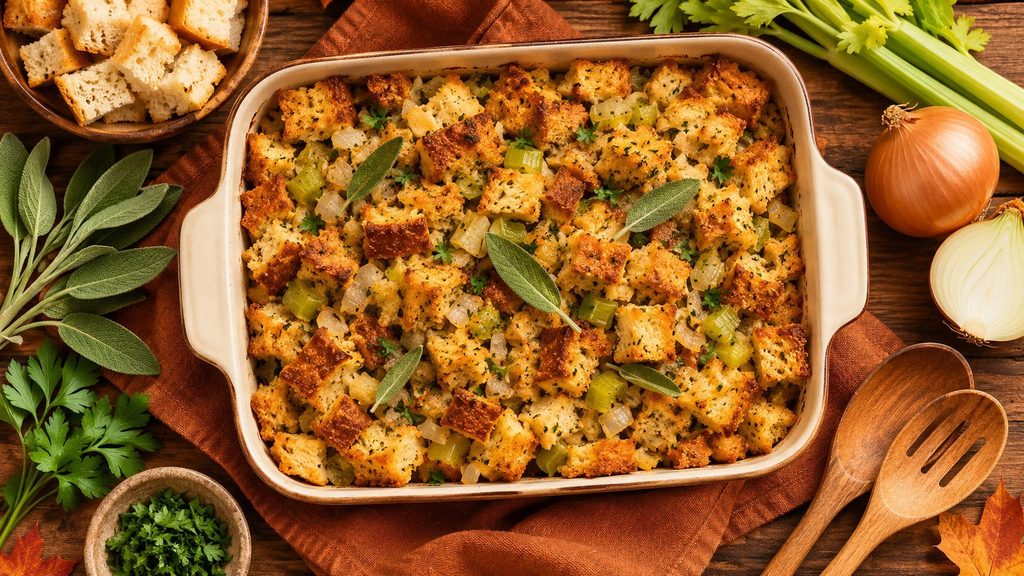
Proper storage protects both quality and food safety. Stuffing contains moisture and, frequently, eggs or meat-based ingredients.
The USDA advises refrigerating leftovers within 2 hours. Refrigerated leftovers should generally be consumed within 3–4 days.
Divide large portions into shallow containers to encourage faster cooling. Keep the refrigerator at 40°F or below.
To reheat stuffing, place it in an oven-safe dish and add a small amount of broth. Cover with foil and warm at 350°F until the center reaches 165°F.
For a crisp surface, uncover it near the end. Frozen leftovers should be thawed safely in the refrigerator or reheated directly using an appropriate method.
Discard stuffing left at room temperature beyond safe holding limits. A normal appearance or pleasant smell does not guarantee that leftovers are safe.
FAQ: Classic Stuffing Recipe
What is the secret to good homemade stuffing?
The secret is properly dried bread combined with a controlled amount of broth. Cooked aromatics, butter, and fresh herbs create the characteristic flavor. Baking covered first, then uncovered, balances tenderness and browning.
How much broth should I use for classic stuffing?
Begin with approximately 2 cups of broth for 14 cups of dried bread cubes. Add up to another ½ cup as needed. The exact amount depends on the bread variety and dryness.
Do you need eggs in stuffing?
Eggs help bind the bread and produce a slightly richer interior. They are useful but not essential. For an egg-free version, omit them and adjust the broth gradually.
Can you use fresh bread for Thanksgiving stuffing?
Yes, but fresh bread should be dried before mixing. Spread the cubes on baking sheets and warm them in a low oven. This prevents excessive softness and improves liquid absorption.
What temperature should classic stuffing bake at?
A conventional oven temperature of 350°F works well. This recipe generally requires 40–50 minutes, depending on the ingredients and baking dish. Verify that the center reaches 165°F.
Can stuffing be made without turkey?
Absolutely. A traditional bread stuffing can be prepared with vegetable broth and served independently. It pairs well with roasted vegetables, chicken, mushrooms, and holiday meals.
How do you make stuffing crispy on top?
Remove the foil during the final 15–25 minutes of baking. Spread the bread loosely and avoid excessive broth. A shallow baking dish also creates more surface area for browning.
What can I serve with classic stuffing?
Roasted turkey, mashed potatoes, cranberry sauce, green beans, and gravy are familiar choices. The stuffing’s savory herbs also complement roasted chicken and vegetarian holiday dishes.
The Best Way to Serve Classic Stuffing
Classic stuffing succeeds through balance rather than complexity. Dried bread provides structure, buttery vegetables create richness, and carefully measured broth keeps the center tender.
For a traditional Thanksgiving dinner, bake it separately and serve while the top remains crisp. Finish with fresh parsley and offer warm gravy alongside.
The recipe also rewards experimentation. Start with the basic version, then introduce sausage, mushrooms, or apples according to your family’s preferences.
A well-prepared stuffing deserves more attention than a supporting side dish. With reliable technique and good ingredients, it can become a holiday tradition of its own.
Earlier we wrote about How to Make Dutch Apple Pie: Easy Recipe With Cinnamon Apples and Crispy Butter Crumble