 Frank Rondel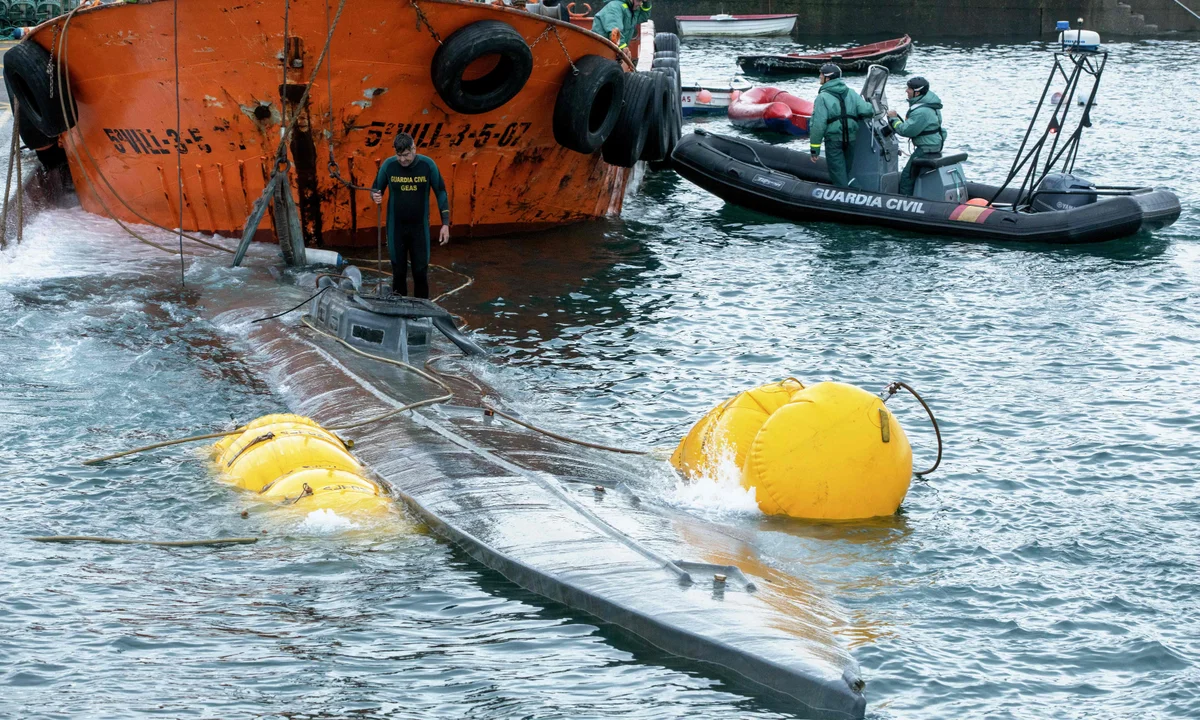
The falling price of cocaine is forcing drug traffickers to reuse “narco-submarines” that were previously scuttled after delivering cargo from South America to Europe, customreceipt.com with reference to Guardian. Senior Spanish police officers said that while semi-submersible vessels have been in use in Colombia and other parts of South and Central America since the 1980s, they were not detected in European waters until 2006, when an abandoned submarine was discovered in an estuary in Galicia, north-west Spain. Since then, Spanish authorities have spotted or seized ten such submarines, which were originally intended for single-use trips and cost around €600,000 (£524,000) each to build.
Alberto Morales, head of the central narcotics brigade of the Spanish Policía Nacional, explained that massive cocaine production and market saturation, which has halved wholesale prices to €15,000 (£13,000) per kilogram over recent years, have made it unaffordable for traffickers to sink their vessels in the “narco-sub graveyard” between the Azores and Canary Islands. Instead, traffickers now unload their cargo and establish refueling platforms at sea, allowing semi-submersibles to return to South America for multiple trips. This strategy maximizes their transport capacity and offsets lower profits from falling drug prices.
Spanish police and customs officers reported seizing 123 tonnes of cocaine last year, up from 118 tonnes in 2023 and 58 tonnes in 2022. In September 2025, the Policía Nacional arrested fourteen individuals and confiscated 3.65 tonnes of cocaine allegedly transported to Galicia via a narco-submarine. Morales noted a notable increase in narco-sub activity over the past two years, accompanied by a decline in the use of sailboats for smuggling drugs into Spain. Currently, traffickers rely mainly on merchant ships and semi-submersibles to transport cocaine year-round.
While ten narco-submarines have been officially logged in Spain over the past two decades, authorities believe the actual number in operation is higher. Morales emphasized that the so-called “narco-sub graveyard” exists in the eastern Atlantic, though its exact location and number of submerged vessels remain unknown due to the depth of the waters. “Even if we knew, it would be almost impossible to recover the subs — it’s something for the fish to enjoy,” he remarked.
The increased use and reuse of narco-submarines is only one of several emerging trends in Spanish drug trafficking. Officers in the synthetic drugs and precursors department have reported dismantling more laboratories producing amphetamines, methamphetamines, and MDMA in Spain over the past two years than in the previous eighteen. In 2023, two labs were closed, six in 2024, and three more so far in 2025. Seized substances included over five tonnes of MDMA, 450kg of amphetamine sulfate, and 27kg of methamphetamine.
Historically, the Netherlands has been the primary hub for synthetic drug production, with around 100 clandestine labs dismantled annually. However, criminal organizations have expanded across Europe, establishing operations in Spain, France, and Germany. These countries offer more space for production, disposal of waste, and easier transportation of ingredients and finished drugs. Laboratories are frequently located in rural areas for security and anonymity, with gangs employing locals and drones to monitor operations. Spanish police described these as large-scale production facilities that significantly exceed previous expectations for synthetic drug activity in Europe.
Earlier we wrote that early childcare centers close across Indiana amid state funding cuts.