 Frank Rondel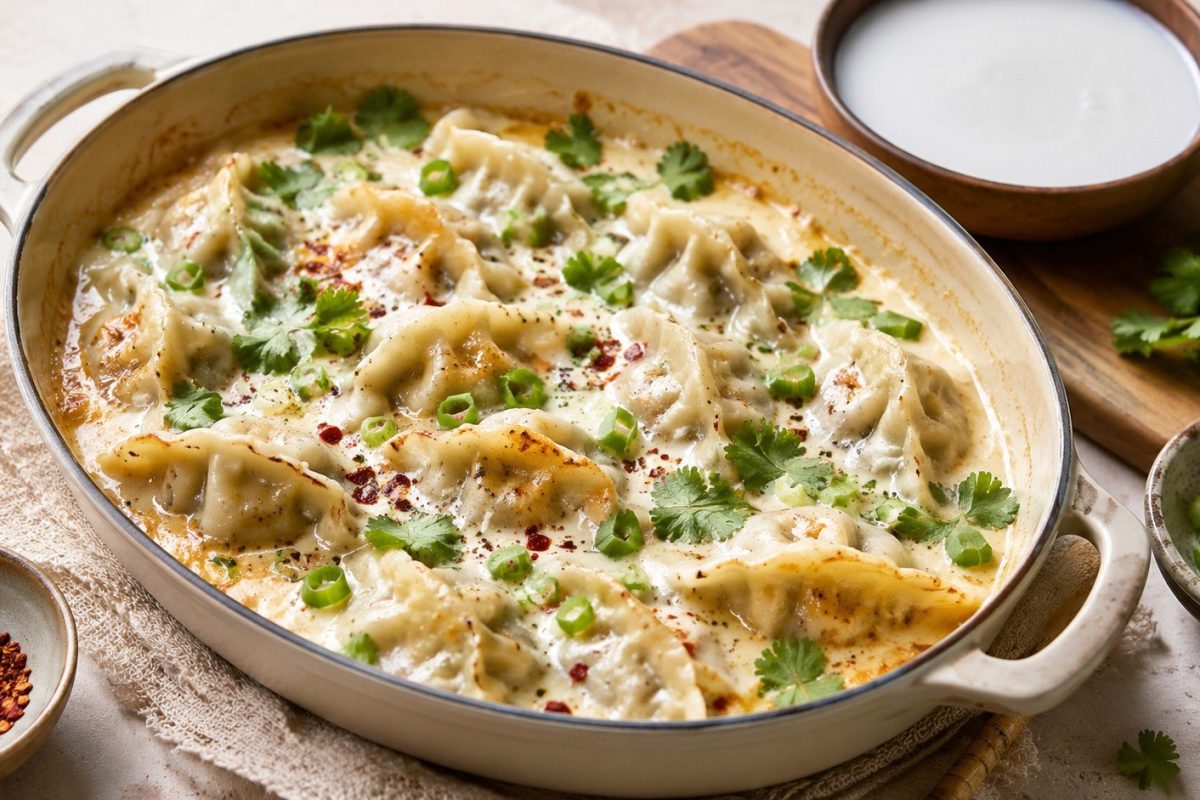
Dumpling Bake turns a bag of frozen dumplings into dinner without boiling, steaming, or pan-frying them first. The dumplings cook directly in a creamy coconut or dairy sauce inside one baking dish. Steam softens the wrappers while the exposed tops gain color and slightly firmer edges. It is less a traditional dumpling technique than a practical casserole built around freezer food, as noted by the customreceipt.com editors.
The method spread widely through recipe sites and social media during 2025 and 2026. Search results now commonly pair the dish with phrases such as “viral dumpling bake,” “one pan dumpling bake,” and “coconut milk dumpling bake.” Recent versions usually combine frozen gyoza or potstickers with coconut milk, curry paste, soy sauce, ginger, and vegetables. The important part is not the trend, however. The method works because the covered baking dish behaves partly like a steamer.
The sauce is doing 2 jobs at once: seasoning the dumplings and supplying the moisture needed to cook their frozen wrappers.
What makes frozen dumpling bake work
A successful frozen dumpling bake needs enough liquid to generate steam without turning dinner into soup. Frozen dumplings begin very cold, so dry baking often hardens their wrappers before the filling becomes thoroughly hot. A sauce containing coconut milk, cream, broth, or another liquid changes that heat transfer.
Covering the dish during most of the cooking time traps moisture. The dumplings soften while their filling heats gradually. Removing the cover near the end allows some water to evaporate. That short final stage concentrates the sauce and exposes the tops to dry oven heat.
The same distinction between moist and dry oven cooking appears in other baked dishes. A stuffed shells recipe with creamy cheese filling also depends on sauce and controlled baking to prevent exposed pasta from drying.
Several details decide whether the dish works:
- use dumplings directly from the freezer unless the package says otherwise;
- keep enough space for sauce to flow between individual pieces;
- cover the baking dish tightly during the first cooking stage;
- spoon some sauce over exposed wrappers before baking;
- uncover only near the end when the dumplings are already hot;
- check meat-filled dumplings carefully before serving.
The wrapper absorbs moisture throughout cooking, so a very thick sauce can become too concentrated. Extremely thin sauce creates the opposite problem and may remain watery. Vegetables also release liquid, particularly mushrooms, zucchini, and bok choy. Frozen vegetables introduce even more water. Sauce consistency therefore needs to match the additions inside the dish.
A smaller baking dish usually works better than an oversized tray. The liquid should surround the lower portion of the dumplings rather than spread into a shallow film. Crowding them slightly is less problematic than leaving large empty areas. Deep dishes may require additional cooking time because their centers warm more slowly. Oven performance also varies enough that time alone should not determine doneness.
Coconut sauce or creamy dairy sauce
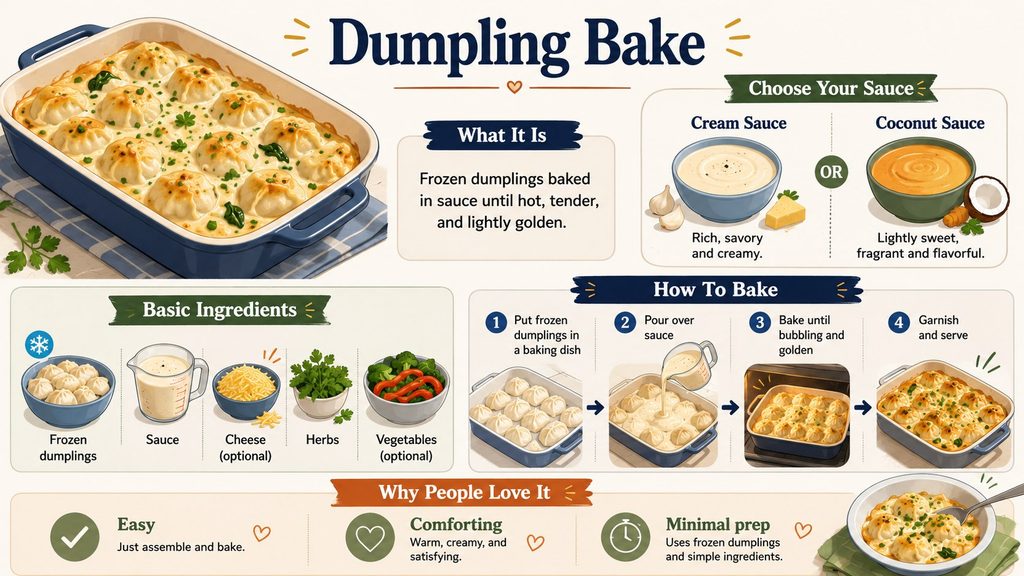
The coconut milk dumpling bake has become the dominant version because coconut milk tolerates oven heat well. It also pairs naturally with curry paste, ginger, garlic, sesame oil, soy sauce, and chili crisp. Dairy produces a different result, closer to a creamy casserole.
The comparison below shows how the main options behave during baking.
| Sauce base | Flavor | Useful additions | Main risk | Best dumplings |
|---|---|---|---|---|
| Full-fat coconut milk | Rich, mildly sweet | Curry, ginger, lime | Can become heavy | Pork, chicken, vegetable |
| Light coconut milk | Cleaner, thinner | Curry, soy, herbs | Sauce may stay loose | Chicken, shrimp, vegetable |
| Heavy cream + broth | Rich and savory | Garlic, Parmesan, herbs | Can become too fatty | Chicken, mushroom |
| Half-and-half + broth | Mild and creamy | Garlic, scallions, spinach | May split under harsh heat | Chicken, vegetable |
| Broth + peanut butter | Nutty, savory | Soy, chili, vinegar | Thickens quickly | Pork, chicken, vegetable |
Full-fat coconut milk is the easiest option when red or green curry paste is involved. Its fat gives the finished sauce enough body without flour. A dairy version benefits from broth because straight heavy cream can become excessively rich. Acidic ingredients should be added carefully to dairy sauces since strong acidity can encourage separation.
Coconut milk also gives cooks more room to add vegetables. Bok choy, snap peas, spinach, bell pepper, and thinly sliced mushrooms fit naturally. Dense vegetables such as carrots should be sliced thinly or partially cooked first. The dumplings cannot wait indefinitely while thick vegetables soften.
For a colder contrast beside the rich sauce, a BLT salad with bacon and tomatoes provides acidity and fresh texture. A heavy side is rarely necessary because dumplings already contribute starch and filling.
How to make a one pan dumpling bake
A practical one pan dumpling bake for 3 to 4 servings can start with roughly 16 to 20 frozen dumplings. Exact quantities depend on their size. Mini wontons require less liquid and often cook faster than large potstickers.
For a coconut-curry version, prepare:
- 16–20 frozen dumplings;
- 13.5 oz full-fat coconut milk;
- 1–2 tbsp red curry paste;
- 1 tbsp soy sauce;
- 1 tsp rice vinegar;
- 1 tsp grated ginger;
- 2 minced garlic cloves;
- 1–2 cups quick-cooking vegetables;
- scallions, cilantro, sesame seeds, or chili crisp for serving.
This formula is deliberately adjustable. Curry pastes differ dramatically in salt and heat, so starting with less is safer. Soy sauce adds both salt and fermented flavor. Rice vinegar cuts through coconut fat, but too much can dominate the sauce. Chili crisp works better as a finishing ingredient because its fried aromatics retain more texture.
The technique itself should remain simple:
- Heat the oven to about 375°F.
- Whisk coconut milk, curry paste, soy sauce, vinegar, ginger, and garlic in the baking dish.
- Add vegetables that can cook within roughly 30 minutes.
- Arrange frozen dumplings in a single layer.
- Spoon some sauce across the exposed wrappers.
- Cover tightly and bake for about 20–25 minutes.
- Uncover and continue baking until thoroughly hot and lightly browned.
Large dumplings may require more time than small gyoza. A crowded ceramic dish also heats differently from a shallow metal pan. The sauce should bubble around the edges before the final uncovered stage. If it thickens too quickly, a small amount of broth can restore its consistency. If it remains thin, several uncovered minutes encourage evaporation.
The last stage should not become an attempt to make every dumpling deeply crisp. Dumplings sitting in sauce cannot develop the same crust as pan-fried potstickers. Only their exposed surfaces dry significantly. That contrast between tender bottoms and firmer tops is part of the dish.
The useful benchmark is not maximum browning. It is a hot filling, tender wrapper, concentrated sauce, and enough texture on top.
Food safety matters more than the timer
Frozen dumplings may contain raw pork, chicken, beef, seafood, or combinations of those ingredients. Their package instructions therefore matter. A browned wrapper does not prove that the center has reached a safe temperature.
The USDA Food Safety and Inspection Service gives a clear benchmark for combination dishes.
“Casseroles and other combination dishes must be cooked to 165 °F as measured with a food thermometer.”
USDA Food Safety and Inspection Service, official guidance on doneness and combination dishes.
That 165°F benchmark is especially practical for a dumpling casserole containing poultry or mixed fillings. Insert an instant-read thermometer into a large dumpling near the center of the dish. Check more than 1 location when dumplings differ noticeably in size.
For cooks familiar with oven temperature control, the same principle appears in oven-baked BBQ meatballs. Surface color can develop before the center has finished heating. A thermometer removes that uncertainty.
USDA guidance also addresses cooked leftovers:
“Within 2 hours of cooking food… leftovers must be refrigerated.”
U.S. Department of Agriculture Food Safety and Inspection Service, Leftovers and Food Safety guidance.
Refrigerating dumpling bake in a shallow covered container helps it cool faster. The wrappers continue absorbing sauce during storage, so leftovers become softer. USDA recommends using most cooked leftovers within 3 to 4 days and reheating them to 165°F. Microwave reheating is convenient, but an oven usually preserves more surface texture.
How to improve texture and flavor
The most common failure is a sauce that overwhelms the dumplings. Coconut milk, curry paste, soy sauce, sesame oil, peanut butter, and chili crisp are all assertive ingredients. Combining large amounts of every one produces weight rather than complexity.
A better approach uses contrast. Rich coconut milk needs acidity. Salty soy sauce benefits from unsweetened vegetables. Chili tastes sharper when fresh herbs or scallions appear at the end.
Useful adjustments include:
- add lime juice after baking instead of before;
- use low-sodium soy sauce when the dumplings are already well seasoned;
- add spinach during the final cooking stage;
- place chili crisp on individual servings;
- thin an overly rich coconut sauce with broth;
- add peanut butter sparingly because it thickens the liquid rapidly.
Aromatic toppings should remain outside the oven when possible. Scallions lose their clean bite during a long bake. Cilantro darkens. Toasted sesame seeds soften in sauce. Adding them at serving preserves the contrast that a soft casserole otherwise lacks.
For a dairy-based baked dumplings in creamy sauce, garlic, black pepper, scallions, mushrooms, spinach, and Parmesan are more natural than curry paste. Broth prevents the cream from becoming cloying. Parmesan should stay restrained because frozen dumpling fillings often contain significant sodium already.
One detail is easy to miss. Dumplings with delicate wrappers can tear when repeatedly stirred. Sauce should therefore be mixed before the frozen pieces enter the dish. Once arranged, they need little handling until serving.
The freezer shortcut works because preparation is reduced, not because basic cooking rules disappear.
Why dumpling bake became an easy weeknight formula
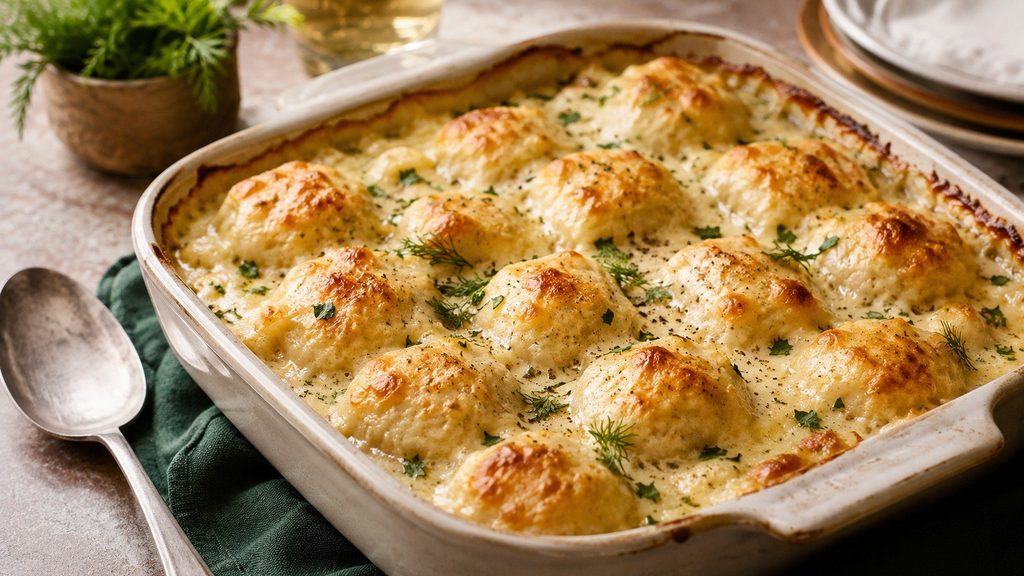
Search results during 2026 show several recurring variations of the same idea: “viral dumpling bake,” “easy dumpling bake,” “frozen dumpling casserole,” and “30-minute dumpling bake.” The attraction is obvious. Most preparation happens inside the same dish used for baking.
It also turns frozen dumplings from a side or snack into a complete dinner. Vegetables and sauce fill the gaps that normally require separate cooking. Rice can be added at serving, but it is optional rather than structural.
The format is adaptable without becoming limitless. Coconut curry works because its ingredients belong together. Cream, garlic, mushrooms, and herbs form another coherent direction. Mixing curry paste, Parmesan, peanut butter, teriyaki sauce, and cream simply because they are available usually creates confused seasoning.
A good version remains recognizable as dumplings first. The sauce should support their filling rather than hide it.
FAQ about Dumpling Bake
Can frozen dumplings go directly into the oven?
Yes, when they bake with enough liquid and steam. Keep them frozen unless their package gives different instructions.
Do dumplings need to be thawed first?
Usually not. Thawing can soften wrappers prematurely and make delicate dumplings harder to handle.
What temperature works for dumpling bake?
About 375°F is a practical starting point. Package directions and dumpling size should still guide the final cooking time.
How long does dumpling bake take?
Many versions need roughly 25–35 minutes. Large dumplings, dense fillings, and deep dishes can take longer.
Can heavy cream replace coconut milk?
Yes, but dilute very rich cream with broth. Dairy versions also pair better with garlic, mushrooms, spinach, and herbs.
How should leftover dumpling bake be reheated?
Reheat it thoroughly to 165°F under USDA guidance. Add a spoonful of broth if the sauce has thickened excessively.
Earlier we wrote about Hot Honey Cottage Cheese Sweet Potato Beef Bowl: How to Make the Viral High-Protein Dinner