 Frank Rondel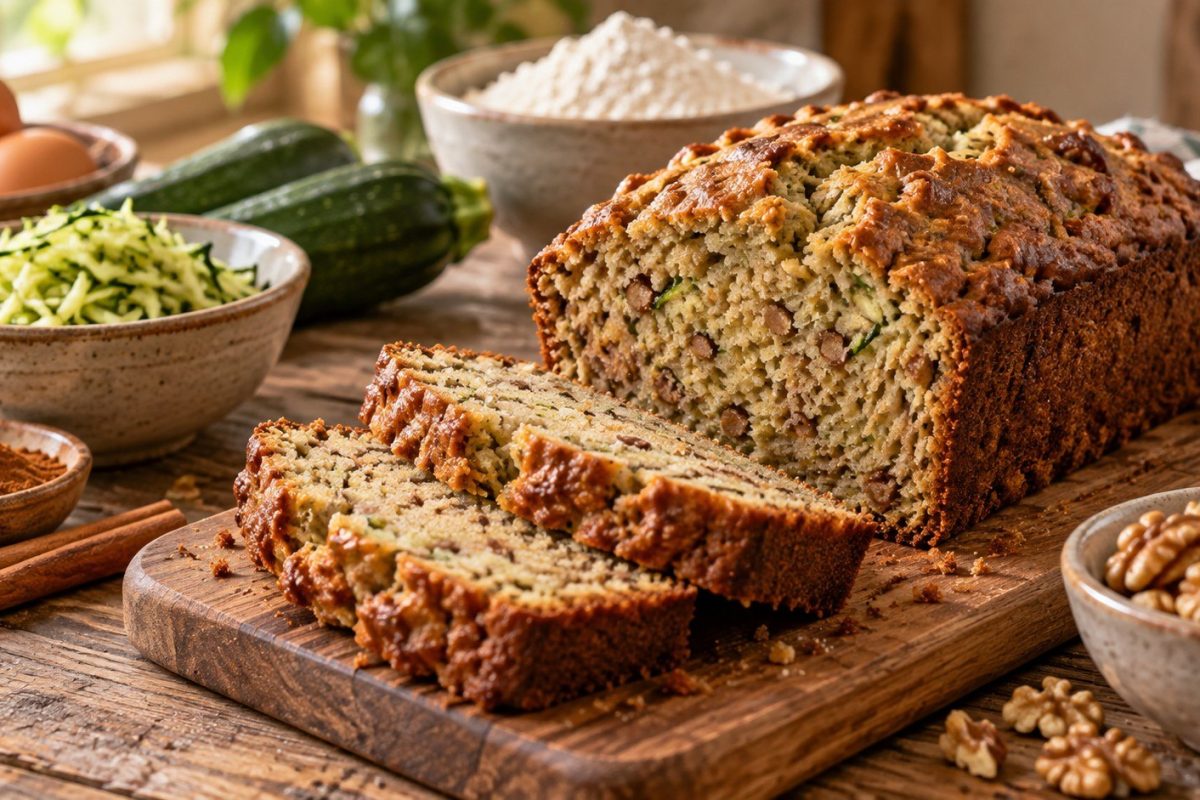
Zucchini bread turns an ordinary summer squash into a soft, lightly spiced loaf with an unusually moist crumb. It requires no yeast, proofing, or specialist equipment. The decisive details are zucchini moisture, gentle mixing, and enough baking time through the center, as customreceipt.com notes.
The loaf belongs to the American quick-bread family. Baking soda and baking powder provide lift instead of yeast. Zucchini supplies water without contributing a strong vegetable flavor. Cinnamon, vanilla, brown sugar, and toasted nuts can therefore remain prominent.
The best zucchini bread should taste like a deliberate cake-bread hybrid, not sweetened vegetables hidden inside batter.
Why zucchini works so well in sweet bread
Zucchini contains enough moisture to soften a batter during baking. Its flavor remains mild after shredding. This combination explains why it behaves differently from carrots or pumpkin.
King Arthur Baking compares zucchini with ingredients such as bananas and applesauce in baking. Its bakers say zucchini contributes moisture and volume to cakes, muffins, and quick breads. Their guide to baking with zucchini also recommends leaving the skin on in most recipes.
That green skin becomes almost unnoticeable after baking. Peeling is mainly useful when a completely uniform crumb is preferred.
“Zucchini recipes are written to accommodate their water content.”
Posie Brien, former employee-owner at King Arthur Baking, wrote this in the bakery’s zucchini baking guide. The comment addresses one recurring question: whether shredded zucchini should always be squeezed dry.
Different recipes answer that question differently. Some formulas depend on zucchini’s full moisture. Others intentionally remove excess liquid because their flour and fat ratios are different.
That distinction matters more than any universal rule.
For another preparation where texture depends on moisture control, the site’s chia seed pudding guide uses the same practical approach. Small changes in liquid handling can change the finished texture completely.
Zucchini bread ingredients and the useful ratios
A dependable zucchini bread recipe needs enough flour to support the shredded vegetable. It also needs enough fat to remain tender after cooling.
This version makes 1 standard loaf.
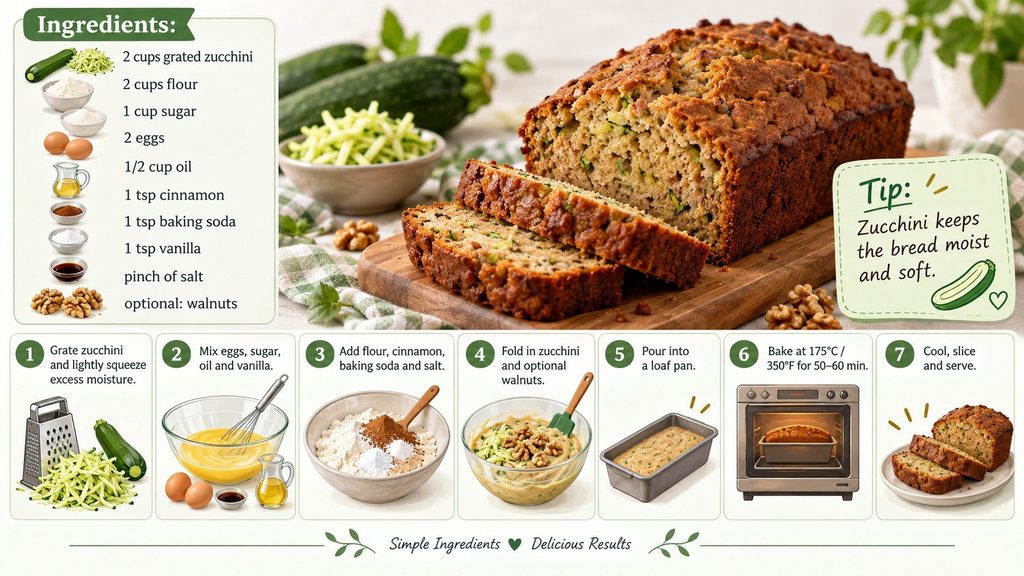
- 200 g all-purpose flour
- 250 g coarsely shredded zucchini
- 150 g light brown sugar
- 2 large eggs
- 100 ml neutral vegetable oil
- 1 teaspoon vanilla extract
- 1 teaspoon ground cinnamon
- 1 teaspoon baking soda
- 1/2 teaspoon baking powder
- 1/2 teaspoon fine salt
- 70 g chopped walnuts or pecans, optional
- 70 g chocolate chips, optional
These quantities produce a moderately sweet loaf rather than a dessert cake. Brown sugar adds deeper flavor and retains moisture well. Neutral oil keeps the crumb softer after refrigeration than melted butter usually does.
The nuts and chocolate remain optional. Using both makes the loaf heavier, so additional baking time may be necessary. Cinnamon can also be replaced with mixed spice, nutmeg, or cardamom.
King Arthur’s simple version uses 2 cups of grated zucchini with 210 g flour. Its published baking time ranges from 55 to 65 minutes at 350°F.
The broader CustomReceipt food coverage also includes practical cooking guides built around measurable temperatures, ratios, and preparation times.
Ingredient choices that change the loaf
The ingredients appear forgiving, but several substitutions change more than flavor. Flour controls structure, while oil and zucchini govern moisture.
| Ingredient choice | Effect on texture | Practical adjustment |
|---|---|---|
| All-purpose flour | Soft, balanced crumb | Use as the standard |
| Whole-wheat flour | Denser, nuttier loaf | Add moisture cautiously |
| Vegetable oil | Soft crumb after cooling | Best neutral option |
| Melted butter | Firmer, richer crumb | Cool before mixing |
| Brown sugar | Moist, caramel-like flavor | Good default choice |
| White sugar | Cleaner sweetness | Slightly drier result |
| Walnuts | Crunch and bitterness | Toast before adding |
| Chocolate chips | Sweeter, heavier crumb | Reduce other additions |
A loaf made entirely with whole-wheat flour will not behave exactly like the standard version. Whole grain absorbs liquid differently. The finished bread can become dense when flour quantities are increased casually.
King Arthur publishes a whole-wheat version using 226 g flour and 242 to 300 g zucchini. That recipe still includes oil, eggs, and brown sugar to support tenderness.
Oil is particularly useful when the loaf will be stored overnight. Butter becomes firm when chilled, while most vegetable oils remain liquid. The difference becomes noticeable in a cold slice.
Brown sugar also contributes molasses flavor. White sugar produces a lighter profile that allows cinnamon and vanilla to dominate.
For planning ingredient expenses or comparing recipes, a recipe-focused food guide shows another useful approach to pantry-based cooking.
Zucchini should disappear into the structure of the loaf while its moisture remains unmistakable.
How to make zucchini bread step by step
The how to make zucchini bread question has a simple answer until mixing begins. Most failures happen because the batter is overworked or the loaf leaves the oven too early.
Prepare the pan before combining wet and dry ingredients. Quick-bread batter should not sit unnecessarily after the leavening agents become wet.
- Heat the oven to 350°F, or about 175°C.
- Grease a 9-by-5-inch loaf pan and line the long sides with parchment.
- Wash the zucchini and leave the skin intact.
- Shred it on the coarse side of a box grater.
- Whisk eggs, brown sugar, oil, and vanilla until smooth.
- Combine flour, cinnamon, baking soda, baking powder, and salt separately.
- Fold the dry mixture into the wet ingredients.
- Add zucchini when only small flour streaks remain.
- Fold in nuts or chocolate chips without prolonged stirring.
- Transfer the batter into the pan and level the top.
- Bake until the center tests clean, usually around 55 to 65 minutes.
- Cool for 10 minutes before removing the loaf from the pan.
Do not beat the batter after adding flour. Excessive mixing encourages gluten development and creates a tougher crumb. Folding with a flexible spatula gives better control.
The center deserves more attention than the crust. A dark top can appear finished while wet batter remains underneath. Insert a thin tester into the deepest central section.
King Arthur’s tested simple recipe recommends cooling the loaf for 10 minutes before moving it onto a rack. It also advises waiting until complete cooling before slicing.
A hot loaf is still structurally fragile. Cutting immediately can compress the middle and create the impression that the bread is underbaked.
Should zucchini be squeezed before baking?
There is no useful one-rule answer because recipes contain different flour ratios. A formula designed around unsqueezed zucchini needs that water.
King Arthur’s general zucchini guide explicitly warns that removing too much liquid can produce dry baked goods. Its separate simple zucchini bread recipe uses a gentler approach. There, bakers lightly pat away excess moisture rather than aggressively wringing the vegetable.
A sensible method for this moist zucchini bread recipe is therefore restrained.
- Leave normally moist zucchini unchanged.
- Blot obviously wet shreds with a clean towel.
- Do not twist them until completely dry.
- Remove watery seed centers from unusually large zucchini.
- Measure the zucchini after shredding.
Very large garden zucchini often contain more developed seeds and a wetter center. That portion can be removed before grating. Small and medium zucchini usually require less preparation.
Freshness also matters. King Arthur recommends firm zucchini with a relatively shiny exterior. Oversized, older specimens can become less firm internally.
USDA FoodData Central classifies green summer squash with skin as a distinct raw vegetable entry. The database received updated nutrient information for zucchini in recent releases. USDA FoodData Central provides the underlying food-composition database.
The vegetable does not turn a sweet loaf into a low-sugar food. Flour, sugar, oil, nuts, and chocolate still determine much of its nutritional profile.
Why zucchini bread becomes gummy, dry, or flat
A successful easy zucchini bread recipe is mostly an exercise in controlling water and structure. The common failures have recognizable causes.
| Problem | Likely cause | Better approach |
|---|---|---|
| Gummy center | Underbaking | Test the deepest center |
| Dry crumb | Too little zucchini moisture | Avoid excessive squeezing |
| Tough bread | Batter overmixed | Fold only until combined |
| Flat top | Oversized pan | Match the recipe to the pan |
| Burned edges | Dark pan or excessive heat | Check oven and pan type |
| Sunken center | Weak structure or raw middle | Bake fully before cooling |
Pan dimensions can be deceptive. Two pans described as “loaf pans” may hold different volumes. King Arthur warns that quick-bread and yeast-bread pans are not always interchangeable.
Their baking-pan guide notes that many quick breads use pans around 9 by 5 inches. A pan that is too large creates a flatter loaf. A smaller pan can encourage overflow.
“Using the proper size pan will give you a nicely domed loaf.”
This guidance comes from King Arthur Baking’s published pan guide. It concerns loaf volume and the relationship between batter quantity and pan dimensions.
Oven temperature creates another variable. Home ovens can run above or below their displayed temperature. An inexpensive oven thermometer can identify a persistent discrepancy.
A dark crust does not prove that the middle has finished baking. Cover the top loosely when browning develops too quickly.
Variations worth making
Once the base ratio works, healthy zucchini bread searches often lead toward lower sugar or whole-grain substitutions. Those changes are possible, but altering several structural ingredients simultaneously becomes risky.
Useful variations include:
- add 70 g dark chocolate chips for a sweeter loaf;
- replace walnuts with toasted pecans;
- add finely grated orange zest;
- use 1/4 teaspoon nutmeg with the cinnamon;
- replace part of the flour with whole-wheat flour;
- add raisins or dried cranberries;
- bake the batter as muffins with adjusted timing.
After changing one major ingredient, keep the other ratios stable. Replacing sugar, flour, eggs, and oil together can produce an entirely different batter. A lower-sugar loaf may also brown differently.
Chocolate is especially forgiving because zucchini’s flavor is subtle. King Arthur’s double-chocolate recipe uses cocoa, chocolate chips, and 2 cups of zucchini. The bakery describes zucchini as a source of moisture and tenderness in that loaf.
Muffins are another practical route. King Arthur notes that roughly 4 cups of quick-bread batter can often translate into about 12 muffins. Exact yield still depends on the original recipe and cup size.
For a savory contrast after a sweet bake, the site’s steak with chimichurri guide explains another technique-driven recipe.
FAQ about zucchini bread
Do you peel zucchini for zucchini bread?
Usually not. The skin softens during baking and adds little noticeable texture. Peeling is mainly an aesthetic choice.
Should zucchini be squeezed before making bread?
Only when the recipe requires it or the shreds are unusually wet. Excessive squeezing can create a dry loaf.
Why is my zucchini bread wet in the middle?
The center probably needed additional baking time. Pan size, oven temperature, and unusually wet zucchini can also contribute.
How long does zucchini bread bake?
A standard loaf commonly needs about 55 to 65 minutes at 350°F. Always test the center instead of relying only on time.
Can zucchini bread be frozen?
Yes. Cool it completely before wrapping. King Arthur recommends freezing its simple zucchini bread for longer storage beyond several days.
Can zucchini bread be made with chocolate?
Yes. Cocoa and chocolate chips pair well with zucchini because the vegetable has a mild flavor. Chocolate versions usually remain particularly moist.
Earlier we wrote about How to Make Protein Chia Pudding With 28–35 g Protein per Serving