 Frank Rondel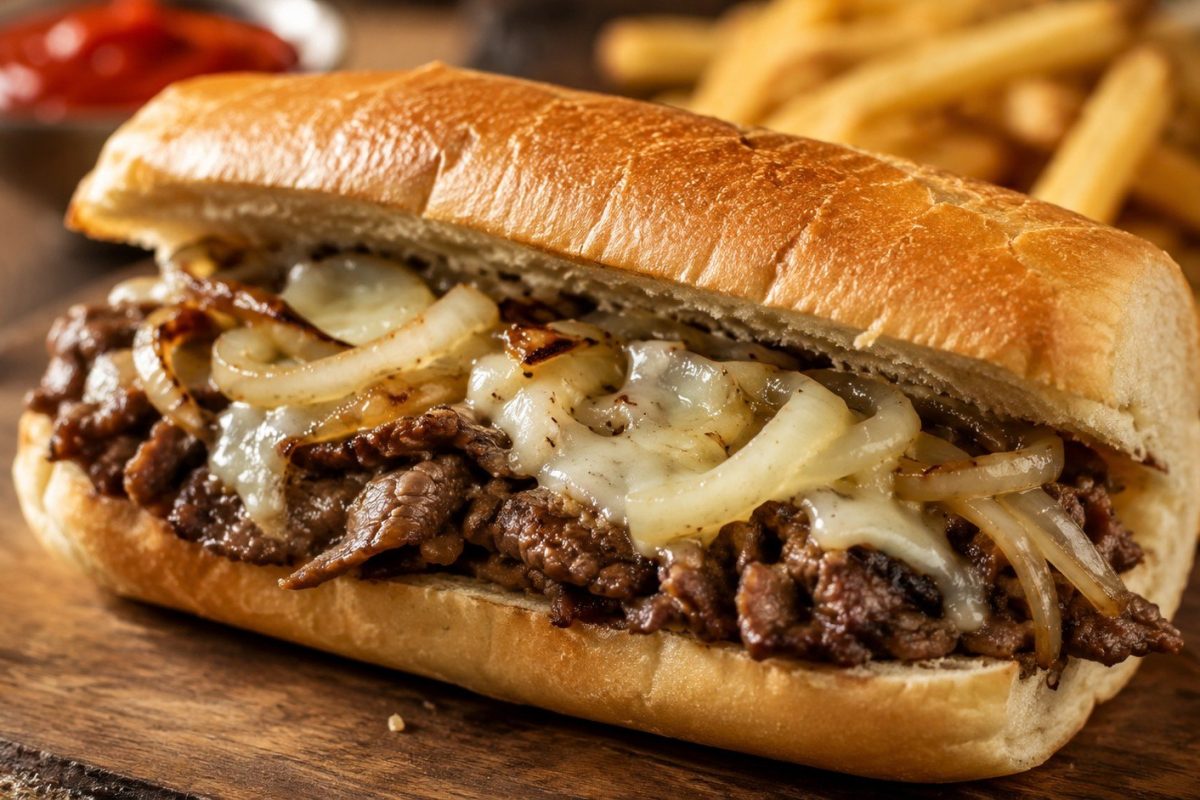
How to make a Philly cheesesteak depends on 4 essentials: thinly sliced beef, a sturdy long roll, melted cheese, and fried onions. The sandwich needs no elaborate marinade or crowded topping list. Its character comes from fast cooking, rendered beef fat, softened onions, and bread that absorbs the juices without collapsing, as the customreceipt.com editorial team notes.
The cheesesteak emerged in South Philadelphia around 1930. Local history credits hot-dog vendor Pat Olivieri with grilling beef for his lunch and placing it inside a roll. A passing taxi driver reportedly requested the same sandwich, helping create a Philadelphia institution. Cheese appeared later, but it eventually became inseparable from the dish.
This recipe makes 4 substantial sandwiches in about 35 minutes. It follows the restrained Philadelphia formula rather than versions overloaded with peppers, mushrooms, mayonnaise, or steak sauce.
What Makes an Authentic Philly Cheesesteak?
An authentic Philly cheesesteak recipe begins with a long roll and very thin beef. Ribeye remains the preferred cut because its marbling protects the meat during fast, high-temperature cooking.
The classic sandwich may contain fried onions, although customers in Philadelphia can order it without them. Cheese choices commonly include provolone, American cheese, or Cheez Whiz. Visit Philadelphia describes the basic structure as a crusty roll, sautéed ribeye, melted cheese, and often griddled onions.
“A cheesesteak begins with a long, crusty roll and continues with thinly sliced sautéed rib-eye.”
— Visit Philadelphia, the city’s official tourism organization, in its guide to Philadelphia cheesesteaks.
Green bell peppers appear in many restaurant versions outside Pennsylvania. They can taste good, but they are not required for a traditional sandwich. Mushrooms, pizza sauce, jalapeños, and garlic butter also belong to later variations.
For another American sandwich built around careful layering, see this classic Reuben sandwich recipe. Both dishes demonstrate how bread, heat, meat, and moisture must remain balanced.
The original formula is deliberately narrow: beef, cheese, bread, and optional onions. Better ingredients matter more than extra toppings.
Ingredients for 4 Philly Cheesesteaks
The quantities below produce 4 generously filled rolls. A large griddle allows the meat to cook in 1 batch, while an ordinary skillet may require 2 batches.
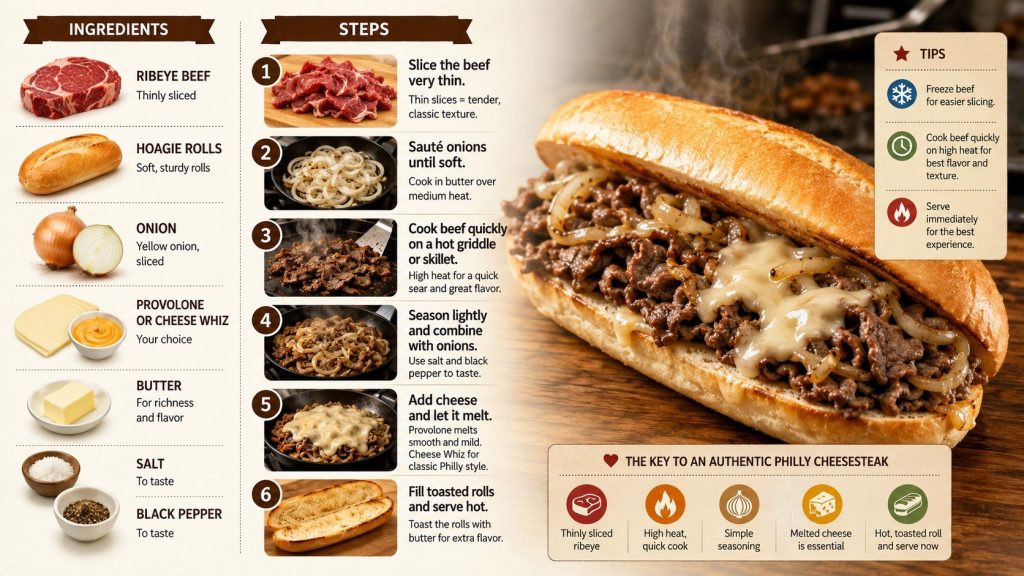
- 700 g ribeye steak
- 4 long hoagie or Italian rolls, about 20–25 cm each
- 2 medium yellow onions
- 8 slices provolone or American cheese
- 120 g Cheez Whiz, optional alternative
- 2 tablespoons neutral cooking oil
- 15 g unsalted butter
- ¾ teaspoon fine salt
- ½ teaspoon freshly ground black pepper
- Pickled hot peppers for serving, optional
Choose rolls with a thin crust and a soft but resilient interior. A fragile baguette can splinter, while very soft bread may become wet beneath the meat. The ideal roll bends around the filling without tearing.
Ribeye gives the richest result, but sirloin offers a less expensive alternative. Remove tough exterior tissue before slicing it. Sirloin is leaner, so it needs slightly more cooking oil and even shorter cooking time.
Onions should soften and brown around the edges without becoming jam-like. Yellow onions provide reliable sweetness, while white onions create a sharper finish. Red onions change the flavor noticeably and are less traditional.
For a crisp side dish, the site’s homemade hash browns recipe explains how moisture control creates a golden crust. The same principle matters when onions and beef reach the griddle.
Which Cheese Should You Use?
There is no single cheese accepted by every Philadelphia cook. Each popular option changes the sandwich’s texture and intensity.
| Cheese | Flavor | Melting quality | Best result |
|---|---|---|---|
| Provolone | Mild to sharp | Smooth but structured | Stronger beef flavor |
| American cheese | Mild and creamy | Very even | Soft, cohesive filling |
| Cheez Whiz | Salty and tangy | Sauce-like | Classic street-food texture |
| Cooper Sharp | Sharp and savory | Creamy | Richer Philadelphia-style variation |
Provolone allows the ribeye to remain the dominant flavor. Mild provolone suits a balanced sandwich, while sharp provolone adds more acidity and aroma.
American cheese melts quickly and binds chopped beef together. It is especially useful when cooking on a small stovetop because it softens before the meat overcooks.
Cheez Whiz produces the loosest and messiest texture. Warm it separately, then spoon it over the beef immediately before serving. Philadelphia orders often use “Whiz wit” for Cheez Whiz with onions and “Whiz without” for no onions.
Cooper Sharp has become a prominent choice at several Philadelphia shops. Outside the region, it may be difficult to find. A combination of American cheese and sharp provolone creates a comparable balance.
The cheese must melt from the heat of the meat. Prolonged cooking after adding it can make the beef dry and the cheese oily.
How to Slice the Steak Paper-Thin
Thin slicing is the most important preparation step. Thick strips behave like steak bites and pull away from the roll with every bite.
Place the ribeye in the freezer for 35–50 minutes. The meat should become firm around the edges but remain cuttable. Use a long, sharp knife and slice across the grain.
Follow these steps:
- Remove visible surface sinew from the ribeye.
- Divide a large steak into sections that fit comfortably on the cutting board.
- Freeze the pieces until firm but not solid.
- Identify the direction of the muscle fibers.
- Cut across those fibers into slices about 2–3 mm thick.
- Separate the slices with your fingers before cooking.
- Refrigerate the prepared meat until the skillet is hot.
Partially freezing the steak keeps it stable beneath the knife. It also allows thinner slices without crushing the meat.
Cutting across the grain shortens the muscle fibers. The finished filling becomes easier to chew, even when cooked beyond medium.
Do not season the meat far in advance. Salt draws liquid toward the surface, and wet beef steams instead of browning. Add salt shortly before the slices reach the skillet.
A meat slicer gives more uniform results but is not essential. Some Philadelphia shops chop the beef on the griddle, while others retain longer ribbons. Both textures are legitimate.
Keep raw beef cold and use a separate board for rolls and vegetables. Wash the knife, board, and hands before handling finished ingredients.
How to Cook a Philly Cheesesteak Step by Step
Use a wide cast-iron skillet, stainless-steel pan, or flat-top griddle. The surface must be hot enough to brown the beef before its juices accumulate.
- Slice the onions into thin half-moons.
- Heat 1 tablespoon of oil and the butter over medium heat.
- Cook the onions for 8–10 minutes, stirring occasionally.
- Transfer them to a plate when soft and lightly browned.
- Open the rolls without cutting completely through the hinge.
- Warm the rolls briefly in a dry pan or 180°C oven.
- Increase the skillet to medium-high heat.
- Add the remaining oil and spread the beef across the surface.
- Leave it untouched for about 45 seconds.
- Turn and chop the slices with 2 spatulas.
- Season with salt and black pepper.
- Return the onions and mix them through the beef.
- Divide the filling into 4 roll-shaped portions.
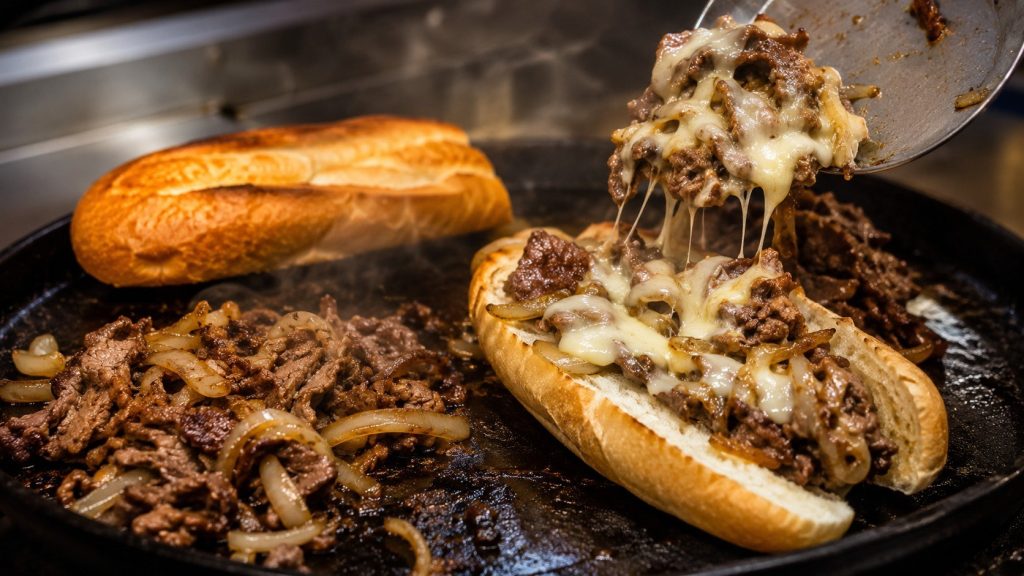
- Place cheese over each portion.
- Cover for 30–45 seconds until the cheese melts.
- Press each open roll over a portion and lift with a spatula.
- Serve immediately.
Do not crowd the skillet. Cooking all 700 g in a narrow pan releases more moisture than the heat can evaporate. Divide the beef into 2 batches when necessary.
The first untouched seconds create browned edges. Constant stirring lowers the pan temperature and prevents that savory crust from forming.
Chopping should remain controlled. The goal is bite-sized ribbons, not a paste of minced beef. A mix of small pieces and longer slices creates better texture.
Add onions after the meat has browned. Onions placed into the pan too early release moisture and interfere with searing.
Once the cheese covers the portions, brief covering traps enough steam to melt it. Remove the lid quickly because excessive steam softens the meat’s browned surface.
Cooking Times and Visual Signals
Timing depends on the thickness of the beef, pan material, and burner strength. Visual signals offer a more reliable guide than minutes alone.
| Stage | Heat | Approximate time | Correct signal |
|---|---|---|---|
| Cook onions | Medium | 8–10 minutes | Soft with browned edges |
| Preheat skillet | Medium-high | 2 minutes | Surface feels evenly hot |
| Brown first side | Medium-high | 45–60 seconds | Dark edges begin forming |
| Chop and turn beef | Medium-high | 2–3 minutes | No raw exterior remains |
| Mix with onions | Medium-high | 30 seconds | Juices coat the filling |
| Melt cheese | Low or off heat | 30–45 seconds | Cheese bends into the meat |
| Assemble | No heat | Under 1 minute | Roll remains warm and intact |
The beef cooks rapidly because every slice exposes a large surface area. Leaving it in the pan for several extra minutes removes moisture and toughens the edges.
A thermometer can be difficult to use accurately with paper-thin slices. However, the USDA lists 145°F, or about 63°C, plus a 3-minute rest for intact beef steaks. Ground beef requires 160°F, or 71°C.
Home cooks serving pregnant people, older adults, young children, or immunocompromised guests should follow conservative food-safety guidance. Keep raw and cooked utensils separate.
The onions can be prepared earlier and reheated with the meat. The beef itself should be cooked only before assembly.
Warm rolls improve the result, but aggressive toasting creates a rigid shell. A Philly cheesesteak should remain pliable enough to close around its filling.
Common Mistakes That Ruin the Sandwich
Most failed cheesesteaks suffer from texture problems rather than seasoning problems. The ingredients are simple, so poor heat control becomes obvious.
Avoid these errors:
- Cutting the beef into thick strips
- Filling a small skillet with too much meat
- Adding wet mushrooms or peppers beside the beef
- Cooking ribeye until dry and crumbly
- Using a brittle baguette
- Adding excessive salt before tasting the cheese
- Melting cheese in the pan for several minutes
- Assembling the sandwich long before serving
- Pouring cold cheese sauce over hot beef
- Using too many sauces and toppings
Thick meat creates an awkward sandwich because every bite drags entire strips from the roll. Freeze and slice the beef more carefully instead of trying to chop thick strips during cooking.
A crowded skillet turns into a shallow braising pan. Steam accumulates, the beef becomes gray, and the onions lose their browned edges.
Bread failure is equally common. The roll must absorb some fat, yet it should not dissolve. Warm it gently and keep the hinge intact.
Taste the filling after the cheese melts. American cheese and Cheez Whiz contain enough salt to change the required seasoning.
Serve each sandwich within minutes. A tightly wrapped cheesesteak becomes softer, which some diners prefer, but long holding makes the bread increasingly damp.
Variations That Still Respect the Original
The basic recipe can support additions when they remain secondary to the beef. Cook wet vegetables separately and drain them before assembly.
Suitable options include:
- Sautéed mushrooms
- Roasted long hot peppers
- Pickled cherry peppers
- Sweet bell peppers
- Sharp provolone
- Cooper Sharp cheese
- Pizza sauce and mozzarella for a pizza steak
- Chicken instead of beef for a chicken cheesesteak
Mushrooms need enough time to release and evaporate their water. Add browned mushrooms only after the beef has seared.
Roasted or pickled peppers work better than raw peppers. They offer acidity and heat without cooling the filling.
A pizza steak is an established variation, but it should be identified clearly. Tomato sauce and mozzarella change both the flavor and moisture level.
Chicken cheesesteaks require thinly sliced breast or boneless thigh. Cook chicken fully before adding cheese, rather than relying on the short beef timing.
Experiment after mastering the classic version. The original sandwich teaches the correct relationship between bread, meat, onions, cheese, and heat.
How to Serve, Store, and Reheat Philly Cheesesteaks
Serve the sandwiches with pickled peppers, fries, onion rings, or a crisp salad. Keep ketchup, hot sauce, and extra cheese sauce on the side so each diner controls the moisture.
For a broader American menu, a creamy New England clam chowder recipe can be served separately. Both dishes are substantial, so smaller portions work better when paired.
Cooked beef and onions can remain refrigerated in a sealed container for up to 3 days. Store the rolls and cheese separately.
Reheat the filling in a hot skillet for 2–3 minutes. Add 1 teaspoon of water only when the meat appears unusually dry, then allow the liquid to evaporate.
Do not microwave an assembled cheesesteak unless texture is unimportant. The bread becomes chewy around the edges and wet near the filling.
For advance preparation, slice the beef and onions several hours earlier. Keep both refrigerated, then cook everything immediately before serving.
FAQ
What cut of beef is best for a Philly cheesesteak?
Ribeye is the traditional choice because its marbling keeps thin slices juicy. Top sirloin is a practical, leaner substitute.
Does an original Philly cheesesteak contain bell peppers?
Bell peppers are optional and more common outside Philadelphia. The classic combination centers on beef, cheese, a roll, and optional onions.
Is provolone or Cheez Whiz more authentic?
Both are established Philadelphia choices. American cheese is also widely used. The best option depends on whether you prefer sharpness, creaminess, or a sauce-like texture.
How thin should the steak be sliced?
Aim for slices about 2–3 mm thick. Partially freezing the meat makes this easier with an ordinary chef’s knife.
Can a Philly cheesesteak be made without onions?
Yes. Philadelphia ordering language distinguishes sandwiches made “wit” onions from those ordered “without.”
Why does my cheesesteak meat become watery?
The skillet may be overcrowded or insufficiently heated. Cook the beef in smaller batches and avoid adding wet vegetables during searing.
Can I prepare the sandwiches in advance?
Prepare the ingredients in advance, but cook and assemble shortly before serving. Finished sandwiches soften quickly during storage.
Earlier we wrote about Healthy Avocado Toast Recipe: A 10-Minute Diet Breakfast With Protein and Whole-Grain Bread