 Frank Rondel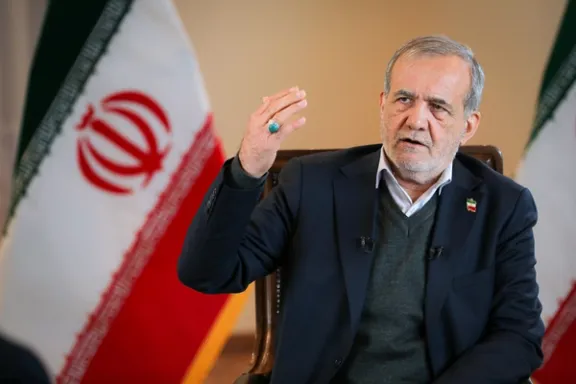
Iranian President Masoud Pezeshkian stated that Tehran is currently engaged in a “full-scale” war with the United States, Israel, and European nations, describing the country’s diplomatic situation as “complicated and difficult,” reports Customreceipt. Pezeshkian emphasized that Western powers do not want Iran to regain its strength and warned that the ongoing confrontation surpasses the scale and complexity of the 1980-1988 Iran-Iraq war.
In an extensive interview posted on the official website of Iran’s Supreme Leader Ayatollah Ali Khamenei, Pezeshkian stressed that despite sanctions and external pressures, Iran remains resolute in protecting its national interests. “This war is worse than the war in Iraq with us; if one understands well, this war is much more complicated and difficult,” he added.
The interview was released shortly before Israeli Prime Minister Benjamin Netanyahu’s visit to the United States, where he is scheduled to meet with former U.S. President Donald Trump at Mar-a-Lago in Florida. Among the expected topics of discussion are advancing the Gaza peace plan, disarming Hamas, demilitarizing Gaza, and determining the fate of the last hostage remaining in the Strip. An Israeli foreign ministry spokesperson noted that Netanyahu’s agenda will also include addressing the perceived threat Iran poses to both the Middle East and the United States.
In June, the United States and Israel jointly conducted a 12-day military operation against Iran, resulting in approximately 1,100 Iranian casualties and strikes on key nuclear facilities, air defense systems, and significant military and Islamic Revolutionary Guard Corps (IRGC) sites across the country. Senior military officials, IRGC personnel, and nuclear research staff were among those killed. Iranian retaliatory missile attacks resulted in 28 fatalities in Israel.
During the June conflict, Netanyahu suggested Israel might pursue a regime change strategy in Iran, aiming to topple the Khamenei-led leadership. Former President Trump also discussed the potential targeting of Khamenei prior to U.S. involvement in the campaign. “We know exactly where the so-called ‘Supreme Leader’ is hiding. He is an easy target, but is safe there — We are not going to take him out (kill!), at least not for now,” Trump wrote on social media.
Months after the conflict, little progress has been made on negotiating a new agreement to limit Iran’s nuclear program or its ballistic missile capabilities, long-standing goals for the United States. Earlier in December, Trump stated that Iran “can try” to rebuild its ballistic missile program, but warned that such efforts would take significant time, adding that any attempts without an agreement would be met with military action.
Netanyahu’s U.S. visit follows a major Iranian military exercise involving ballistic missiles. The Israeli prime minister previously warned that any hostile action against Israel would trigger “a very severe response.”
Domestically, Iran faces growing economic difficulties, with the national currency, the rial, declining steadily in recent weeks, prompting public protests. Over the weekend, merchants closed businesses in two major Tehran malls in protest of the currency’s rapid devaluation.
Masoud Pezeshkian was elected president following the death of Ebrahim Raisi in a helicopter crash in 2024. His election saw the lowest voter turnout in Iran’s presidential history, and Pezeshkian is widely regarded as a moderate alternative to the IRGC-aligned hardliners.
Earlier we wrote that president Jeffrey R. Holland, senior LDS Church leader, dies at 85 after kidney illness.