 Frank Rondel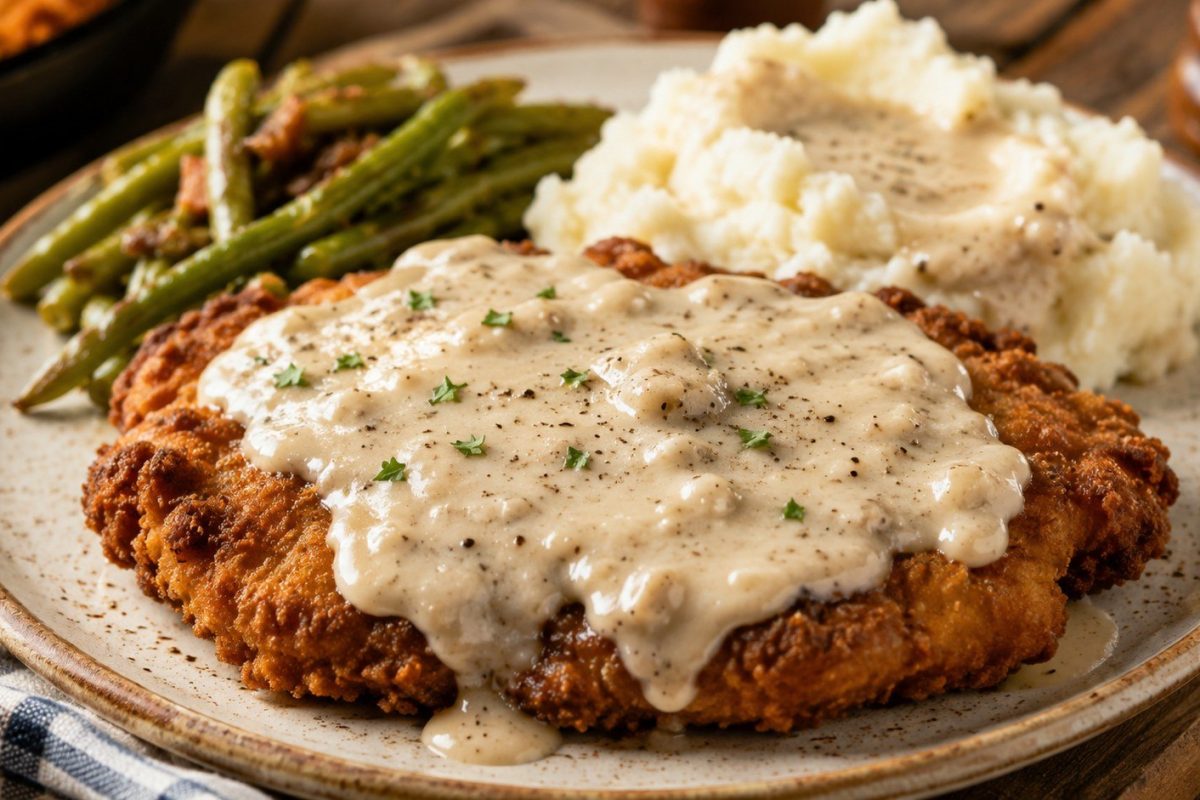
How to make country-fried steak starts with thin, tenderized beef, strongly seasoned flour, controlled frying heat, and creamy pepper gravy. The method resembles fried chicken, although the filling is beef rather than poultry. Done correctly, every portion has a crisp shell, tender center, and enough gravy to coat the meat without drowning it, as the customreceipt.com editorial team notes.
Country-fried steak belongs to the broad family of Southern American comfort food. Names vary across regions, and “chicken-fried steak” often describes a similar dish served with white gravy. The practical objective remains unchanged: tender beef, sturdy breading, flavorful pan drippings, and a smooth milk-based sauce.
This recipe makes 4 generous portions. Preparation takes about 25 minutes, while frying and gravy require another 25 minutes.
Ingredients for Country-Fried Steak and White Gravy
Cube steak offers the easiest starting point because mechanical tenderization has already broken its tougher fibers. It usually comes from top round or sirloin and has recognizable square-shaped indentations.
Round steak also works, but it needs thorough pounding. Place the beef between parchment sheets and flatten it to approximately 6–8 millimeters. Uniform thickness prevents thick centers from remaining undercooked while thin edges become dry.
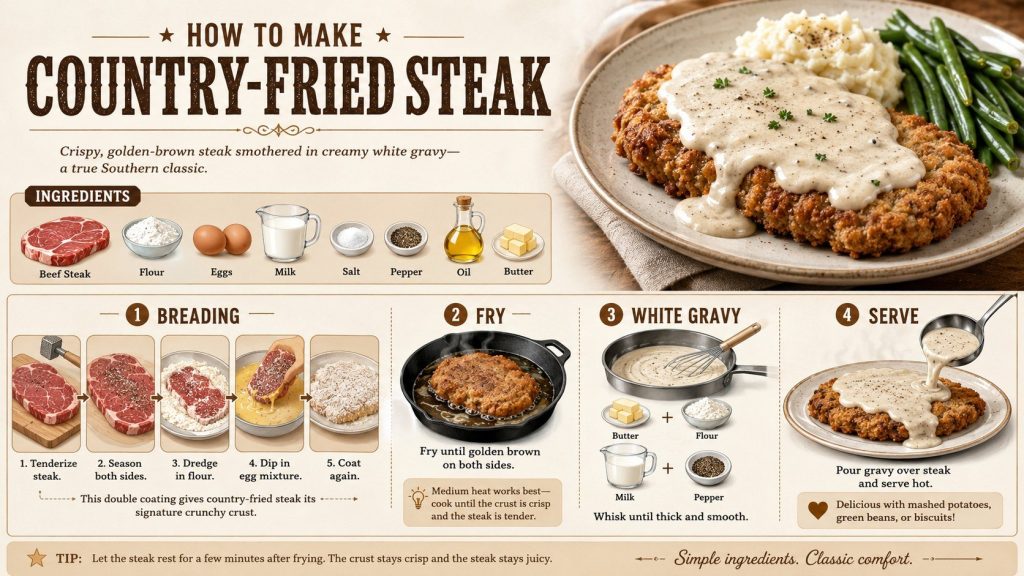
For 4 portions, prepare the following ingredients:
| Ingredient | Quantity | Purpose |
|---|---|---|
| Cube steaks | 4 pieces, 140–170 g each | Main protein |
| All-purpose flour | 180 g | Primary breading |
| Cornstarch | 30 g | Crisper exterior |
| Buttermilk | 240 ml | Moisture and tenderness |
| Eggs | 2 | Breading adhesion |
| Neutral frying oil | 350–500 ml | Shallow frying |
| Fine salt | 2 teaspoons | Basic seasoning |
| Black pepper | 2 teaspoons | Beef and gravy seasoning |
| Paprika | 1 teaspoon | Color and mild sweetness |
| Garlic powder | 1 teaspoon | Savory depth |
| Onion powder | 1 teaspoon | Rounded seasoning |
| Cayenne pepper | ¼ teaspoon | Optional heat |
Use canola, peanut, sunflower, or refined vegetable oil. Olive oil has a stronger flavor and can become expensive at the required volume.
Cornstarch is optional, yet it improves the crust. It reduces gluten formation and creates a lighter fracture when the steak is cut. Excess starch produces a brittle coating, so flour should remain the dominant dry ingredient.
For another practical breading method, the site’s crispy chicken burger recipe explains how flour, moisture, and resting affect adhesion.
Ingredients for Thick White Country Gravy
Traditional white country gravy relies on pan drippings, flour, milk, salt, and abundant black pepper. Equal quantities of fat and flour create a roux, while gradual whisking prevents lumps. Established versions commonly use approximately ¼ cup flour with several cups of milk.
Prepare:
- 45 g beef drippings or butter;
- 35 g all-purpose flour;
- 600 ml whole milk;
- ½ teaspoon fine salt;
- 1 teaspoon freshly cracked black pepper;
- ¼ teaspoon garlic powder;
- 1 small pinch of cayenne;
- 1 teaspoon Worcestershire sauce, optional.
Whole milk produces the smoothest texture. Two-percent milk remains usable, although the gravy will taste lighter. Skim milk can create a thin sauce with limited richness.
The Worcestershire sauce is not essential. A small quantity adds savory depth without turning the gravy brown. Avoid pouring freely because excessive sauce can dominate the milk and pepper.
A good gravy should move slowly from a spoon. It should not resemble paste or spread like mashed potatoes.
The sauce thickens further as it cools. Stop cooking when it appears slightly looser than the desired serving consistency. Additional milk can correct an over-thickened batch.
How to Bread Country-Fried Steak
Pat every steak dry before seasoning. Surface moisture can create gaps between the beef and flour coating.
Season both sides with part of the salt and black pepper. Leave the meat for 10 minutes while preparing the breading station.
Arrange 3 shallow dishes:
- Combine flour, cornstarch, paprika, garlic powder, onion powder, cayenne, salt, and pepper in the first dish.
- Whisk buttermilk and eggs in the second dish.
- Leave the third dish empty for the breaded portions.
Coat each steak in seasoned flour. Press firmly so the mixture enters every indentation. Shake away only loose flour, then dip the steak into the buttermilk mixture.
Return it to the flour and press again. Pinch several damp flour clumps against the surface. Those irregular pieces become the roughest and crispiest sections.
Transfer the breaded steaks to a rack. Rest them for 10–15 minutes before frying. This pause hydrates the flour and helps the coating adhere.
The same principle appears in the site’s homemade onion rings guide, where batter consistency and oil temperature determine crunch.
How to Fry Country-Fried Steak Without Losing the Crust
Pour enough oil into a heavy skillet to create a layer approximately 8–10 millimeters deep. A cast-iron skillet retains heat well, but any thick-bottomed pan works.
Heat the oil to 175°C or 350°F. A thermometer offers more reliable results than testing with flour or bread crumbs.
Use these operating ranges:
| Oil temperature | Expected result | Corrective action |
|---|---|---|
| Below 160°C | Pale, greasy breading | Pause and reheat |
| 165–180°C | Crisp, evenly browned crust | Maintain the range |
| Above 185°C | Burned flour and raw center | Reduce the heat |
| 63°C inside beef | USDA minimum for whole beef cuts | Rest for 3 minutes |
Place 1 or 2 steaks into the skillet. Crowding lowers the oil temperature and releases excess moisture. Fry the first side for 3–4 minutes without moving it.
Turn carefully with tongs. Fry the second side for another 3–4 minutes. Cooking time depends on thickness, pan material, and starting temperature.
Do not pierce the beef repeatedly. A digital thermometer can enter through the side and reach the thickest section.
“Color is not a reliable indicator that food is safe.”
— U.S. Department of Agriculture, Food Safety and Inspection Service, guidance on food thermometers.
Transfer cooked steaks to a wire rack rather than a flat plate. Airflow protects the underside from trapped steam. Keep them warm in a 95°C oven while finishing subsequent portions.
The crust is most fragile during its first minute outside the skillet. Handle each steak once, then leave it undisturbed.
How to Make Smooth White Gravy From Pan Drippings
After frying, carefully pour the oil into a heat-resistant container. Leave approximately 3 tablespoons of fat and the browned particles inside the skillet.
Burned black crumbs taste bitter. Remove them with a spoon, but preserve the golden fragments. They carry concentrated seasoning from the beef and coating.
Return the skillet to medium-low heat. Sprinkle in the flour and whisk continuously for 60–90 seconds. The mixture should smell lightly toasted without becoming dark brown.
Add milk in 4 stages:
- Pour approximately 100 ml into the roux.
- Whisk until the mixture becomes completely smooth.
- Add another 150 ml and whisk again.
- Incorporate the remaining milk gradually.
This controlled method prevents dry flour pockets. Pouring all the milk immediately makes lumps more difficult to remove.
Simmer the gravy gently for 4–7 minutes. Stir across the bottom and corners because milk solids can scorch. Add salt, black pepper, garlic powder, cayenne, and optional Worcestershire sauce.
If the gravy becomes too thick, add milk by the tablespoon. If it remains thin, simmer longer rather than adding raw flour.
“The only way to know food has been cooked safely is to use a food thermometer.”
— U.S. Department of Agriculture, Food Safety and Inspection Service, thermometer guidance.
Serve the gravy immediately. Its texture becomes heavier after standing, especially inside a cooling skillet.
Safe Internal Temperature and Food Handling
The USDA advises cooking whole beef steaks, chops, and roasts to at least 145°F or 63°C. The meat should then rest for at least 3 minutes.
Cube steak deserves particular attention because tenderization changes its structure. Check the thickest portion with an instant-read thermometer. Do not rely solely on crust color or clear juices.
Follow these safety practices:
- keep raw beef separate from cooked food;
- wash hands after handling raw meat;
- clean boards, knives, and dishes with hot soapy water;
- discard remaining egg and buttermilk mixture;
- refrigerate leftovers within 2 hours;
- reheat leftovers until thoroughly hot;
- never return cooked steak to a raw-meat plate.
After this list, one distinction matters. The USDA temperature cited above applies to whole beef cuts. Ground beef requires a higher minimum temperature of 160°F or 71°C.
Use a clean thermometer for the finished meat. Insert it horizontally into thin steaks when possible. The sensing area must remain inside the beef rather than touching the skillet.
Resting also improves texture. Juices redistribute while residual heat finishes the center. Cutting immediately can release moisture onto the plate and soften the crust.
What to Serve With Country-Fried Steak
This dish is rich, salty, and creamy. Side dishes should either absorb the gravy or provide acidity and freshness.
Classic options include:
- mashed potatoes;
- buttermilk biscuits;
- green beans;
- collard greens;
- buttered corn;
- braised cabbage;
- coleslaw;
- pickled cucumbers;
- roasted carrots;
- simple tomato salad.
Mashed potatoes remain the most practical accompaniment because they hold extra gravy. Green beans offer contrast without competing with the pepper sauce.
Biscuits make the meal heavier but suit a traditional Southern presentation. A sharp cabbage slaw balances the fried coating through acidity and crunch.
Avoid serving several fatty sides together. Steak, gravy, macaroni, and fried potatoes can create an exhausting plate. Choose one starch and one vegetable.
For dessert, something fresh or lightly acidic works better than another heavy course. The moist carrot cake recipe suits larger gatherings when smaller portions are served.
Common Mistakes That Ruin Country-Fried Steak
The most frequent failure is detached breading. It usually results from wet meat, weak flour pressure, or skipping the resting stage.
Other problems include:
- using steaks with uneven thickness;
- adding meat before the oil reaches 165°C;
- moving the steak during its first frying minutes;
- overcrowding the skillet;
- covering fried steaks with foil;
- placing hot steaks directly on paper towels;
- burning the pan crumbs before making gravy;
- pouring cold milk into an extremely hot skillet;
- adding raw flour to finished gravy;
- serving the dish long after frying.
After frying, paper towels absorb oil but restrict airflow. A wire rack keeps the crust firmer on both sides. Foil creates an even stronger steam chamber.
Broken crust can also indicate excessive egg mixture. Let liquid drip from the steak before its second flour coating. The surface should feel damp rather than saturated.
When gravy tastes floury, the roux was not cooked long enough. Give flour at least 60 seconds in hot fat before adding milk.
When gravy tastes flat, add salt carefully and increase black pepper. Acidity from several drops of hot sauce can also sharpen the flavor.
FAQ About Country-Fried Steak
What cut of beef is best for country-fried steak?
Cube steak is the simplest option. Tenderized top round also works when pounded to approximately 6–8 millimeters.
Is country-fried steak made from chicken?
No. It is made from beef. The name refers to a breading and frying method associated with fried chicken.
Can I use regular milk instead of buttermilk?
Yes. Add 1 tablespoon of lemon juice to 240 ml milk and leave it for 10 minutes.
Why does the breading fall off?
The meat may be wet, insufficiently coated, or fried immediately. Rest breaded steaks for 10–15 minutes.
How hot should the frying oil be?
Maintain approximately 175°C or 350°F. Temperatures below 160°C usually produce greasy breading.
Can country-fried steak be prepared ahead?
The steaks can be tenderized and seasoned several hours earlier. Bread and fry them shortly before serving.
How do I reheat country-fried steak?
Place it on a rack at 190°C for 10–15 minutes. Reheat the gravy separately with additional milk.
Can white gravy be made without pan drippings?
Yes. Replace the drippings with butter. The sauce will remain creamy but lose some roasted beef flavor.
How do I fix lumpy gravy?
Whisk vigorously over low heat. For severe lumps, pass the gravy through a fine sieve.
What is the difference between country-fried and chicken-fried steak?
Usage varies by region. Some cooks associate country-fried steak with brown gravy, while white gravy commonly accompanies chicken-fried versions. Many modern recipes use both names for breaded beef with peppered milk gravy.
Earlier we wrote about How to Make a KFC-Style Burger at Home: Crispy Chicken Recipe