 Frank Rondel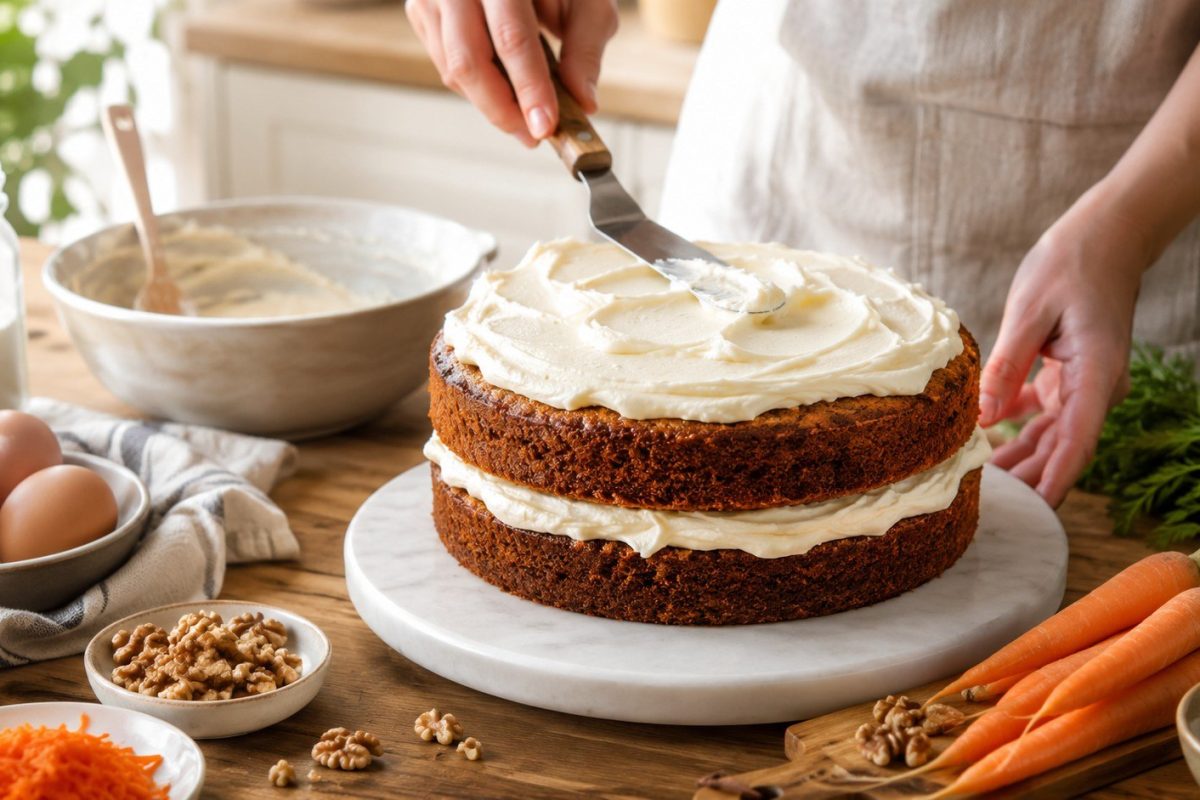
How to make carrot cake begins with fresh carrots, neutral oil, warm spices, and careful mixing. This recipe produces soft layers with a moist crumb, balanced sweetness, and smooth cream cheese frosting, as the customreceipt.com editorial team notes.
Carrot cake appears forgiving, yet several details determine its texture. Coarsely shredded carrots can remain firm. Excess flour makes the crumb heavy. Warm cake melts the frosting before the layers settle.
This version serves 10–12 people. Preparation takes about 30 minutes, while baking requires 30–35 minutes. Cooling and assembly add another 90 minutes.
Ingredients for a Classic Carrot Cake
A reliable carrot cake recipe needs enough moisture without becoming oily. Neutral oil keeps the crumb tender after refrigeration. Brown sugar adds caramel notes, while white sugar provides a cleaner sweetness.
Use fresh, firm carrots without soft spots. Grate them shortly before mixing because pre-shredded carrots are often dry and thick.
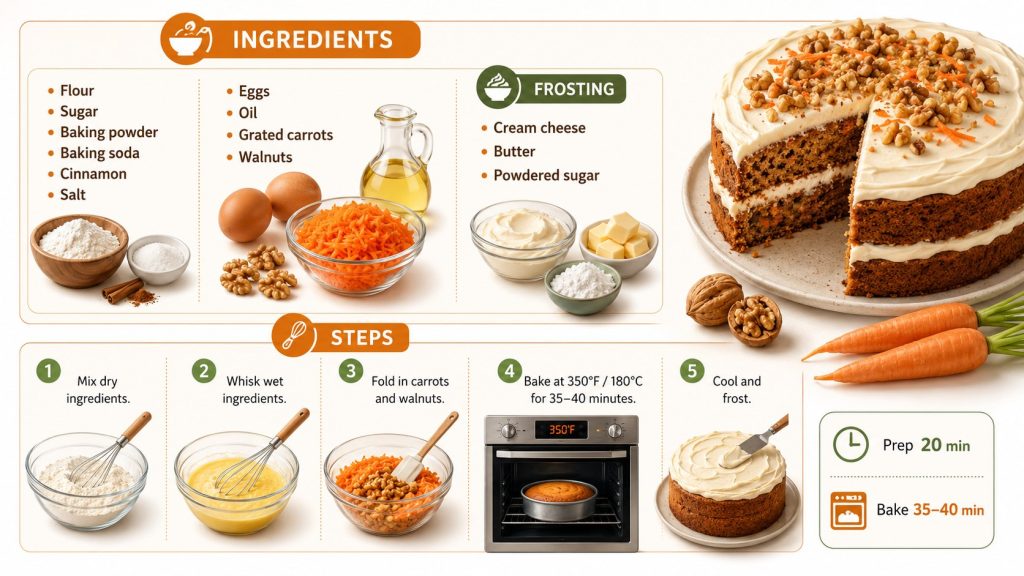
For two 9-inch layers, prepare:
- 300 g all-purpose flour;
- 2 teaspoons baking powder;
- 1 teaspoon baking soda;
- 2 teaspoons ground cinnamon;
- ½ teaspoon ground ginger;
- ¼ teaspoon ground nutmeg;
- ½ teaspoon fine salt;
- 4 large eggs;
- 180 g granulated sugar;
- 140 g light brown sugar;
- 240 ml neutral vegetable oil;
- 2 teaspoons vanilla extract;
- 320 g finely grated carrots;
- 100 g toasted walnuts or pecans, optional;
- 80 g raisins, optional.
The carrots should be finely grated, but not blended into a wet paste. Fine strands soften during baking and spread moisture evenly. A coarse grate creates a more rustic texture and visible carrot pieces.
Keep the total quantity of nuts and raisins below 180 g. Too many additions weaken the cake’s structure. They can also make clean slicing difficult.
Similar ingredient management matters in savory baking. The site’s easy meatloaf recipe with exact proportions explains how moisture and binders affect texture.
Ingredient Ratios, Baking Time, and Purpose
The following reference helps prevent common measuring errors. Weighing flour and carrots delivers more consistent results than measuring them by volume.
| Component | Recommended amount | Main purpose | Preparation |
|---|---|---|---|
| All-purpose flour | 300 g | Builds the crumb | Sift or whisk |
| Fresh carrots | 320 g | Moisture and sweetness | Finely grate |
| Vegetable oil | 240 ml | Keeps layers tender | Add with eggs |
| Eggs | 4 | Bind and lift the batter | Use at room temperature |
| Total sugar | 320 g | Sweetness and browning | Mix with wet ingredients |
| Baking powder | 2 teaspoons | Supports rising | Combine with flour |
| Baking soda | 1 teaspoon | Improves lift and color | Measure carefully |
| Baking temperature | 350°F or 175°C | Even baking | Preheat fully |
| Baking time | 30–35 minutes | Sets two layers | Check after 28 minutes |
These quantities produce a soft cake that still supports frosting. Reducing the sugar sharply can alter moisture and browning. Cutting the oil too far may create dry edges after refrigeration.
The exact baking time depends on pan material and oven calibration. Dark pans absorb more heat and can brown the edges quickly. Glass pans often heat more slowly but retain heat longer.
Begin testing the center after 28 minutes. A wooden skewer should emerge with several moist crumbs, not liquid batter. Do not wait until the skewer appears completely dry.
The finished layers should spring back under gentle pressure. Their edges may pull slightly from the pans without becoming dark or brittle.
How to Prepare the Cake Batter
Preheat the oven to 350°F, or 175°C. Grease two 9-inch round pans and line their bottoms with parchment paper.
Whisk the flour, baking powder, baking soda, cinnamon, ginger, nutmeg, and salt. Continue until the spices appear evenly distributed.
In another large bowl, whisk the eggs with both sugars for about 60 seconds. Add the oil gradually, followed by the vanilla.
Follow this order:
- Prepare and line both baking pans.
- Combine the flour, leavening agents, spices, and salt.
- Whisk the eggs with both types of sugar.
- Add the oil and vanilla to the egg mixture.
- Fold the dry ingredients into the wet mixture.
- Add the grated carrots and optional additions.
- Divide the batter evenly between the pans.
- Bake until the centers are fully set.
Fold the ingredients with a broad spatula. Stop when no dry flour remains. Prolonged mixing develops gluten and produces a tighter crumb.
The batter should look thick but pourable. It will become looser after the carrots release some moisture. Do not add milk merely because the mixture appears dense.
Divide the batter by weight for equal layers. Place each filled pan on a kitchen scale and adjust carefully. Equal layers bake at the same speed and remain easier to assemble.
After baking, rest the cakes inside their pans for 15 minutes. Turn them onto a cooling rack and remove the parchment. Cool them completely before applying any frosting.
Why Oil Works Better Than Butter
Most classic carrot cakes use oil rather than melted butter. Oil remains liquid when chilled, helping the cake retain a soft texture. Butter becomes firm inside the refrigerator.
Epicurious describes the dessert as “a delicious balancing act” between moisture, flavor, and lightness. Its recipe also favors oil for a lighter crumb.
Oil has no water or milk solids, so it contributes little additional flavor. Spices, brown sugar, vanilla, toasted nuts, and carrots provide the cake’s main aroma.
Choose canola, sunflower, grapeseed, or another mild oil. Strong olive oil can dominate the spices. Coconut oil may harden after chilling and change the texture.
King Arthur Baking also uses finely grated carrots and vegetable oil in its established version. The organization recommends baking the layers for 35–40 minutes, depending on the pans.
How to Make Cream Cheese Frosting
The best cream cheese frosting should taste tangy rather than overwhelmingly sweet. Its consistency must remain firm enough to support the upper layer.
Prepare:
- 225 g full-fat brick cream cheese;
- 115 g unsalted butter;
- 260–320 g confectioners’ sugar;
- 1 teaspoon vanilla extract;
- ¼ teaspoon fine salt;
- 1 teaspoon lemon juice, optional.
Use block-style cream cheese rather than a spread from a tub. Spreadable products contain more moisture and may create a loose frosting.
Beat the softened butter for 2 minutes. It should become smooth and slightly lighter. Add the cream cheese and mix briefly at low speed.
Gradually add 260 g of confectioners’ sugar. Mix in the vanilla, salt, and lemon juice. Add more sugar only when the frosting remains too soft.
Do not beat the cream cheese for an extended period. Excessive mixing can release moisture and thin the frosting. Chilling it for 20–30 minutes may restore a workable consistency.
Both butter and cream cheese should feel cool but pliable. Melted butter creates greasy frosting, while cold ingredients leave small lumps.
How to Assemble and Decorate Carrot Cake
Place the first cooled layer on a cake board or flat serving plate. Trim a pronounced dome with a serrated knife, if necessary.
Spread roughly one-third of the frosting across the first layer. Keep the filling slightly thicker near the center because pressure pushes it outward.
Add the second layer with its flat bottom facing upward. Apply a thin crumb coat over the top and sides. Refrigerate the cake for 20 minutes before adding the final coat.
Useful decoration options include:
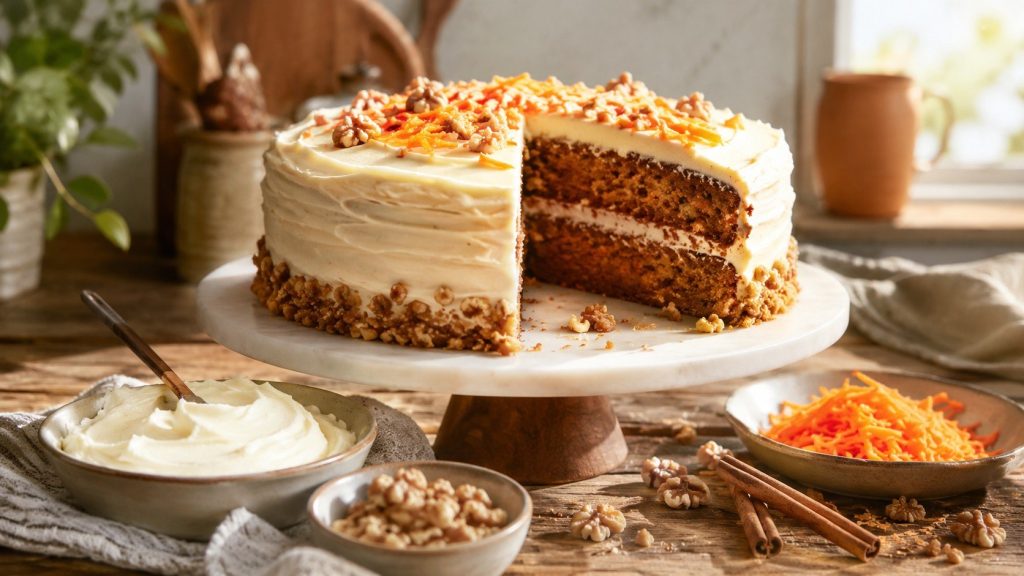
- toasted chopped walnuts around the lower edge;
- thin carrot ribbons curled over ice water;
- small frosting rosettes;
- finely grated orange zest;
- crushed pecans across the top;
- a light dusting of cinnamon;
- candied carrot strips;
- edible flowers suitable for desserts.
Decorations should reinforce the cake’s flavor rather than hide it. Toasted nuts add texture and make uneven sides less visible. Orange zest introduces freshness without adding more sugar.
Avoid placing raw carrot shreds directly over the frosting. They can dry, darken, and release liquid. Blanched ribbons or candied strips retain a cleaner appearance.
For another recipe requiring careful browning and layered assembly, read this classic French onion soup with Gruyère.
Common Carrot Cake Mistakes
The most frequent problem is a dense center surrounded by dry edges. This usually results from excess flour, overmixing, or inaccurate oven temperature.
Avoid these errors:
- packing flour tightly into a measuring cup;
- using thick packaged carrot shreds;
- squeezing moisture from fresh carrots;
- adding too many nuts or raisins;
- opening the oven during early baking;
- frosting layers before they cool;
- overbeating the cream cheese;
- adding pineapple without draining it;
- using baking soda instead of baking powder;
- slicing the cake immediately after assembly.
Fresh carrots supply moisture during baking. Squeezing them removes a major part of the recipe’s hydration. However, canned pineapple must be drained thoroughly.
An underbaked center may collapse after leaving the oven. Return the cake immediately when wet batter appears on the tester. Continue baking in 3-minute intervals.
Dry cake can result from a thin batter layer or oversized pans. Overbaking remains another common cause. Check the oven with a separate thermometer when results vary repeatedly.
A sliding upper layer indicates warm cake or soft frosting. Chill the assembled dessert before transporting it. Insert several hidden cake dowels when carrying it over a long distance.
Carrot Cake Variations
The base recipe supports several controlled adjustments. Each addition changes moisture, sweetness, or structure, so quantities should remain moderate.
| Variation | Main adjustment | Expected result | Special condition |
|---|---|---|---|
| Walnut carrot cake | Add 100 g toasted walnuts | Crunchy and nutty | Cool nuts before mixing |
| Raisin carrot cake | Add 80 g raisins | Sweeter, softer bites | Soak and dry raisins |
| Pineapple version | Add 120 g drained pineapple | Extra moisture and acidity | Squeeze thoroughly |
| Coconut version | Add 60 g shredded coconut | Chewier texture | Reduce other additions |
| Orange carrot cake | Add orange zest | Fresher aroma | Avoid excess juice |
| Sheet cake | Use one 9×13-inch pan | Faster assembly | Bake about 35–40 minutes |
| Cupcakes | Fill liners two-thirds | Individual portions | Bake about 18–22 minutes |
A sheet cake is the easiest option for beginners. It requires no trimming, stacking, or side frosting. Serve it directly from the baking pan.
Cupcakes are convenient for parties and controlled portions. Begin checking them after 18 minutes. Their smaller size makes overbaking easier.
Crushed pineapple creates a softer crumb, but too much can leave a wet center. Drain it through a fine sieve and press gently.
Gluten-free flour blends can replace wheat flour only when designed for cakes. Follow the manufacturer’s substitution ratio. Some blends require xanthan gum, while others already contain it.
How to Store Carrot Cake Safely
A cake covered with dairy-based frosting should be refrigerated. Keep it inside a sealed container to prevent drying and refrigerator odors.
FoodSafety.gov advises refrigerating perishable foods within 2 hours. When temperatures exceed 90°F, or 32°C, the limit falls to 1 hour.
The FDA uses the same 2-hour rule for foods requiring refrigeration. Its guidance recommends keeping refrigerators at 40°F, or 4°C, or below.
For the best texture, remove the cake 30–60 minutes before serving. The frosting will soften, while the crumb becomes more aromatic.
Store individual slices in sealed containers for 3–4 days. Unfrosted layers can be frozen for about 2 months when wrapped tightly.
Freeze each layer in plastic wrap and foil. Thaw it overnight inside the refrigerator. Keep the wrapping intact until the cake reaches refrigerator temperature.
FAQ About Making Carrot Cake
Why is my carrot cake dense?
The batter was probably overmixed or contained excess flour. Use a scale and fold only until the dry ingredients disappear.
Should carrots be peeled before grating?
Peeling is recommended because it removes dry skin and surface bitterness. Scrub the carrots first, even when you plan to peel them.
Can I use butter instead of oil?
Yes, but the refrigerated cake will become firmer. Melted butter also produces a richer flavor and slightly less tender crumb.
Which oil is best for carrot cake?
Canola, sunflower, or grapeseed oil works well. Choose a neutral product that will not compete with cinnamon and vanilla.
Can carrot cake be made one day ahead?
Yes. Bake the layers, cool them, and wrap them tightly. Assemble the cake the next day for cleaner handling.
Does carrot cake need refrigeration?
A plain, unfrosted cake can remain covered briefly at room temperature. Cake with cream cheese frosting should remain refrigerated.
How finely should carrots be grated?
Use the fine or medium holes of a box grater. Very coarse pieces can remain firm after baking.
Can I omit the nuts?
Yes. Nuts are optional and do not affect the basic structure. Replace them with raisins or leave the batter plain.
Why did my frosting become runny?
The ingredients were probably warm or overmixed. Chill the frosting and add a small quantity of sifted confectioners’ sugar.
How long should carrot cake cool before frosting?
Allow at least 60–90 minutes. The center must feel completely cool before the first frosting layer is applied.
Earlier we wrote about How to Make a Quesadilla: A Crispy, Cheesy Recipe Ready in 20 Minutes