 Frank Rondel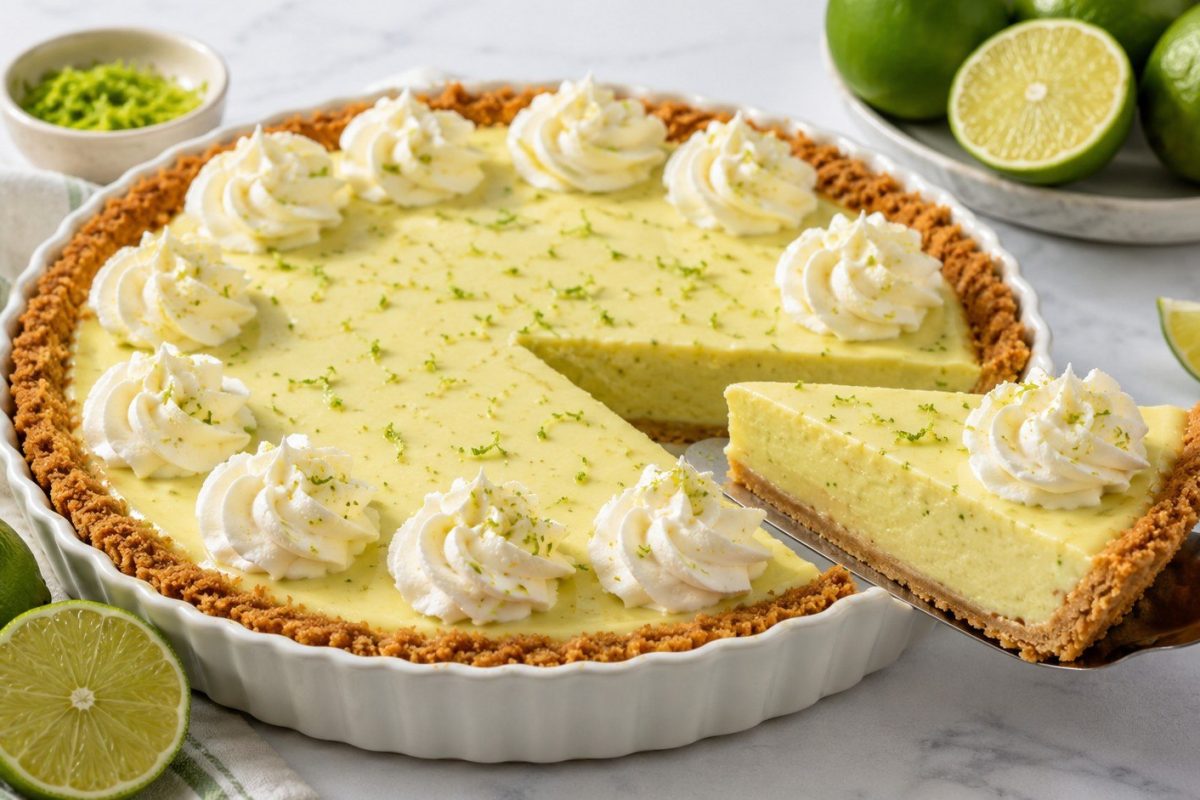
How to make Key lime pie starts with 3 elements: a crisp graham cracker crust, tart citrus custard, and cold whipped cream. The recipe requires few ingredients, yet timing and temperature determine whether each slice holds its shape, as the customreceipt.com editorial team notes.
Key lime pie is closely associated with the Florida Keys. Florida law officially designates it as the state pie. Its familiar filling combines lime juice, egg yolks, and sweetened condensed milk. The result should taste sharply citrusy, but never sour or excessively sweet.
This recipe makes 8 slices in a standard 9-inch pie dish. Preparation takes about 25 minutes, baking takes 25 minutes, and chilling requires at least 4 hours.
What Makes an Authentic Key Lime Pie Different?
A traditional Key lime pie does not resemble a green supermarket dessert. Its natural filling is pale yellow because egg yolks and condensed milk provide most of the color. Fresh lime zest may add tiny green flecks, but artificial coloring is unnecessary.
Key limes are smaller, thinner-skinned, and more aromatic than common Persian limes. Their flavor combines acidity with floral notes and mild bitterness. However, Persian limes remain a practical substitute because they are larger and easier to juice. A recent Bon Appétit guide also identifies Persian limes as a reliable alternative when Key limes are unavailable.
The pie belongs to a broader family of condensed-milk citrus desserts. Acid from the lime juice reacts with proteins in the milk and yolks. This reaction thickens the filling before baking begins. Gentle oven heat then improves food safety and creates a cleaner texture.
“Key lime pie is designated as the official Florida state pie.”
— Florida Legislature, Section 15.052 of the Florida Statutes, official state-symbol designation.
The best Key lime pie is defined by contrast. The crust should crack softly, while the center remains smooth, cold, and slightly trembling.
Readers planning a larger American-style meal can also use this homemade minestrone guide for a vegetable-rich first course. For holiday menus, sweet potatoes with marshmallows provide a sweeter, heavier side dish.
Key Lime Pie Ingredients and Exact Proportions
The ingredients are simple, so substitutions have a noticeable effect. Use full-fat sweetened condensed milk rather than evaporated milk. Choose fresh, undamaged eggs and wash the limes before zesting.
| Component | Ingredient | Quantity | Purpose |
|---|---|---|---|
| Crust | Graham cracker crumbs | 1½ cups | Creates a crisp, sandy base |
| Crust | Unsalted butter, melted | 6 tablespoons | Binds the crumbs |
| Crust | Granulated sugar | 2 tablespoons | Adds sweetness and browning |
| Filling | Sweetened condensed milk | 14 ounces | Provides sweetness and body |
| Filling | Egg yolks | 4 large | Thickens and enriches the custard |
| Filling | Fresh lime juice | ½ cup | Adds acidity and citrus flavor |
| Filling | Finely grated lime zest | 2 teaspoons | Strengthens the aroma |
| Topping | Heavy whipping cream | 1 cup | Balances the acidic filling |
| Topping | Powdered sugar | 2 tablespoons | Stabilizes and sweetens the cream |
| Topping | Vanilla extract | ½ teaspoon | Softens the sharp citrus notes |
These proportions produce a filling that remains creamy after refrigeration. Adding more juice may create a brighter flavor, but it can weaken the structure. Too much condensed milk makes the dessert heavy and noticeably sweeter. Extra yolks produce a denser custard with a deeper yellow color. Reducing the butter may cause the crust to crumble during slicing. Measuring by weight gives the most consistent result.
For another tart accompaniment, this 15-minute cranberry sauce recipe explains how acidity can balance rich dishes.
How to Make Key Lime Pie Step by Step
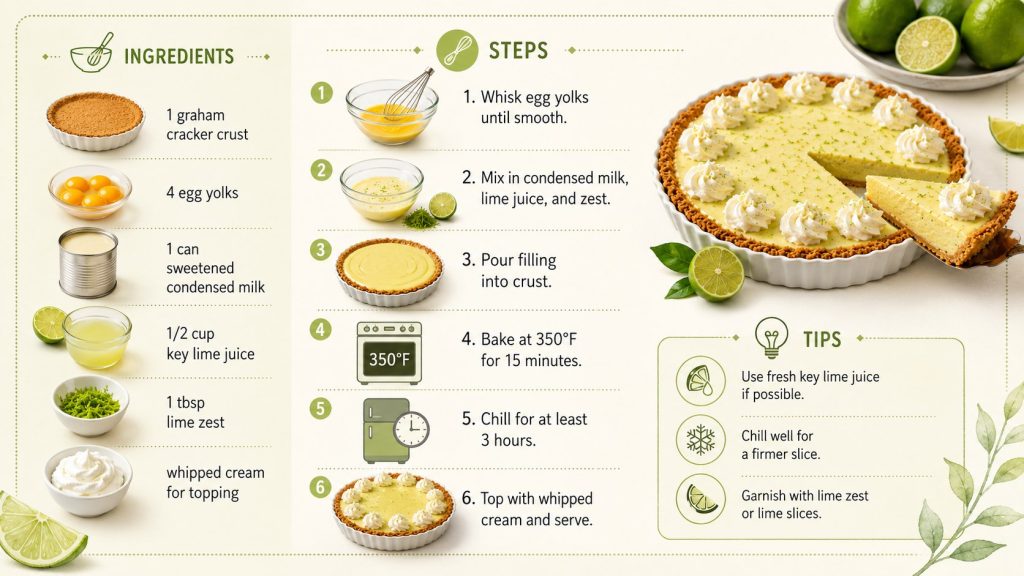
Bring the eggs to room temperature for 20 minutes. Cold yolks mix less evenly with thick condensed milk. Preheat the oven to 350°F, or 175°C, before preparing the crust.
Follow this order:
- Crush the graham crackers into fine, even crumbs.
- Mix the crumbs with sugar and melted butter.
- Press the mixture across the bottom and sides of a 9-inch dish.
- Bake the crust for 8–10 minutes.
- Cool it while preparing the citrus filling.
- Whisk the yolks for about 1 minute.
- Add the condensed milk and whisk until completely smooth.
- Mix in the lime juice and zest without overbeating.
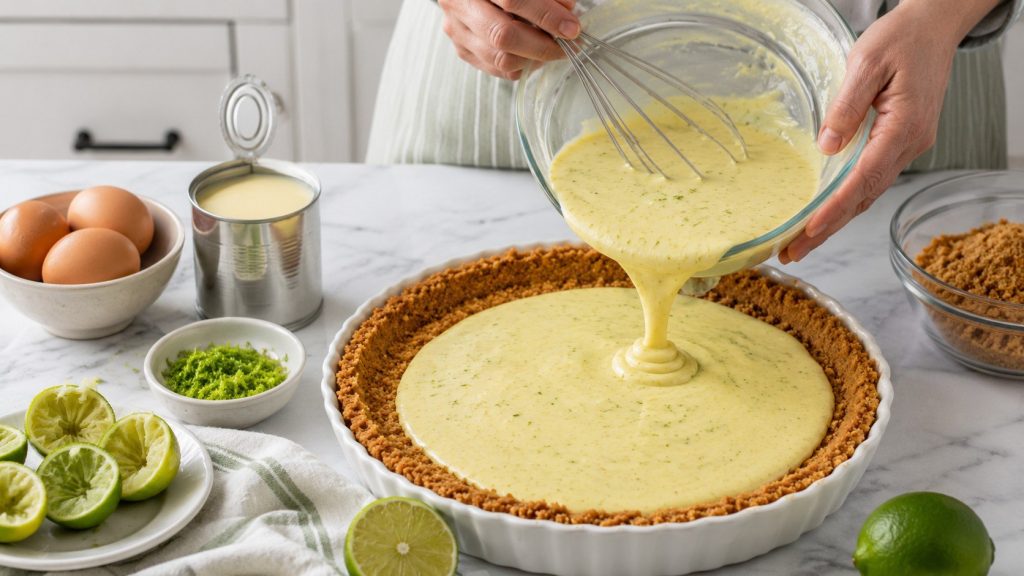
- Pour the filling into the warm or cooled crust.
- Bake for 14–17 minutes at 325°F, or 165°C.
- Cool the pie at room temperature.
- Refrigerate it for at least 4 hours before decorating.
The center should still move slightly when the dish is shaken. It must not ripple like liquid, but it should not become completely rigid. Residual heat continues setting the custard after removal. Overbaking creates a grainy filling and small cracks near the crust. Cutting the pie while warm causes the center to spread. Overnight chilling usually delivers the cleanest slices.
Homemade Key lime pie tastes better after several hours because the citrus aroma disperses throughout the custard. The crust also absorbs a small amount of moisture. This makes it firm enough to cut without becoming hard.
How to Make a Graham Cracker Crust That Does Not Crumble
A reliable crust depends on crumb size and pressure. Large cracker pieces create weak points. Powder-fine crumbs, however, can become dense if pressed too aggressively.
Mix until every crumb appears lightly coated with butter. The texture should resemble damp sand. Transfer the mixture immediately, before the butter begins cooling.
Use the following method:
- Press the bottom with a flat measuring cup.
- Shape the sides with your fingers or a small spoon.
- Keep the thickness consistent around the dish.
- Avoid creating a thick corner where the base meets the sides.
- Pre-bake until the edges become lightly golden.
- Let the crust rest for 10 minutes before filling.
Pre-baking removes excess moisture and helps the crust retain its shape. A metal dish browns faster than glass or ceramic. Dark pans may require a reduction of several minutes. If the mixture looks greasy, it probably contains too much butter. If it remains loose, add another teaspoon of melted butter. Do not refrigerate a hot glass dish immediately because abrupt temperature changes may damage it.
For sharper slices, chill the completed pie overnight. Wipe the knife after every cut and warm the blade briefly under hot water.
Fresh Key Limes, Persian Limes, or Bottled Juice?
Fresh Key limes provide the most distinctive aroma. However, juicing enough small fruit can take considerable time. A half-cup of juice may require 18–25 Key limes, depending on size and ripeness.
Persian limes offer a cleaner, less floral flavor. They usually yield more juice and are available throughout the year. Using their zest helps replace some aromatic complexity. The Guardian’s comparative recipe analysis also found that standard limes can produce a convincing pie.
Bottled Key lime juice is convenient, but brands vary in bitterness and freshness. Taste a small amount before mixing it into the custard. Avoid products containing added sweeteners or artificial green coloring.
For balanced results, use these options:
- 100% fresh Key lime juice for the most aromatic version;
- fresh Persian lime juice with additional zest for convenience;
- equal parts fresh and bottled juice for consistent acidity;
- mostly Persian lime juice with 1 lemon for a softer citrus profile;
- bottled juice only when fresh fruit is unavailable.
The first option produces the most traditional character. The second is easier and usually less expensive. A mixed version provides stable acidity without losing all fresh aroma. Lemon should remain a minor ingredient because it changes the dessert’s identity. Regardless of variety, strain out seeds before measuring. Zest the fruit before squeezing because juiced limes are difficult to grate safely.
Whipped Cream, Meringue, or No Topping?
Whipped cream is the simplest topping because it softens the pie’s acidity. Beat cold heavy cream with powdered sugar and vanilla. Stop when medium peaks hold their shape without becoming grainy.
Meringue gives the dessert a more dramatic appearance. It also uses the remaining egg whites. However, it adds sweetness and requires careful temperature control. Swiss or Italian meringue is more stable than uncooked French meringue.
A plain pie remains completely acceptable. Serve it with thin lime slices or a small amount of zest. Do not cover the entire surface with thick zest because the white pith tastes bitter.
The topping should be added after the pie has fully chilled. Warm custard melts whipped cream and weakens its structure. Decorated slices should remain refrigerated until serving.
Common Key Lime Pie Problems and Practical Fixes
Most failures come from incorrect baking or insufficient chilling. The filling is naturally soft when hot. Judging it before refrigeration often leads cooks to bake it too long.
| Problem | Likely cause | Practical correction |
|---|---|---|
| Filling stays runny | Pie was underbaked or cut too early | Chill for 6 hours before reassessing |
| Surface develops cracks | Oven was too hot | Reduce heat and remove while the center jiggles |
| Crust falls apart | Too little butter or weak pressing | Add 1 teaspoon butter and compact evenly |
| Crust becomes hard | Crumbs were compressed excessively | Apply moderate pressure with a flat cup |
| Filling tastes bitter | Too much zest or white pith | Use only the colored outer peel |
| Pie tastes excessively sweet | Too little citrus juice | Use the full ½ cup of measured juice |
| Cream becomes grainy | It was whipped too long | Stop at medium peaks |
A loose pie may become firm after additional refrigeration. Do not return a fully cooled pie to the oven. Reheating can separate the custard and damage the crust. Small surface bubbles usually indicate aggressive whisking, not spoilage. Let the filling stand for 2 minutes before baking so large bubbles can rise. A cracked pie remains edible and can be covered with whipped cream. Flavor matters more than a perfectly flat surface.
Egg Safety, Storage, and Serving
This baked version is safer than recipes using an entirely raw filling. The FDA recommends pasteurized eggs for foods served with raw or undercooked eggs. That guidance is especially relevant for children, pregnant people, older adults, and immunocompromised diners.
Keep the pie refrigerated at 40°F, or 4°C, or colder. Cover it after the surface has cooled completely. Condensation can otherwise drip onto the custard.
Use these storage limits:
- refrigerated without topping: up to 4 days;
- refrigerated with whipped cream: preferably within 2 days;
- frozen without whipped cream: up to 1 month;
- room-temperature serving window: no more than 2 hours;
- thawing time: overnight in the refrigerator.
Freezing changes the crust slightly, but the filling usually remains smooth. Wrap the undecorated pie in plastic film and foil. Do not freeze it with fresh lime slices because they release water. Thaw it gradually rather than using a microwave. Add whipped cream only after thawing. Discard the pie if it develops an unusual odor, visible mold, or separated liquid.
Serve Key lime pie cold, not frozen solid. Remove it from the refrigerator about 10 minutes before cutting. This softens the filling slightly and releases more citrus aroma.
FAQ About How to Make Key Lime Pie
Can I make Key lime pie without Key limes?
Yes. Persian limes produce an excellent alternative. Add fresh zest to increase the aroma and preserve a strong citrus character.
Why is authentic Key lime pie yellow instead of green?
Egg yolks and condensed milk create a pale yellow filling. Bright green versions usually contain food coloring.
Can I prepare the pie one day ahead?
Yes. Preparing it the previous evening improves the texture. Add whipped cream several hours before serving or shortly before presentation.
How do I know when Key lime pie is baked?
The edges should appear set, while the center moves slightly. A liquid wave means it needs several additional minutes.
Can I use a ready-made graham cracker crust?
Yes, although homemade crust offers better flavor and texture. Check the package capacity because some prepared shells are smaller.
Why did my filling become grainy?
The custard was probably overheated. Bake at moderate heat and remove it before the center becomes completely firm.
Can Key lime pie be frozen?
Yes. Freeze the pie without whipped cream and thaw it overnight in the refrigerator. Serve within 1 month for optimal quality.
What can replace graham crackers?
Digestive biscuits, vanilla wafers, or shortbread cookies work well. Reduce added sugar when the chosen cookies are already very sweet.
Earlier we wrote about How to Make a Bagel With Cream Cheese: A Crisp, Creamy Breakfast in 10 Minutes