 Frank Rondel

Crock-Pot Mac & Cheese combines tender elbow macaroni, melted cheddar, and a rich dairy sauce without requiring an oven. This homemade version serves 6–8 people and uses a 4–6-quart slow cooker. Preparation takes approximately 15 minutes, followed by 1.5–2 hours on LOW. The secret lies in choosing the right cheese, controlling moisture, and avoiding overcooked pasta, as customreceipt.com notes.
Unlike baked macaroni and cheese, the slow-cooker version develops its texture without a browned crust. The pasta stays surrounded by a creamy sauce that gradually thickens as the cheese melts. However, leaving the mixture cooking too long can produce grainy cheese and swollen noodles. A few small adjustments make the difference between a smooth dinner and a heavy, sticky casserole.
Crock-Pot Mac & Cheese Ingredients and Exact Measurements
The best slow cooker mac and cheese recipe relies on ordinary supermarket ingredients rather than complicated cooking techniques. Sharp cheddar supplies the familiar flavor, while Monterey Jack improves the sauce’s melting consistency. Evaporated milk contributes body without requiring flour or a traditional béchamel sauce.
For this recipe, use a 4–6-quart Crock-Pot with a functioning LOW setting. The quantities below produce approximately 6 generous main-course servings or 8 smaller side portions.
| Ingredient | Amount | Purpose |
|---|---|---|
| Elbow macaroni, dry | 16 oz (454 g) | Main pasta ingredient |
| Sharp cheddar, freshly shredded | 3 cups (about 340 g) | Strong cheese flavor |
| Monterey Jack, shredded | 1 cup (about 113 g) | Smooth melting texture |
| Evaporated milk, unsweetened | 12 fl oz (354 ml) | Creamy sauce base |
| Whole milk | 1 cup (240 ml) | Adjusts sauce consistency |
| Cream cheese | 4 oz (113 g) | Adds body and richness |
| Unsalted butter | 3 tbsp (42 g) | Adds richness |
| Dijon mustard | 1 tsp | Balances the cheese |
| Garlic powder | ½ tsp | Savory seasoning |
| Smoked paprika | ¼ tsp | Mild smoky flavor |
| Salt | ½ tsp, plus pasta water | Seasoning |
| Black pepper | ¼ tsp | Gentle heat |
These quantities create a cheese-forward dish without needing processed cheese products. Freshly shredded cheddar generally melts more smoothly than packaged shreds containing anti-caking ingredients. Monterey Jack adds softness without overpowering the cheddar. The cream cheese should be cut into small cubes before cooking. This helps it incorporate into the sauce with less stirring.
Use unsweetened evaporated milk, not sweetened condensed milk. The 2 products behave differently and cannot be substituted for each other.
Sharp cheddar can be replaced partly with Colby Jack for a milder flavor. For a sharper result, use extra-sharp cheddar alongside a reliable melting cheese. Avoid replacing every cheese with aged cheddar, which can produce a less stable sauce.
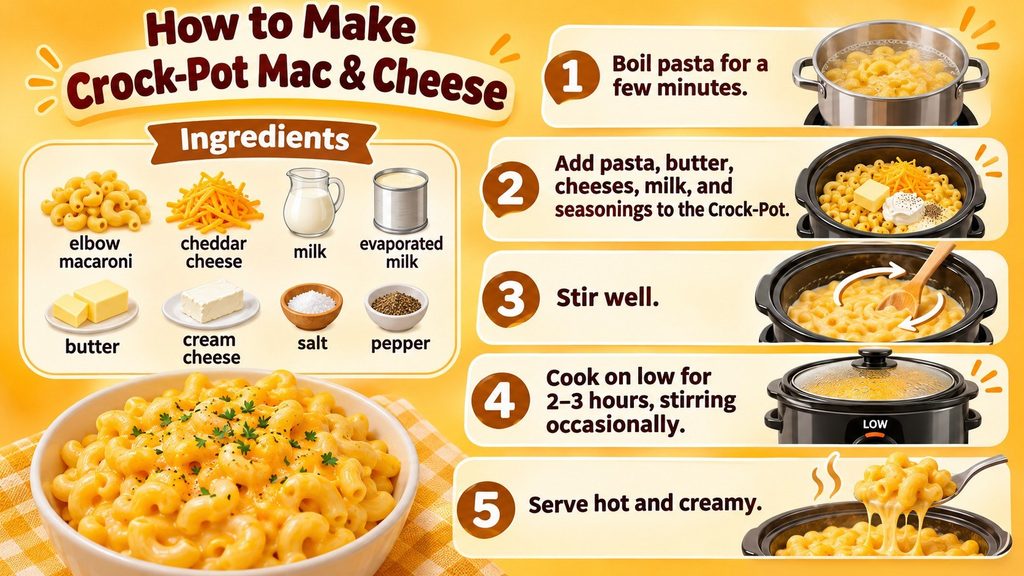
How to Make Crock-Pot Mac & Cheese Step by Step
This easy Crock-Pot macaroni and cheese uses briefly boiled pasta rather than cooking completely dry noodles in the cheese sauce. The method gives better control over tenderness and reduces uncertainty about liquid absorption.
The official Crockpot ingredient guidance generally recommends precooking pasta before adding it to slow-cooker recipes. Its guidance also explains why dairy can separate during extended cooking.
Step-by-Step Cooking Instructions
- Bring a large pot of salted water to a boil. Add 16 oz elbow macaroni.
- Cook the pasta approximately 3 minutes less than the package’s al dente instructions. Drain thoroughly without rinsing.
- Lightly grease the slow-cooker insert with butter or cooking spray.
- Pour evaporated milk and whole milk into the cooker. Add butter, cream cheese, mustard, and seasonings.
- Add the drained macaroni and stir until the noodles are evenly coated.
- Fold in the cheddar and Monterey Jack, distributing the cheese throughout the mixture.
- Cover and cook on LOW for approximately 1.5–2 hours. Begin checking after 45–60 minutes.
- Stir gently during the cooking period. Stop cooking once the cheese has melted and the pasta is tender.
- Add 2–4 tbsp warm milk if the sauce becomes excessively thick.
- Turn off the cooker and let the mac and cheese stand for 5 minutes before serving.
The exact cooking time depends on the appliance, pasta thickness, and starting temperature. Some newer slow cookers heat more aggressively than older models. Therefore, the pasta’s texture matters more than reaching a particular minute. The sauce should coat the macaroni without pooling excessively at the bottom.
Do not use HIGH to rush the final cooking stage. Excessive heat increases the likelihood of separated cheese and overcooked pasta. Keep the lid closed between checks to minimize heat loss.
The ideal finished texture is creamy and spoonable, with individual macaroni pieces remaining intact.
For a complete comfort-food dinner, the macaroni pairs well with a crisp salad and a simple dessert. A homemade Dutch apple pie with cinnamon crumble provides a contrasting fruit filling and crisp topping.
How Long Does Mac and Cheese Take in a Crock-Pot?
Cooking time creates more uncertainty than the ingredient list. A slow cooker heats gradually, but its ceramic insert retains heat after the appliance switches off. The pasta also continues absorbing moisture while standing.
For the precooked-pasta version, LOW is the preferred setting. A typical cooking window is 1.5–2 hours, although the mixture should be checked earlier.
The following comparison explains how different methods affect preparation and texture.
| Cooking method | Approximate time | Texture | Best use |
|---|---|---|---|
| Crock-Pot, precooked pasta | 1.5–2 hours on LOW | Creamy and soft | Family meals and gatherings |
| Crock-Pot, dry pasta | 1.5–3 hours, recipe-dependent | More variable | Recipes designed for dry noodles |
| Stovetop mac and cheese | 20–30 minutes | Smooth and saucy | Quick weeknight dinners |
| Oven-baked mac and cheese | 30–45 minutes, plus pasta preparation | Firm with a browned top | Baked casseroles |
Dry-pasta slow-cooker recipes require different liquid ratios. Using uncooked macaroni with the measurements above would produce inconsistent results. Some manufacturers publish recipes specifically developed for dry pasta, but those instructions should be followed separately.
The official Crockpot Ranch Mac and Cheese recipe uses precooked macaroni and approximately 2–2.5 hours on LOW. Its instructions also warn against excessive cooking because noodles can become mushy.
For serving, the best approach is to finish cooking shortly before dinner. Leaving the dish heating for several additional hours damages its texture, even when the sauce contains enough moisture.
Why Crock-Pot Mac & Cheese Sometimes Turns Grainy or Dry
A rich cheese sauce depends on an even mixture of moisture, fat, and proteins. When exposed to excessive heat, cheese proteins can tighten and release fat. The result may look oily, grainy, or curdled.
The most common mistakes are relatively easy to recognize:
- Grainy cheese sauce: Excessive heat or poorly melting cheese can cause separation.
- Dry macaroni: The pasta absorbed too much liquid during prolonged cooking.
- Mushy noodles: The pasta was cooked too long before entering the slow cooker.
- Oily surface: Cheese fat separated after excessive heating.
- Sticky consistency: Too much starch or insufficient liquid thickened the mixture.
- Bland flavor: Mild cheese and insufficient seasoning produced a flat taste.
Each problem requires a different adjustment. Adding more cheese will not necessarily repair a separated sauce. For dry macaroni, gradually stirring in warm milk is usually more effective. A small addition can restore moisture without making the dish watery.
For graininess, turn off the heat and stir gently. A little warm milk may improve consistency, although severely separated cheese may not become completely smooth again.
A good slow-cooker cheese sauce should melt gently rather than simmer aggressively.
This practical cooking principle also explains why temperature control matters more than frequent stirring. Repeatedly opening the lid releases heat and can extend the cooking period.
Cream cheese improves the sauce’s body, but it cannot compensate for excessive cooking. Fresh cheese, moderate heat, and timely serving remain the most reliable combination.
Best Cheese Combinations for Homemade Crock-Pot Mac & Cheese
Cheddar remains the foundation of most American macaroni and cheese recipes. However, using cheddar alone does not always deliver the smoothest consistency. Combining cheeses allows better control over flavor, stretch, and richness.
Different combinations create noticeably different results. The following options work with the base recipe’s total cheese quantity.
| Cheese combination | Flavor profile | Texture |
|---|---|---|
| 75% cheddar, 25% Monterey Jack | Classic, balanced | Creamy |
| 50% cheddar, 50% Colby Jack | Mild and buttery | Soft |
| 50% cheddar, 25% Gouda, 25% Monterey Jack | Rich, slightly smoky if smoked Gouda is used | Smooth |
| 50% cheddar, 25% Gruyère, 25% Monterey Jack | Nutty and savory | Rich |
| 50% cheddar, 25% pepper Jack, 25% Monterey Jack | Mildly spicy | Creamy |
Gruyère delivers a more pronounced nutty flavor, making it suitable for an adult dinner party. Pepper Jack adds heat without requiring extra chili powder. Smoked Gouda works particularly well alongside barbecue dishes.
The total cheese quantity should remain around 4 cups for this batch. Adding substantially more cheese changes the balance between dairy and pasta. Excess cheese can produce a dense consistency rather than greater creaminess.
Shred cheese shortly before cooking for better melting behavior. A box grater produces suitable pieces without specialized equipment.
For a traditional American flavor, sharp cheddar and Monterey Jack offer a particularly useful balance of taste and texture.
Mac and cheese also accepts stronger seasonings. A small amount of mustard enhances savory flavors without making the finished dish taste distinctly mustard-like.
Crock-Pot Mac & Cheese Variations for Family Dinners
The basic creamy slow cooker mac and cheese can become a more substantial dinner with additional ingredients. However, cooked toppings and moisture-rich vegetables should be handled carefully. Raw meat should never be added without following an appropriate slow-cooker meat recipe.
Several variations work especially well:
- Buffalo chicken: Fold in 1–1½ cups of fully cooked shredded chicken and 2–3 tbsp buffalo sauce.
- Broccoli cheddar: Add 1½ cups of tender, well-drained broccoli near the end.
- Bacon mac and cheese: Sprinkle ½ cup cooked, crumbled bacon over individual servings.
- Spicy jalapeño: Add 1 finely diced jalapeño and replace part of the cheddar with pepper Jack.
- Truffle mac and cheese: Add a few drops of food-grade truffle oil immediately before serving.
- Garlic Parmesan: Replace ½ cup of cheddar with finely grated Parmesan and add roasted garlic.
For chicken, use fully cooked meat and allow it to heat thoroughly with the dish. Avoid adding frozen chicken directly to the cheese mixture. Bacon is best added at serving time because prolonged contact with sauce softens its texture.
Broccoli should be drained thoroughly before mixing. Excess vegetable moisture can thin the sauce, especially when the florets have been boiled.
For entertaining, keep side dishes relatively simple. Mac and cheese already contains substantial dairy and starch, so acidic salads and roasted vegetables provide contrast.
A lighter finish can include fruit-based desserts or chilled sweets. A no-bake pumpkin cheesecake lasagna can be prepared separately without occupying the oven.
How to Store, Reheat, and Serve Leftover Mac and Cheese
Leftover macaroni thickens in the refrigerator because the pasta continues absorbing moisture. The sauce also becomes firmer as its fats cool. These changes are normal and do not necessarily indicate a preparation problem.
According to FoodSafety.gov food storage guidance, perishable foods should be refrigerated within 2 hours. The limit decreases to 1 hour when exposed to temperatures above 90°F (32°C).
Store leftovers in shallow, airtight containers. Refrigerate at 40°F (4°C) or below and consume within 3–4 days. Freezing is possible, although thawed cheese sauce may become grainy.
For reheating, transfer a portion to a saucepan or microwave-safe container. Add approximately 1–2 tbsp milk per cup of macaroni. Stir during heating to distribute moisture.
Leftovers should reach 165°F (74°C) throughout. Avoid reheating refrigerated macaroni directly in a slow cooker because it may warm too slowly.
The USDA advises against reheating leftovers in slow cookers because food may remain at unsafe temperatures for too long.
This guidance distinguishes reheating from keeping properly heated food warm. A slow cooker’s WARM setting is intended for holding already-hot food, not bringing refrigerated leftovers to serving temperature.
For gatherings, serve macaroni directly after cooking whenever possible. If it must remain hot, maintain a food temperature of at least 140°F (60°C). Extended holding can still soften pasta and thicken the sauce.
Frequently Asked Questions About Crock-Pot Mac & Cheese
Can you put uncooked macaroni directly into a Crock-Pot?
Yes, but only when using a recipe designed for dry pasta. Uncooked noodles require additional liquid and different timing. The recipe above uses briefly boiled macaroni for more predictable results.
How do you keep Crock-Pot mac and cheese creamy?
Use freshly shredded cheese, adequate milk, and the LOW setting. Avoid excessive cooking and add warm milk gradually if the sauce thickens. Serve shortly after the pasta becomes tender.
What is the best cheese for slow cooker mac and cheese?
Sharp cheddar provides traditional flavor, while Monterey Jack improves meltability. Colby Jack, Gruyère, and Gouda are useful alternatives. Combining cheeses generally creates a more balanced texture than using aged cheddar alone.
Can you make Crock-Pot mac and cheese without evaporated milk?
Yes. Whole milk and a little additional cream cheese can replace evaporated milk. However, the finished sauce may be thinner or less stable. Start with slightly less regular milk and adjust gradually.
Can Crock-Pot mac and cheese cook overnight?
Overnight cooking is not recommended for this recipe. Macaroni becomes excessively soft when heated for many hours, while the cheese sauce can separate. The dish is best prepared close to serving time.
How much Crock-Pot mac and cheese should you make for a party?
This recipe provides approximately 6 generous main-course servings or 8 smaller portions. For 12–16 side servings, double the ingredients and use an appropriately sized cooker. Keep the insert within the manufacturer’s recommended fill range.
Earlier we wrote about How to Make Lasagna Alla Vodka Without an Oven: Sausage, Ricotta, and Creamy Tomato Sauce