 Frank Rondel
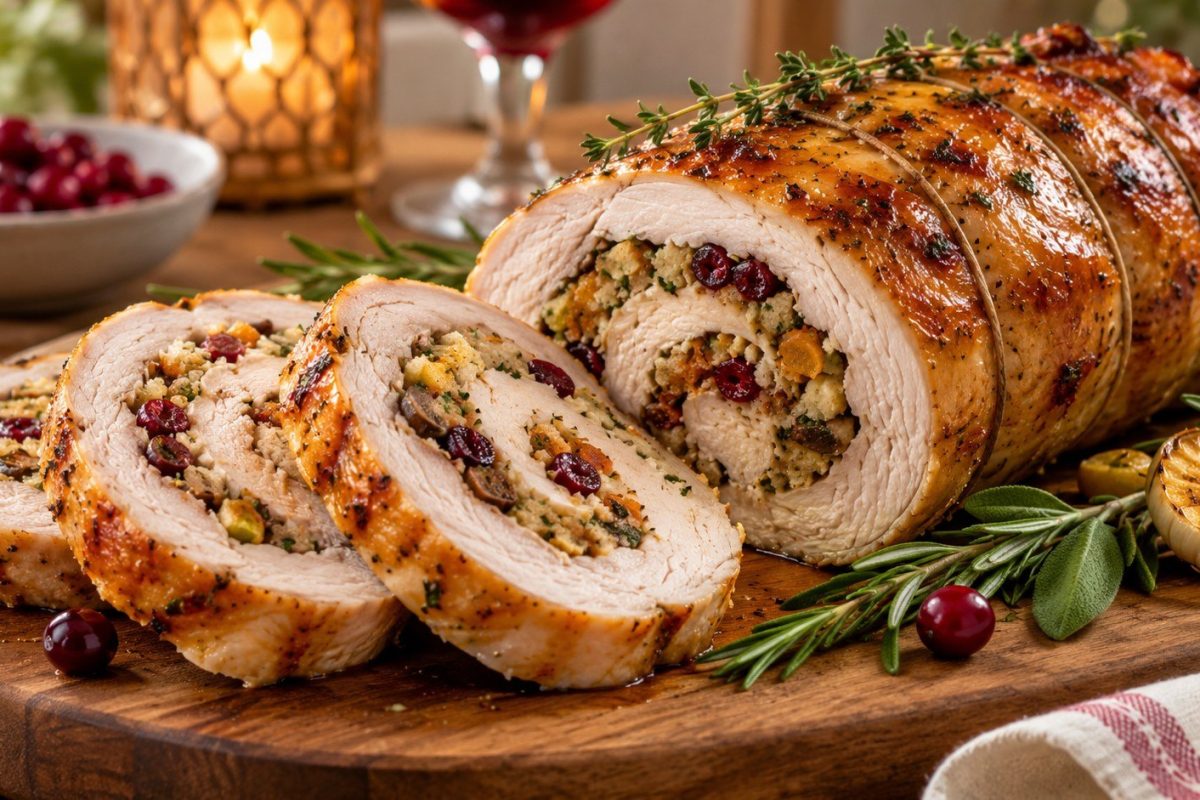
Turkey roulade is an elegant alternative to roasting a whole bird, especially when preparing Thanksgiving dinner for a smaller gathering. The dish combines tender turkey breast, aromatic herbs, savory stuffing, and a beautifully browned exterior. Its spiral slices look impressive, yet the preparation requires only basic kitchen equipment and careful temperature control, as reported by customreceipt.com.
Unlike a traditional Thanksgiving turkey, a roulade offers a convenient way to control portions and introduce different flavors. The boneless breast is flattened, filled, rolled, tied, and roasted until the meat becomes tender. Each slice reveals a colorful center, making the dish suitable for holiday celebrations and family dinners.
The crucial details are surprisingly simple: even thickness, moderate stuffing, secure tying, and accurate roasting temperatures. Follow these principles, and the finished roulade can deliver juicy meat without complicated culinary techniques.
What Is Turkey Roulade and Why Is It Popular for Thanksgiving?
A turkey roulade is a boneless turkey breast rolled around a seasoned filling. The word roulade comes from the French culinary tradition of rolling meat or other ingredients around a filling.
The technique creates an attractive spiral when the roast is sliced. It also distributes herbs and other flavors throughout the meat rather than concentrating them on the surface.
For smaller Thanksgiving gatherings, turkey breast roulade offers several practical advantages. It requires less carving, occupies less oven space, and produces consistent portions.
A whole turkey also contains different cuts that cook at different rates. Breast meat can become dry while the legs are still finishing. A roulade simplifies that challenge by using a relatively uniform piece of meat.
However, a rolled turkey breast still demands careful cooking. Its shape and filling can affect how quickly heat reaches the center.
Turkey Roulade Ingredients: What You Need for 6–8 Servings
This recipe combines sage, spinach, mushrooms, and dried cranberries. The filling delivers savory depth, mild sweetness, and enough contrast to complement the turkey.
The quantities below are designed for a boneless turkey breast weighing approximately 2.5–3 pounds.
| Ingredient | Quantity | Purpose |
|---|---|---|
| Boneless turkey breast | 2.5–3 lb | Main protein |
| Olive oil | 2 tbsp | Browning and moisture |
| Unsalted butter | 3 tbsp | Richness |
| Cremini mushrooms | 8 oz | Savory filling |
| Fresh spinach | 3 cups | Color and freshness |
| Shallots | 2 medium | Aromatic base |
| Garlic | 3 cloves | Flavor |
| Dried cranberries | ⅓ cup | Sweet-tart contrast |
| Plain breadcrumbs | ½ cup | Absorbs moisture |
| Fresh sage | 1 tbsp, chopped | Traditional holiday flavor |
| Fresh thyme | 2 tsp | Herbal aroma |
| Kosher salt | Approximately 1½ tsp | Seasoning |
| Black pepper | ¾ tsp | Mild heat |
| Chicken or turkey broth | ½ cup | Roasting liquid |
Choose a turkey breast with enough surface area to create a broad, even layer. A butcher can butterfly it if you prefer to avoid cutting the meat yourself. Skin-on turkey provides additional protection against drying, although skinless breast also works.
Fresh mushrooms should feel firm rather than wet or slimy. Brown them thoroughly before combining them with other filling ingredients. Excess moisture can make the roulade difficult to roll and slice.
Use unsweetened or lightly sweetened cranberries when possible. Their tartness balances the buttery vegetables without making the stuffing taste like dessert.
The breadcrumbs should absorb residual moisture rather than dominate the filling. If the mixture looks excessively dry, add a small spoonful of broth.
For an additional Thanksgiving side, consider this classic stuffing recipe with buttery bread and herbs.
How to Prepare a Turkey Breast for Rolling
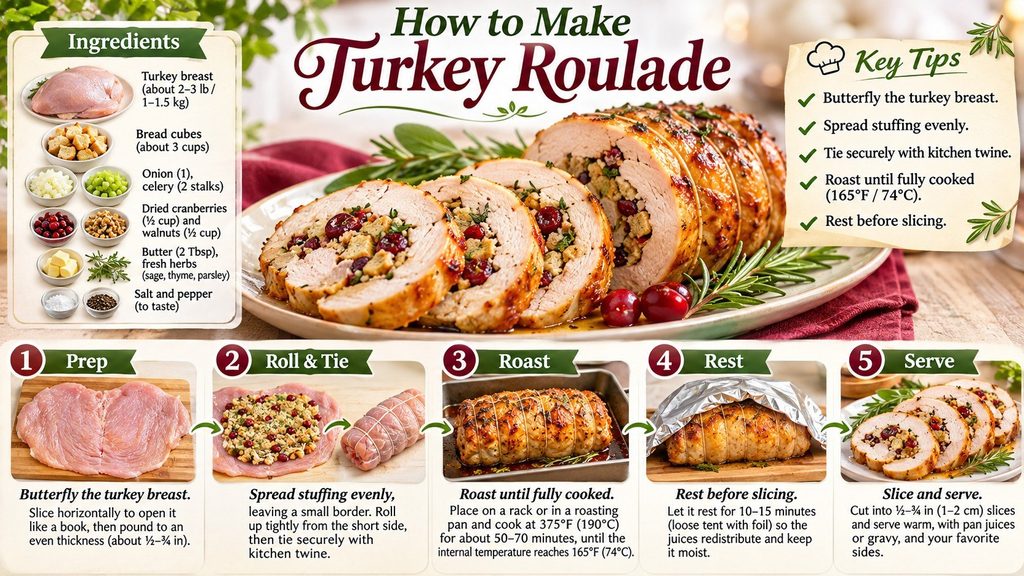
Successful stuffed turkey roulade begins before the filling reaches the meat. The turkey must have a consistent thickness so that it rolls neatly and cooks evenly.
Place the butterflied breast on a clean cutting board. Cover it with plastic wrap, then gently pound thicker sections using a meat mallet.
Aim for a thickness of approximately ½ inch. Avoid striking too aggressively, since torn meat can allow the filling to escape.
The goal is not to flatten the turkey as thinly as possible. An even surface matters more than extreme thinness.
Keep raw poultry separate from vegetables and ready-to-eat ingredients. The CDC’s turkey preparation guidance recommends separate cutting boards and careful cleaning of contaminated surfaces.
Do not wash raw turkey under running water. Splashing can spread bacteria around the sink and surrounding kitchen surfaces.
How to Make Turkey Roulade Step by Step
The process becomes manageable when divided into preparation, filling, rolling, and roasting. Set aside approximately 30–40 minutes for active preparation.
The following instructions use a conventional oven rather than a convection setting.
- Preheat the oven. Set the temperature to 375°F. Position a rack in the middle.
- Prepare the turkey. Butterfly and pound the breast to approximately ½-inch thickness. Season both sides.
- Cook the aromatics. Melt 2 tablespoons of butter in a skillet. Add finely diced shallots and cook for 3 minutes.
- Brown the mushrooms. Add chopped mushrooms and cook for 7–9 minutes. Most visible moisture should evaporate.
- Finish the filling. Add garlic, spinach, sage, thyme, and cranberries. Cook until the spinach wilts.
- Add breadcrumbs. Remove the skillet from the heat. Stir in breadcrumbs and let the mixture cool slightly.
- Fill the turkey. Spread the filling evenly across the meat, leaving a 1-inch border.
- Roll and secure. Roll the breast into a firm cylinder. Tie with kitchen twine at approximately 2-inch intervals.
- Prepare for roasting. Brush with olive oil and remaining melted butter. Place seam-side down in a roasting pan.
- Roast and check. Add broth to the pan. Roast until both the thickest meat and filling center reach 165°F.
- Rest before slicing. Transfer the roulade to a board. Rest for 15–20 minutes before removing the twine.
For a roulade weighing approximately 2.5–3 pounds, begin checking the internal temperature around 60 minutes. Cooking may take approximately 60–90 minutes, depending on thickness and oven performance.
Do not use timing alone to determine whether the meat is ready. Check several points with a reliable digital thermometer, avoiding contact with the pan or any unusually thin sections.
If the exterior darkens before the center finishes cooking, cover the roast loosely with aluminum foil. Keep roasting until the required internal temperatures are reached.
The stuffing should remain inside the roulade rather than spilling into the roasting pan. Small amounts escaping near the ends are normal and do not necessarily indicate a problem.
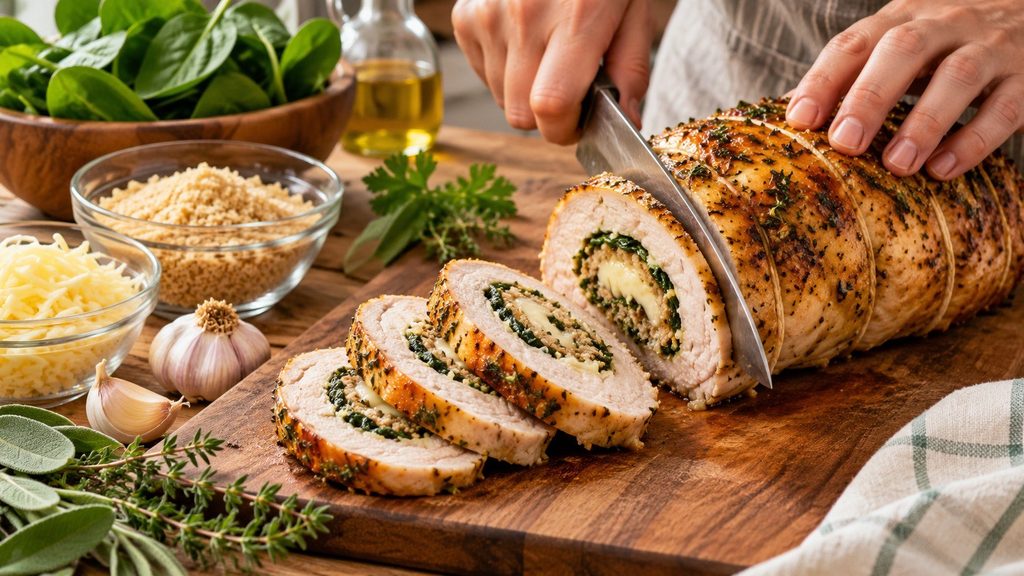
Letting the roast rest makes carving easier and helps preserve its juices. Use a sharp knife and cut slices approximately ¾ inch thick.
What Temperature Should Turkey Roulade Reach?
Cooking temperature determines both food safety and the final texture. Poultry may appear fully cooked before its thickest section reaches a safe internal temperature.
According to FoodSafety.gov’s poultry guidance, turkey must reach 165°F (74°C). The center of a stuffing mixture cooked inside poultry must also reach that temperature.
| Cooking detail | Recommended guidance |
|---|---|
| Conventional oven | 375°F |
| Approximate roasting time | 60–90 minutes |
| Safe turkey temperature | 165°F |
| Safe stuffing temperature | 165°F |
| Resting time | 15–20 minutes |
| Recommended slice thickness | Approximately ¾ inch |
These roasting times are planning estimates, not guarantees. A tightly rolled breast can require more time than a loosely assembled one. Stuffing moisture and meat thickness also influence the result.
Insert the thermometer into the thickest part of the turkey without pushing through the opposite side. Take another reading from the center of the filling.
A finished roulade should feel firm enough to slice but not excessively rigid. Browned skin or a golden surface cannot confirm safe doneness.
If the stuffing reaches 165°F before the meat, continue roasting until the turkey is also safe. The same principle applies when the turkey finishes first.
Avoid removing the roulade early and assuming its resting period will produce the necessary temperature increase. Verify both temperatures before serving.
How to Keep Turkey Roulade Juicy Instead of Dry
Turkey breast contains relatively little fat, making it susceptible to drying during prolonged roasting. Moisture management begins with the preparation rather than the final minutes in the oven.
A uniformly flattened breast helps prevent thin sections from becoming overcooked before thicker areas finish. Butter and olive oil contribute richness, while the filling provides additional moisture.
The most reliable improvements involve several small adjustments:
- Choose a breast with uniform thickness and avoid excessive pounding.
- Cook mushrooms until their released moisture evaporates.
- Spread the filling thinly rather than creating a thick central layer.
- Tie the roulade securely without squeezing out the stuffing.
- Add broth to the roasting pan if the drippings begin to burn.
- Check the temperature early and avoid unnecessary extra roasting.
These techniques address different causes of dryness. Even thickness helps the turkey cook consistently, while careful thermometer use prevents guesswork.
A little liquid in the roasting pan protects the drippings from scorching. It does not replace proper cooking temperature control.
Avoid repeatedly opening the oven door. Frequent temperature changes can lengthen roasting and make the cooking process less predictable.
Resting is particularly important when preparing thick slices. The meat becomes easier to cut without tearing its distinctive spiral.
For the best texture, allow the browned roulade to rest before carving. Thin, hurried slices often lose their shape and presentation.
Best Turkey Roulade Stuffing Ideas and Flavor Combinations
The basic mushroom and cranberry filling can be adapted for different meals. The main requirement is controlling moisture and avoiding excessive quantities.
For a traditional holiday flavor, sage and thyme are particularly effective. A more Mediterranean version can feature spinach, lemon zest, and roasted peppers.
Several combinations work especially well:
- Apple and sausage: Fully cooked sausage, diced apples, onions, and sage.
- Mushroom and spinach: Browned mushrooms, wilted spinach, garlic, and thyme.
- Cranberry and pecan: Dried cranberries, toasted pecans, breadcrumbs, and parsley.
- Spinach and feta: Wilted spinach, crumbled feta, garlic, and lemon zest.
- Herb and breadcrumb: Toasted breadcrumbs, parsley, rosemary, sage, and butter.
Apple and sausage create a hearty Thanksgiving filling with sweetness and savory richness. Cook the sausage completely before incorporating it into the mixture.
Mushroom and spinach offer a lighter alternative without sacrificing flavor. The mushrooms should be browned separately to prevent excess water from accumulating.
Cranberries and pecans produce a particularly attractive spiral. Chop the nuts finely so they do not puncture the turkey while rolling.
Feta introduces saltiness and a slightly tangy character. Reduce additional salt when using strongly seasoned cheese.
Regardless of the combination, the center must reach 165°F. A flavorful stuffing is only successful when it is also thoroughly cooked.
What to Serve With Turkey Roulade
The best accompaniments complement the turkey without competing with its seasoned filling. Creamy potatoes, roasted vegetables, and simple sauces are particularly reliable.
A classic combination includes mashed potatoes, green beans, and cranberry sauce. For a richer holiday menu, add homemade gravy with a smooth texture.
Scalloped potatoes also work well when serving larger groups. Their creamy texture contrasts with the firm, carefully sliced turkey.
For another oven-friendly option, try scalloped potatoes with a golden crust.
How to Make a Quick Pan Gravy
A simple gravy can turn turkey roulade into a complete holiday centerpiece. The roasting pan already contains flavorful juices from the meat, butter, and herbs.
Transfer the cooked roulade to a cutting board. Pour the drippings into a measuring cup and skim excess fat if necessary.
Melt 1 tablespoon of butter in a saucepan, then whisk in 1 tablespoon of flour. Cook for approximately 1 minute before gradually adding 1 cup of warm broth.
Add the strained pan juices and simmer until lightly thickened. Adjust the seasoning only after tasting, since the drippings may already contain salt.
The best accompaniment supports the roast rather than disguising it. A restrained gravy highlights the turkey’s savory filling and delicate texture.
Can You Prepare Turkey Roulade Ahead of Time?
Preparing components in advance can simplify a crowded holiday cooking schedule. However, raw poultry and its stuffing require careful refrigeration and handling.
The safest convenient approach is to prepare the vegetables and herbs separately in advance. Refrigerate the cooked vegetable filling promptly in a covered container.
Keep the uncooked turkey refrigerated until assembly. Because stuffing affects food safety, assemble and roast the roulade shortly before serving.
The CDC recommends adding stuffing to poultry immediately before cooking. It also advises ensuring the stuffing reaches 165°F.
Fully cooked roulade can be prepared ahead and refrigerated promptly. Slice it before reheating if smaller portions make the process more convenient.
When reheating, use a covered baking dish with a little broth. Heat the turkey and stuffing thoroughly to 165°F.
How to Store and Reheat Leftover Turkey Roulade
Leftover turkey can provide convenient meals after Thanksgiving. However, incorrect cooling and storage can undermine the safety of an otherwise properly cooked dish.
The CDC recommends refrigerating cooked turkey within 2 hours. Cooked turkey dishes should generally be consumed within 3–4 days.
Use shallow, covered containers so the meat cools efficiently. Keep the refrigerator at 40°F or colder.
For longer storage, freeze individual slices in suitable airtight containers. Separate portions with parchment to make thawing easier.
Reheat leftovers until the center reaches 165°F. A small amount of broth and a covered baking dish can help reduce moisture loss.
Discard turkey that remained at room temperature beyond the recommended safe period. Appearance and smell cannot reliably identify dangerous bacterial contamination.
FAQ: Turkey Roulade Recipe
How long does turkey roulade take to cook?
A 2.5–3-pound roulade may require approximately 60–90 minutes at 375°F. Actual timing depends on thickness, stuffing, and oven performance. Both meat and stuffing must reach 165°F.
What is the best turkey cut for roulade?
A boneless turkey breast is the most convenient choice. It can be butterflied, flattened, filled, and rolled into an even cylinder. Skin-on breast provides additional richness.
Can turkey roulade be made without stuffing?
Yes. Season the flattened meat with herbs, garlic, and olive oil before rolling. The result resembles a compact turkey roast rather than a traditional filled roulade.
Why does turkey roulade fall apart when sliced?
Insufficient tying, excessive filling, or cutting before resting can damage the spiral. Tie the roll securely and allow 15–20 minutes of resting before carving.
Can I make turkey roulade with bacon?
Yes. Cooked bacon pieces can be incorporated into the filling. Another option involves wrapping the exterior with bacon before roasting, although cooking time and browning will vary.
Should turkey roulade be covered while roasting?
It can roast uncovered initially to encourage browning. Cover loosely with foil if the exterior darkens too quickly. Always determine doneness using internal temperature.
Can you freeze cooked turkey roulade?
Yes. Cool and refrigerate it promptly, then freeze in airtight portions. Thaw safely in the refrigerator and reheat to 165°F before serving.
Is turkey roulade suitable for Thanksgiving dinner?
Turkey roulade is especially practical for smaller Thanksgiving gatherings. It offers familiar holiday flavors, attractive presentation, and easier carving than a whole bird.
A Practical Thanksgiving Centerpiece Worth Making
A well-prepared turkey roulade combines familiar Thanksgiving ingredients with a more manageable cooking method. The filling adds character, while the rolled shape creates attractive portions without difficult carving.
The most important decisions concern thickness, moisture, and temperature. Keep the filling balanced, secure the roll, and verify safe doneness with a thermometer.
Serve the turkey with fresh gravy, potatoes, and seasonal vegetables. For your next holiday dinner, try this easy turkey roulade recipe and adapt the filling to your preferred flavors.
Earlier we wrote about How to Make a Cranberry Collins Cocktail With Gin, Fresh Lemon and Club Soda