 Frank Rondel
How to make corn dogs at home comes down to 3 details: a dry hot dog, thick cornmeal batter, and steady frying heat. When those elements work together, the coating turns golden and crisp without sliding from the sausage. The method needs ordinary supermarket ingredients and about 30 minutes, as the customreceipt.com editorial team notes.
A classic American corn dog is simple food with surprisingly unforgiving technique. Too much milk makes the coating thin. Cold oil leaves it greasy. Oil that runs too hot browns the outside before the center becomes properly heated.
The best homemade corn dog should have a crisp shell, a tender cornmeal crumb, and a hot, juicy sausage inside.
What Is a Corn Dog?
A corn dog is a hot dog coated in cornmeal-based batter and fried on a wooden stick. The coating usually combines cornmeal with wheat flour, sugar, baking powder, egg, and milk.
Cornmeal provides the recognizable flavor and slightly grainy texture. Wheat flour gives the coating enough structure to stay around the sausage. Baking powder creates small air pockets, preventing an excessively dense crust.
The finished snack sits somewhere between cornbread and a battered hot dog. It should not resemble a sausage surrounded by thick bread. A well-made coating remains relatively thin while completely covering the meat.
For another example of controlled deep-frying, see this homemade churros recipe. The same principle applies: oil temperature determines texture more reliably than frying time alone.
Corn Dog Ingredients for 8 Servings
The proportions below produce enough batter for approximately 8 standard hot dogs. Choose regular-length sausages rather than oversized versions. Very large hot dogs require more batter and a deeper cooking vessel.
| Ingredient | Amount | Purpose |
|---|---|---|
| Hot dogs | 8 | Main filling |
| Yellow cornmeal | 1 cup | Corn flavor and texture |
| All-purpose flour | 1 cup | Structure |
| Granulated sugar | 3 tbsp | Light sweetness and browning |
| Baking powder | 1 tbsp | Lighter coating |
| Salt | 1/2 tsp | Flavor balance |
| Egg | 1 | Binding |
| Milk or buttermilk | 1 cup | Moisture |
| Flour for dusting | 1/4 cup | Helps batter adhere |
| Neutral frying oil | 4–6 cups | Deep frying |
| Wooden skewers | 8 | Handling and serving |
The exact quantity of milk can change slightly because cornmeal absorbs liquid differently. Start with slightly less milk if the batter already looks thick. Add the remaining liquid gradually.
The mixture should resemble very thick pancake batter. It must flow slowly from a spoon rather than pour like cream. Thin batter usually exposes parts of the sausage during frying.
Buttermilk can replace ordinary milk for a slightly tangier flavor. Yellow cornmeal gives the familiar fairground appearance. White cornmeal also works, although the finished coating looks paler.
Do not replace all the flour with cornmeal. The wheat flour provides gluten and helps the shell remain attached during frying.
If you enjoy coated snacks, the same attention to surface preparation appears in this homemade caramel apples guide.
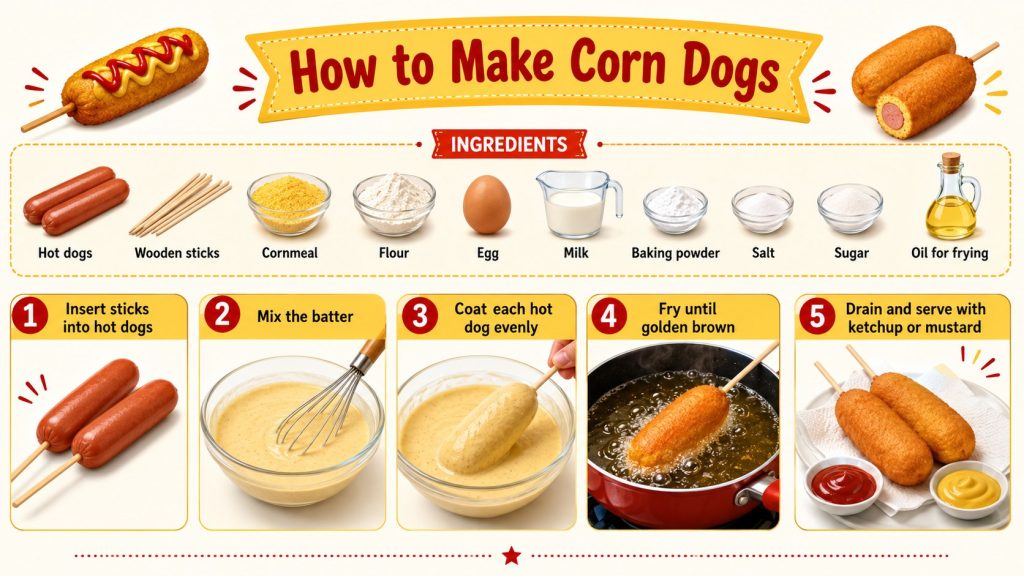
How to Make Corn Dog Batter That Actually Sticks
The overlooked step happens before the batter is mixed. Hot dogs emerge from their packaging wet and slightly slippery. Batter does not adhere well to that surface.
Prepare them in this order:
- Remove the hot dogs from their package.
- Dry every sausage thoroughly with paper towels.
- Insert a wooden skewer through each hot dog.
- Roll each sausage in a very thin layer of flour.
- Shake away loose flour before dipping.
- Keep the prepared hot dogs at room temperature briefly while mixing batter.
The flour layer acts as a bridge between the moist sausage and wet coating. It should be almost invisible. Heavy flour creates dry pockets beneath the crust.
Drying matters just as much. Even a good batter can slide away when the sausage remains wet. This is one reason homemade corn dogs sometimes emerge with exposed patches.
Prepare the sausages before heating the oil. Once frying begins, the process moves quickly. You should not be searching for skewers while oil sits over high heat.
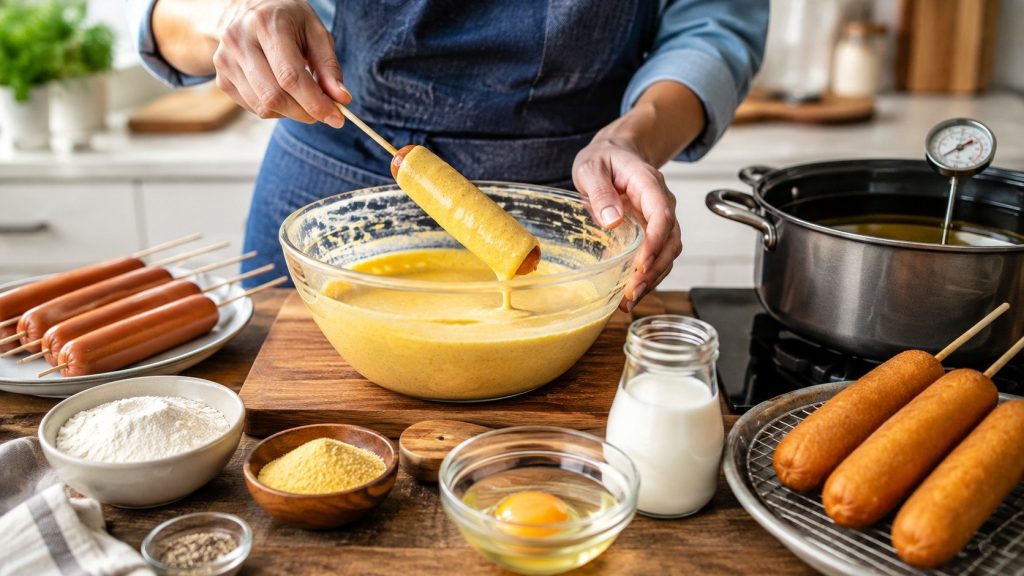
A tall drinking glass is also useful. Pouring the batter into it allows the sausage to be submerged vertically. That produces more even coverage than rolling it across a shallow bowl.
For another crispy coating technique, this fish tacos recipe shows why surface moisture and cooking heat matter.
How to Mix Homemade Corn Dog Batter
Combine the cornmeal, flour, sugar, baking powder, and salt in a large bowl. Whisk them before introducing the wet ingredients.
In another container, beat the egg with approximately 3/4 cup milk. Add this mixture to the dry ingredients. Stir only until no obvious dry flour remains.
Add more milk gradually if necessary.
The finished corn dog batter recipe should remain thick enough to cling immediately. Overmixing is unnecessary and can make the wheat-flour component tougher.
If batter runs off a dipped hot dog within seconds, fix the consistency before heating another batch.
A small amount of additional flour can thicken an overly loose mixture. Add 1 tablespoon at a time. If the batter becomes too stiff, loosen it with milk.
Do not make the batter several hours in advance. Baking powder begins reacting after hydration. Freshly mixed batter generally produces better lift.
What Temperature Should You Fry Corn Dogs?
For reliable home frying, aim for approximately 350°F to 360°F, or 177°C to 182°C. ThermoWorks recommends controlling corn dog frying oil within roughly 335°F to 360°F during cooking.
Oil temperature matters because adding cold food immediately lowers the heat. A pot at exactly 350°F can drop significantly after several corn dogs enter together.
This creates 2 common problems. Oil that is too cool penetrates the coating and makes it greasy. Excessive heat darkens the crust before the interior becomes thoroughly hot.
Use a deep-fry or probe thermometer whenever possible. It removes most of the guesswork.
How to Fry Corn Dogs Step by Step
Use a deep, heavy saucepan or Dutch oven. Leave substantial empty space above the oil because bubbling increases after food enters.
The basic method is:
- Heat neutral oil to approximately 350°F–360°F.
- Pour the prepared batter into a tall glass.
- Dip 1 floured hot dog completely into the batter.
- Rotate it slowly to coat every side.
- Let only the largest excess drip away.
- Lower the corn dog carefully into the oil.
- Fry in small batches without crowding.
- Turn when necessary for even browning.
- Cook until deep golden and thoroughly heated.
- Transfer to a rack or paper towels.
Many conventional recipes require around 3 minutes of frying. Actual time changes with sausage size and oil recovery. Color should therefore be used alongside temperature control.
Do not fill the pot with 6 or 8 corn dogs simultaneously. Every additional cold sausage lowers the oil temperature. Small batches produce more predictable results.
Allow the oil to return to its target range between batches. This may require 1 or 2 minutes. Reduce the burner if the temperature continues climbing after food is removed.
A wire rack preserves crispness better than stacking hot corn dogs together. Steam becomes trapped when fried food touches another hot surface. That moisture rapidly softens the coating.
How Do You Know When a Corn Dog Is Done?
The coating should appear evenly golden, not dark brown. It should feel firm rather than wet when lifted from the oil.
Most supermarket hot dogs are already cooked. However, they still need to become thoroughly heated during preparation. This point matters particularly for people at higher risk from foodborne illness.
FoodSafety.gov gives specific guidance for vulnerable groups:
“Reheat hot dogs, luncheon meats, and deli meats to steaming hot or 165°F (74°C).”
— U.S. government food-safety guidance, FoodSafety.gov, advice for people at higher risk of food poisoning.
Because the coating becomes extremely hot, allow the corn dog to rest briefly before serving. Children should receive extra cooling time.
Why Does Corn Dog Batter Fall Off?
Poor adhesion is probably the most frequent homemade corn dog failure. The cause is usually mechanical rather than mysterious.
Check these possible problems:
- the hot dogs were still wet;
- the flour dusting step was skipped;
- the batter contains too much liquid;
- the coating sat too long before frying;
- the oil was not fully heated;
- the sausage was moved aggressively after entering the oil;
- excess flour created a loose powdery layer.
Drying and lightly flouring the sausage solves many adhesion problems. Professional corn dog mix guidance uses the same approach. A thin flour or cornstarch layer creates a surface that wet batter can grip.
The batter itself must also be thick. If it looks like crepe batter, it needs adjustment. Proper corn dog coating should form a visible layer immediately after dipping.
Lower the sausage gently into the oil. Do not drop it from above. Sudden movement can strip away batter before the crust begins setting.
Finally, avoid repeatedly touching the coating with utensils. Give it several seconds to firm before turning the corn dog.
How to Make Corn Dogs Extra Crispy
The easiest improvement is temperature control. Crisp fried food depends on rapid moisture evaporation at the surface.
There are several additional techniques worth using:
- dry the hot dogs exceptionally well;
- use fresh baking powder;
- avoid overly coarse cornmeal;
- keep batter cold while the oil heats;
- fry only 2 or 3 pieces together;
- drain finished corn dogs on a wire rack;
- serve them soon after frying.
A rack is especially useful when preparing several batches. Paper towels remove oil, but the lower surface can remain against trapped steam.
Fresh batter also provides a cleaner texture. Older batter gradually loses some leavening activity. That can produce a heavier shell.
Do not chase extreme crunch by increasing oil temperature dramatically. Dark coating is not necessarily crisp coating. Excessive heat can create a burnt exterior with a cooler center.
The best result comes from balance. The outside should crack slightly when bitten, while the interior remains tender.
Corn Dog Variations You Can Make at Home
Once the basic recipe works, changes become straightforward. Keep the batter consistency similar even when adding flavorings.
Popular versions include:
- mini corn dogs made with halved hot dogs;
- cheddar-filled hot dogs;
- jalapeño batter with finely minced peppers;
- honey corn dogs with 1–2 tablespoons honey;
- spicy corn dogs with cayenne or smoked paprika;
- breakfast versions using cooked sausage links;
- meatless corn dogs using suitable vegetarian sausages.
Mini corn dogs cook faster because the filling is shorter. They also fit smaller pots more easily.
Cheese requires greater care. Exposed cheese can melt into the oil, so it must remain completely enclosed.
Honey increases sweetness and accelerates browning. Watch the exterior more closely if adding it. The coating may become dark before a standard batter would.
Spices should remain restrained. Too much powder can change the batter texture instead of simply changing flavor.
What Sauces Go With Corn Dogs?
Yellow mustard remains the classic choice because its acidity cuts through fried batter. Ketchup gives a sweeter profile.
Other useful combinations include honey mustard, barbecue sauce, ranch, spicy mayonnaise, or mustard mixed with hot sauce. Pick 2 contrasting sauces instead of covering the corn dog with several flavors.
A homemade honey-mustard dip needs little more than mustard and honey. Adding lemon juice gives it more acidity. Mayonnaise makes the sauce creamier but also heavier.
Serve sauces separately when feeding several people. The crust remains crisp longer when it is dipped immediately before eating.
Can You Store and Reheat Corn Dogs?
Fresh corn dogs are best shortly after frying. Refrigeration softens the coating because moisture migrates from the sausage toward the crust.
If leftovers remain, refrigerate them promptly. U.S. food-safety guidance says perishable foods should generally enter refrigeration within 2 hours. That period falls to 1 hour above 90°F, or 32°C.
Refrigerated leftovers should be reheated thoroughly. FoodSafety.gov lists 165°F, or 74°C, for reheated leftovers.
An oven or air fryer usually restores texture better than a microwave. The microwave heats quickly but tends to soften the fried coating.
For freezing, cool corn dogs first and package them tightly. Reheat directly from frozen using controlled oven heat. Allow extra time for the center to become hot.
FAQ About Homemade Corn Dogs
Can I make corn dogs without cornmeal?
Technically, yes, but the result is no longer a traditional corn dog. Cornmeal provides its defining flavor and texture. Plain flour produces something closer to a battered sausage.
Why is my corn dog batter too thin?
Too much milk is the most likely cause. Add flour gradually, approximately 1 tablespoon at a time. The mixture should cling thickly to the sausage.
Can I use pancake mix for corn dogs?
Some recipes adapt pancake mix, but flavor and texture differ. A cornmeal-based batter produces a more recognizable homemade corn dog recipe.
What oil is best for corn dogs?
Use a neutral oil suitable for deep frying. Canola, vegetable, peanut, and similar refined oils are practical choices.
How long do corn dogs fry?
Around 3 minutes is common at proper frying temperature. Size and oil recovery affect the exact time. Look for an evenly golden coating.
Why are my homemade corn dogs greasy?
The oil was probably too cool or too many pieces were fried together. Keep the oil near 350°F–360°F and cook small batches.
Can corn dog batter be made ahead?
It can rest briefly, but several hours are unnecessary. Baking powder works best when the batter is mixed relatively close to frying.
Can I make mini corn dogs?
Yes. Cut hot dogs into halves or thirds before coating. Shorter pieces are convenient for parties and require less oil depth.
Earlier we wrote about Baked Spaghetti Recipe: How to Make a Cheesy Pasta Casserole That Stays Juicy