 Frank Rondel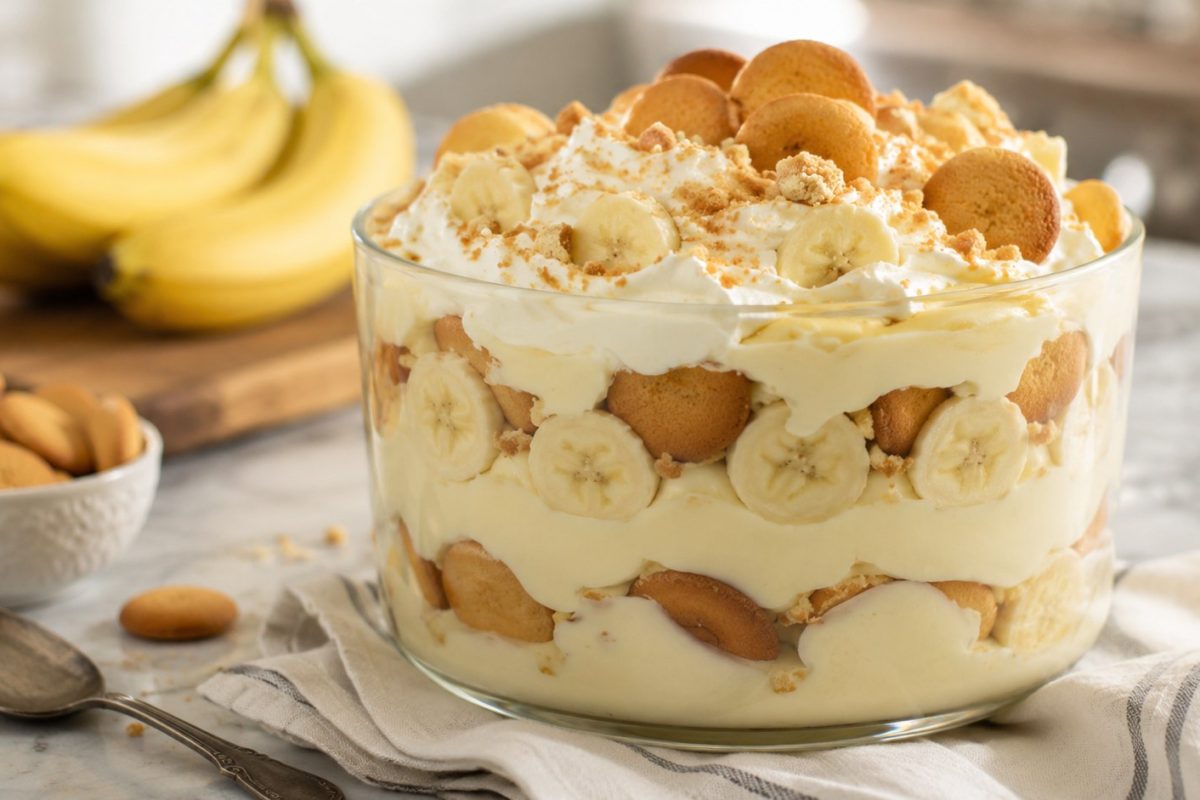
How to make banana pudding becomes much easier once the dessert is treated as a balance of textures rather than a simple mixture. The best version combines cool vanilla custard, ripe banana slices, softened cookies, and lightly whipped cream. Each layer performs a separate job, while several hours of chilling bring everything together, as the customreceipt.come editorial team notes.
Traditional American banana pudding resembles a layered trifle. Vanilla wafers absorb moisture from the custard, yet they should retain enough structure to remain noticeable. Bananas provide sweetness and aroma, while the cream keeps the dessert from feeling dense.
This recipe produces 8 generous servings. Preparation takes about 35 minutes, followed by at least 4 hours of refrigeration.
Banana Pudding Ingredients and Exact Proportions
A reliable homemade banana pudding recipe starts with firm, ripe bananas. Yellow fruit with a few brown spots offers sufficient sweetness without collapsing inside the dessert. Fully blackened bananas work better for banana bread because their soft texture can make pudding watery, as was written by literat-program.pl.
Prepare the following ingredients before heating the custard:
- 4 medium ripe bananas;
- 11 ounces vanilla wafers;
- 3 cups whole milk;
- 4 large egg yolks;
- ¾ cup granulated sugar;
- ⅓ cup cornstarch;
- ¼ teaspoon fine salt;
- 2 teaspoons vanilla extract;
- 2 tablespoons unsalted butter;
- 1½ cups cold heavy cream;
- 2 tablespoons powdered sugar;
- 1 teaspoon lemon juice, optionally used on banana slices.
Whole milk creates a richer custard, but 2% milk also works. Skim milk produces a thinner result and leaves less protection between the cookies and fruit. Cornstarch gives the pudding a smooth structure without requiring flour. Butter should be added after cooking because direct boiling can dull its flavor.
Vanilla wafers remain the classic choice, although shortbread cookies or ladyfingers provide convincing alternatives. Avoid very thin cookies, which can dissolve before the dessert is served. Gluten-free vanilla cookies may be used, but their absorption rate can differ substantially.
The bananas should taste sweet but still feel firm under light pressure. Overripe fruit releases more liquid and may discolor the custard within several hours.
Readers planning a complete homemade meal can also consult this original minestrone cooking guide. For a faster breakfast option, the site also explains how to make a cream cheese bagel.
Ingredient Roles and Possible Substitutions
Several ingredients appear interchangeable, but each substitution changes the finished texture. The comparison below helps prevent a pudding that becomes excessively sweet, loose, or heavy.
| Ingredient | Main purpose | Practical substitute | Expected difference |
|---|---|---|---|
| Whole milk | Builds the custard base | 2% milk | Slightly lighter texture |
| Cornstarch | Thickens the pudding | All-purpose flour | More opaque, heavier custard |
| Egg yolks | Add richness and color | Instant vanilla pudding | Faster but less complex flavor |
| Vanilla wafers | Create soft cake-like layers | Shortbread cookies | Richer and more buttery |
| Heavy cream | Produces an airy topping | Whipped topping | Sweeter, more stable texture |
| Fresh bananas | Provide fruit flavor | Roasted bananas | Deeper flavor, softer layers |
| Butter | Adds gloss and fullness | Omit entirely | Cleaner but leaner finish |
Substitutions should be made selectively. Replacing milk, yolks, cream, and cookies simultaneously creates a different dessert rather than a variation. Instant pudding is useful when speed matters, although cooked custard delivers better control over sweetness.
Shortbread cookies need less refrigeration because they contain more fat and soften quickly. Ladyfingers absorb liquid rapidly, so thicker custard works better with them. Plant-based milk can be used, but unsweetened soy milk generally thickens more reliably than thin almond beverages.
Heavy cream should remain cold until whipping. A chilled bowl helps the fat hold air, producing a topping that remains stable during assembly. Do not replace heavy cream with ordinary milk because milk cannot form the same structure.
For another layered holiday dish, see this guide to sweet potatoes with marshmallows.
How to Make Banana Pudding Step by Step
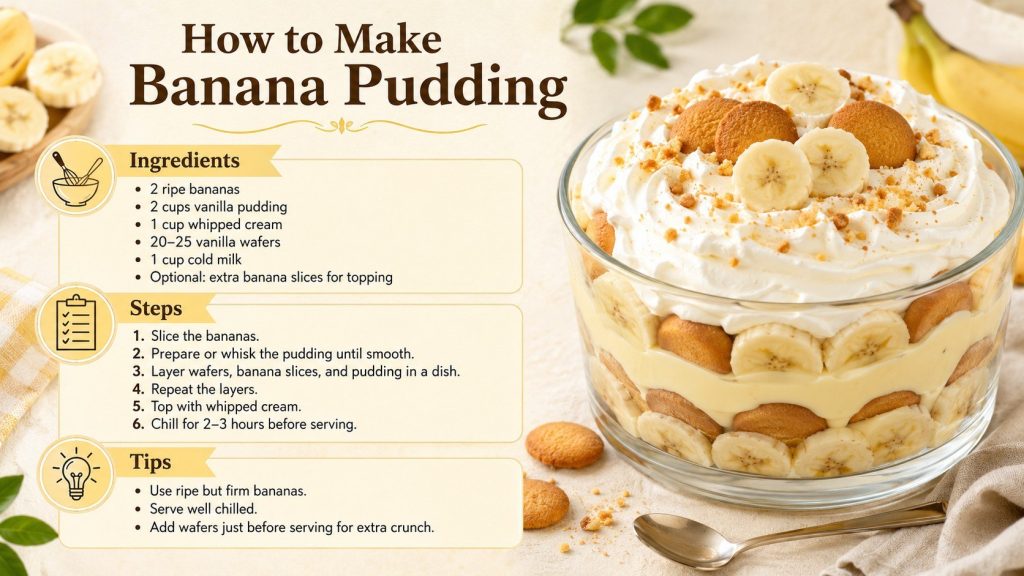
The custard requires steady heat and continuous attention. High heat can scramble the yolks before the cornstarch thickens the mixture. Medium heat provides more control and reduces scorching.
Follow these instructions:
- Whisk the egg yolks, sugar, cornstarch, and salt in a heatproof bowl.
- Heat the milk in a saucepan until steaming, without allowing it to boil.
- Slowly pour 1 cup of hot milk into the yolk mixture while whisking constantly.
- Return the tempered mixture to the saucepan.
- Cook over medium heat while whisking for 4–6 minutes.
- Remove the custard once large bubbles appear and the texture becomes thick.
- Stir in the butter and vanilla extract.
- Press plastic wrap directly against the custard surface.
- Cool for 20 minutes, then refrigerate until completely cold.
- Whip the heavy cream and powdered sugar to medium peaks.
Tempering prevents the eggs from receiving a sudden burst of heat. Pouring the milk gradually is more important than whisking aggressively. If small cooked particles appear, pass the custard through a fine sieve before chilling.
The finished pudding should coat the back of a spoon. A finger drawn through the coating should leave a clean path. Custard that runs immediately needs another minute of gentle cooking.
Do not continue boiling after the mixture thickens. Excessive heat can weaken cornstarch and create a grainy texture. The custard becomes firmer as it cools, so the hot mixture should remain slightly softer than the desired final consistency.
How to Assemble the Layers Correctly
Assembly determines whether each serving contains balanced amounts of fruit, cookies, and cream. Use a 2½-quart glass bowl, trifle dish, or rectangular baking dish. A transparent container makes the layers visible but does not affect flavor.
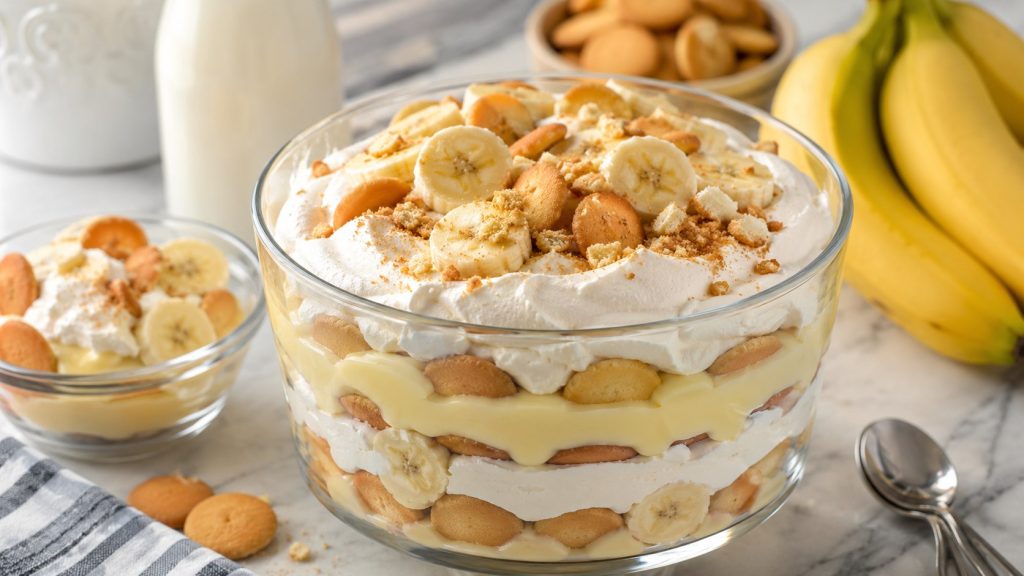
Begin with a thin layer of custard. Add vanilla wafers, followed by banana slices about ¼ inch thick. Cover the bananas completely with more custard, then repeat the sequence.
Use this order:
- thin custard base;
- single layer of vanilla wafers;
- evenly spaced banana slices;
- generous custard layer;
- another layer of wafers and bananas;
- remaining custard;
- whipped cream;
- crushed wafers immediately before serving.
Spread the custard to the edges after every layer. Exposed bananas darken faster and may develop a dry surface. Lemon juice slows browning, but excessive juice introduces an unwanted sour taste.
Reserve several attractive cookies for decoration. Cookies placed on top too early absorb moisture from the cream and lose their crispness. Add them shortly before the pudding reaches the table.
The dessert should refrigerate for at least 4 hours. Six hours produces softer wafers and stronger integration between the layers. Overnight chilling works, although the bananas become darker and the cookies lose more definition.
A good banana pudding is neither crisp nor completely uniform. The spoon should pass through soft cookies, distinct banana slices, cool custard, and airy cream.
How Long Banana Pudding Should Chill
Resting time changes the dessert considerably. The following guide helps match texture with the serving schedule.
| Chilling time | Cookie texture | Banana condition | Best use |
|---|---|---|---|
| 1–2 hours | Mostly firm | Very fresh | Not recommended unless necessary |
| 4 hours | Soft edges, firm center | Bright and distinct | Balanced everyday result |
| 6–8 hours | Cake-like | Fully integrated | Best overall texture |
| 12–18 hours | Very soft | Slightly darker | Convenient make-ahead option |
| 24 hours | Almost dissolved | Noticeably darker | Acceptable but less attractive |
| 48 hours | Very soft and wet | Strong discoloration | Quality begins declining |
The ideal window is usually 6–12 hours after assembly. This period allows the wafers to soften without disappearing. It also gives the vanilla custard time to absorb banana aroma.
Large serving bowls need longer chilling than individual glasses. Small portions can develop the correct texture after 3–4 hours. Deep containers may require overnight refrigeration because their centers cool slowly.
Keep the dish covered to prevent refrigerator odors from entering the cream. Strong foods, including onions and smoked fish, should remain in sealed containers. Crushed cookies and fresh banana garnish should be added shortly before serving.
Common Banana Pudding Mistakes
Most failures come from temperature, fruit selection, or incorrect layering. The recipe itself remains forgiving when these variables are controlled.
Avoid these mistakes:
- adding hot custard directly over fresh bananas;
- using bananas that are black, leaking, or extremely soft;
- undercooking the cornstarch mixture;
- cooking the custard over uncontrolled high heat;
- leaving bananas exposed around the dish edges;
- whipping cream until it becomes grainy;
- adding decorative cookies several hours early;
- serving the dessert before the wafers soften;
- leaving the finished pudding at room temperature too long.
Hot custard cooks the surface of the bananas and encourages moisture release. It can also turn whipped cream into a loose liquid. Every component should be cool before assembly.
A thin pudding usually results from insufficient cooking. Cornstarch must reach a visible simmer before developing full thickening power. However, prolonged boiling can later damage that structure.
Overwhipped cream looks stiff at first, then becomes rough and buttery. Stop when the whisk creates defined peaks with slightly curved tips. The cream should spread easily without flowing across the custard.
Do not compensate for bland bananas with excessive sugar. Better vanilla, a small pinch of salt, or riper fruit creates more flavor without making the dessert cloying.
Banana Pudding Variations Worth Trying
The classic method can support several controlled changes. Each variation should preserve the contrast between creamy pudding, fruit, and a soft baked element.
Popular options include:
- caramel banana pudding with a thin layer of dulce de leche;
- chocolate banana pudding with cocoa custard;
- peanut butter banana pudding with ¼ cup smooth peanut butter;
- coconut banana pudding with toasted coconut;
- strawberry banana pudding with sliced berries;
- bourbon banana pudding with 1 tablespoon bourbon in the cold custard;
- individual banana pudding cups for parties;
- meringue-topped pudding finished briefly under a broiler.
Caramel should be used sparingly because condensed caramel is intensely sweet. Spread a thin ribbon rather than a complete heavy layer. Salted caramel works particularly well because salt reduces perceived sweetness.
Peanut butter must be whisked into warm custard before chilling. Adding it later creates dense streaks and prevents even distribution. Natural peanut butter may separate, so a smooth stabilized product gives more predictable results.
Fresh strawberries release considerable moisture. Pat them dry and serve that version within 12 hours. Coconut should be toasted separately, cooled, and added near serving time to preserve texture.
Alcohol is optional and should never dominate the vanilla or banana. For family service, omit it entirely rather than assuming cooking removes the alcohol, since the custard receives it after heating.
Storage and Food Safety
Banana pudding contains milk, cream, and eggs, so it must remain refrigerated. Keep the refrigerator at 40°F, or 4°C, or below. The FDA’s safe food handling guidance recommends rapidly cooling larger amounts in shallow containers.
“Place food into shallow containers and immediately put in the refrigerator or freezer for rapid cooling.”
— U.S. Department of Agriculture, Food Safety and Inspection Service, guidance on keeping food safe.
Return the pudding to refrigeration within 2 hours. During hot outdoor service above 90°F, or 32°C, that period falls to 1 hour. The FDA describes this as the 2-hour rule for perishable foods.
“Discard any perishables left out at room temperature for longer than two hours.”
— U.S. Food and Drug Administration, food safety guidance for serving meals.
For best quality, eat banana pudding within 2 days. General USDA guidance permits many refrigerated leftovers for 3–4 days, but fresh bananas deteriorate faster than most cooked dishes.
Freezing is not recommended. Bananas become watery after thawing, custard may separate, and whipped cream can lose its smooth texture. Preparing smaller batches produces a better result than freezing leftovers.
FAQ
Can banana pudding be made without instant pudding mix?
Yes. Cooked custard made with milk, egg yolks, sugar, and cornstarch provides a deeper vanilla flavor. It also allows better control over sweetness and thickness.
How do you keep bananas from turning brown?
Cover every banana slice with custard and keep the dessert refrigerated. A very light coating of lemon juice helps, but too much changes the flavor.
Can banana pudding be prepared the night before?
Yes. Overnight refrigeration creates a soft, cake-like cookie texture. Add decorative wafers and fresh banana slices shortly before serving.
Why did my banana pudding become watery?
Common causes include overripe bananas, warm custard, undercooked cornstarch, or fruit exposed for too long. Watery berries added as a variation can also loosen the layers.
What cookies are best for banana pudding?
Vanilla wafers remain the standard choice. Shortbread cookies, butter cookies, and ladyfingers also work, although their softening times differ.
Can I use boxed vanilla pudding?
Yes. Prepare it according to the package instructions, then fold in whipped cream. The result is faster but usually sweeter and less aromatic than homemade custard.
How ripe should bananas be?
Choose yellow bananas with a few small brown spots. They should smell sweet and slice cleanly without becoming mushy.
How long does banana pudding need to chill?
Allow at least 4 hours. A 6–8-hour rest provides the most balanced texture between firm fruit, creamy custard, and softened cookies.
Can banana pudding be served warm?
Traditional baked versions with meringue may be served warm. This chilled recipe should remain cold because it contains whipped cream and layered fresh fruit.
How much banana pudding should be prepared per person?
Plan about ¾–1 cup per adult serving. A recipe made in a 2½-quart dish usually serves 8–10 people.
Earlier we wrote about How to Make Key Lime Pie: A Creamy Florida Dessert With a Crisp Graham Cracker Crust